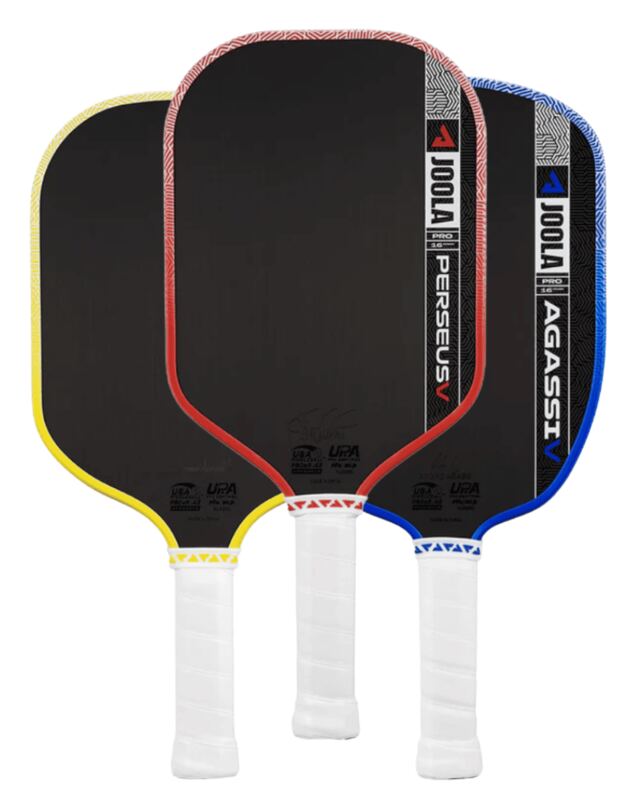
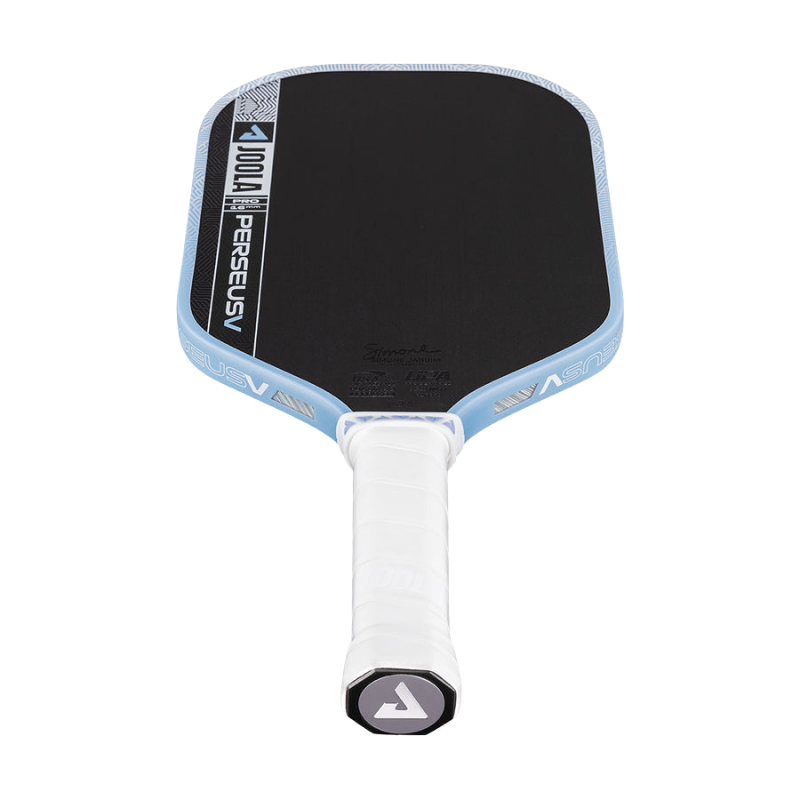
The Joola Perseus Pro V 16mm offers a softer feel and more control compared to its predecessor, the Pro IV, but reviewers noted it's overpriced and lacks significant upgrades like longer-lasting texture or full foam core. Pickleball Studio called it a minimal upgrade that feels more like a lateral change, recommending the older Pro IV for most users. The paddle features an elongated handle shape, 4.25" grip circumference, and 16mm core thickness, with a static weight of 8.04 oz. It's positioned as a power category paddle with average swing weight and spin characteristics.
Full review
KineticFrame flex technology
JOOLA's Pro V line introduces the KineticFrame, a redesigned throat geometry intended to change how the paddle flexes, loads, and releases energy through contact. According to Pickleball Effect's Braydon Unsicker, who attended the Pro V launch event in Phoenix, Arizona, the Pro V flexes more like a platform compared to the Pro IV's diving board-style flex. This design is intended to create what JOOLA calls 'precise power' by promoting a more consistent launch angle and energy transfer. The KineticFrame technology stores momentum and releases it on impact, similar to a kick-point in a hockey stick. Matt Khoury from Matt's Pickleball noted that this results in easier access to power without having to swing harder, and improved absorption of the ball for touch shots. The technology represents a deliberate shift away from the immediate pop and easy offense of the Pro IV, instead favoring a more deliberate activation to generate power.
Core construction and durability concerns
Despite the KineticFrame innovation, JOOLA has maintained the Pro IV's polymer honeycomb core construction rather than moving to full foam cores. This decision was explicitly stated by JOOLA CEO Richard Lee at the launch event, who claimed 'We don't feel at this point that foam cores are that innovative.' Pickleball Studio's Chris Olson noted that the Pro V's core construction is essentially unchanged from the Pro IV, with no longer lasting grit or full foam core. This approach has raised concerns about durability, as many other brands have moved toward full foam core constructions to address long-term core durability issues. The polymer core approach seems to align with preferences of JOOLA's professional players like Ben Johns, who reportedly prefer the feedback and response of a polymer core over foam. However, this choice may put the Pro V at risk of falling behind market trends, especially given that roughly half of the 1,600 players in Matt Khoury's Main Paddle Monitor app are using Gen 4 foam core paddles, indicating foam is no longer a niche preference.
Performance characteristics and playability
The Perseus Pro V 16mm delivers a distinct performance profile that differs significantly from its predecessor. Matt Khoury's testing revealed it to be the heaviest swing in the lineup, with a swing weight of 120.7, which translates to a plow-through and stability that suits steady hitters who want effortless depth on drives at the cost of quick hands. This configuration makes it particularly effective for players who prefer to play through the ball and control pace with weight rather than quickness. The textured carbon fiber face delivers 2,170 RPM of spin in Pickleball Studio's testing, and the combination of grit and dwell time allows for serious topspin generation. The paddle's control score of 60/100 indicates it's not as soft or maneuverable as a pure control paddle but offers impressive feel and touch for a power paddle, making it ideal for advanced players who like to shape the ball.
Weight and balance specifications
This head-heavy weighting provides extra mass behind the ball, which is particularly beneficial for players who want to control pace with weight rather than speed. Matt Khoury's testing showed that even after adding 5 grams of lead tape to each side, the paddle still felt quick in hand battles, demonstrating its flexibility to add weight without sacrificing hand speed. The 16mm core thickness, combined with the elongated shape and longer handle, adds to the overall reach and stability. This configuration makes it a solid choice for players who prefer a heavier feel at the kitchen, as the paddle's weight distribution allows for better control and power generation in transition zones.
Market positioning and value proposition
At $299.95, the Perseus Pro V 16mm sits at the premium end of the pickleball paddle market, positioning itself as a top-tier all-court power paddle. Pickleball Studio's Chris Olson noted that while the Pro V plays well, it's overpriced against the gen 3 competition, especially when compared to the Pro IV which retails for $229-250. The $20 price increase over the Pro IV is justified only for players who want the specific improvements in energy absorption and launch consistency that the KineticFrame technology provides. Pickleheads' Stephen Mijangos recommended the Pro V for advanced players who aren't price-sensitive and want maximum dwell and feel without sacrificing power, noting that it delivers 'amazing feel' and 'huge power' when properly utilized. However, for players seeking alternatives in the $200 price range, options like the Holbrook Fuze and Honolulu Sword & Shield J2NF are suggested, while foam-core enthusiasts might consider the Selkirk Boomstik or CRBN TruFoam Genesis. The paddle's positioning as a pro-level tool with top-of-market performance makes it a compelling choice for serious players who prioritize performance over cost.
Strengths
- +Softer feel for a gen 3 paddle
- +More control than last year's Pro IV
- +3 warranty replacements and a 1 year warranty
- +Elongated handle shape for reach and maneuverability
Watch-outs
- −Overpriced against the gen 3 competition
- −Lacks longer-lasting grit or full foam core
How it compares
The JOOLA Perseus Pro V 16mm offers a softer feel than the Gearbox GX2 Power but lacks the durability and performance upgrades that make the GX2 a better option for aggressive players. While it provides more control than its predecessor, it's overpriced and doesn't offer the significant improvements that would justify its cost compared to the more affordable and performance-rich Joola Pro V Series.
Rating sources
“I think it's very safe to say that this is just an iteration of a Pro 4, which was already an iteration of the 3S, which was also an iteration of the original Gen 3.”
Our 3.4 score is the average of the 3 scored reviews above; 2 more reviewed it without printing a score and are not in the average. More about methodology.