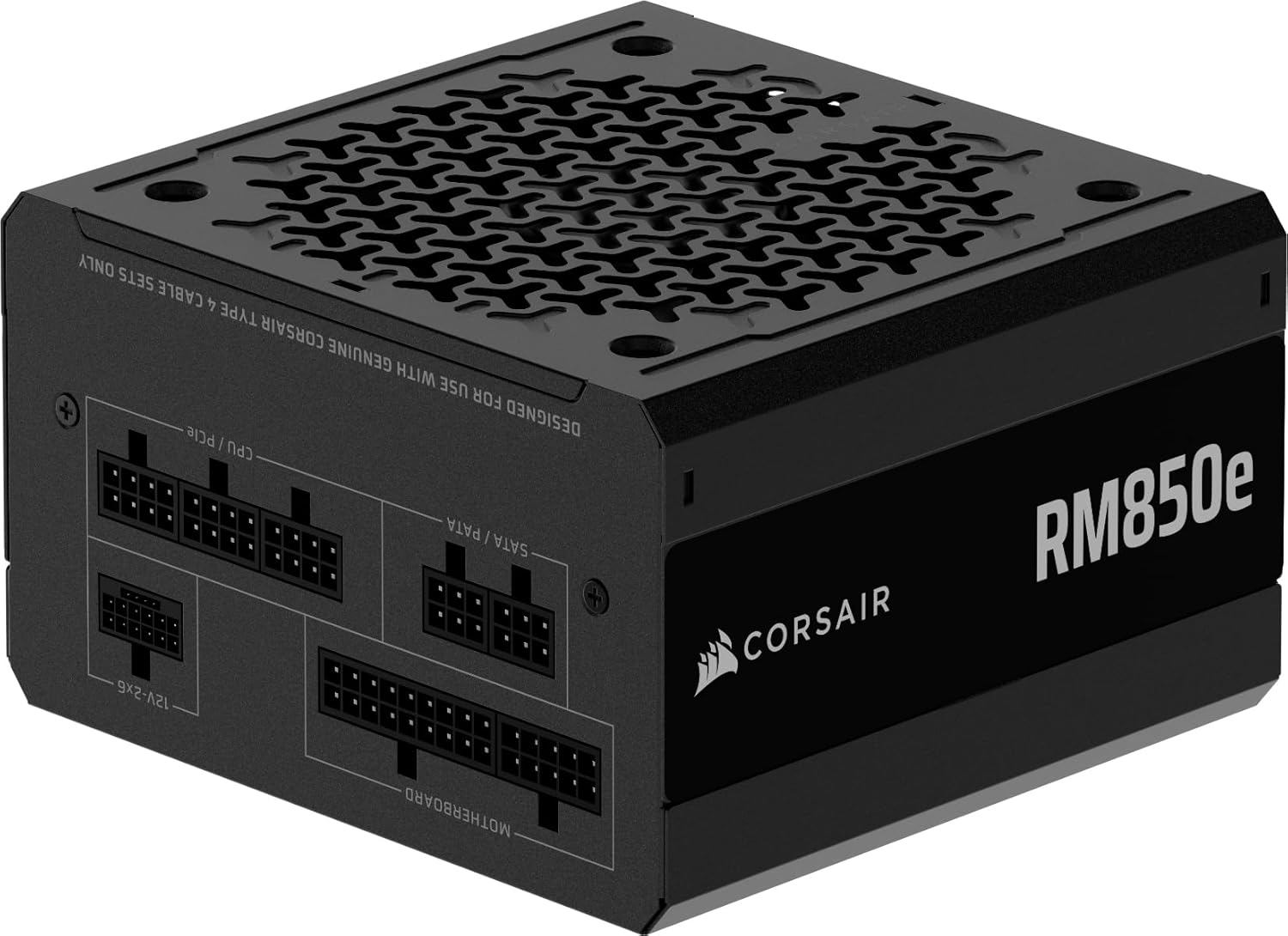
The Corsair RM850e delivers reliable performance as part of Corsair's new RM series, offering fully modular cabling and native 12V-26 connectors for modern GPU support. Reviewers noted its efficient Cybenetics Gold-Certified design and quiet operation with zero RPM fan mode. While it provides solid power delivery and build quality, it trails competitors in warranty length and offers only a modest price increase over the 750W model. This PSU suits enthusiasts seeking a balance of efficiency and reliability without the premium warranty of flagship models.
Full review
Efficiency ratings in real-world use
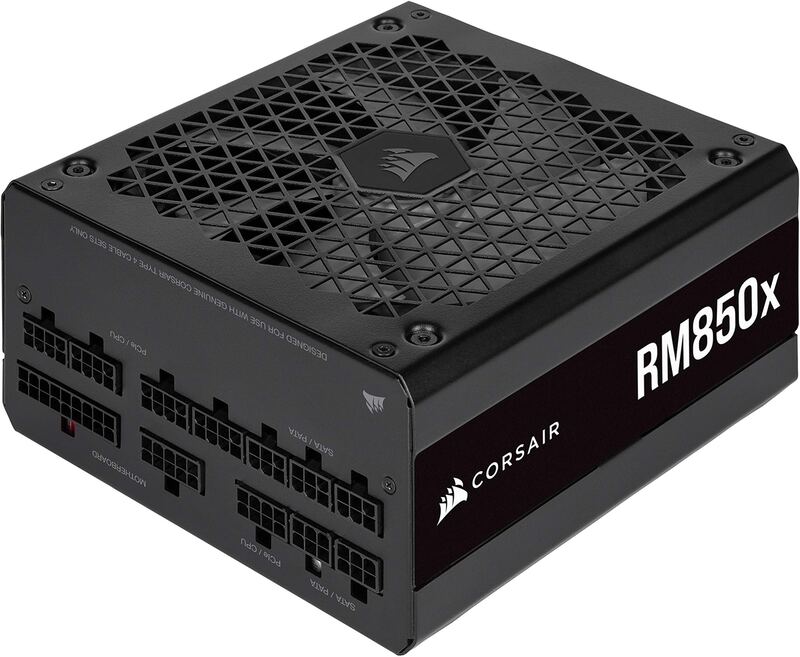
The Corsair RM850e delivers solid efficiency performance across its operating range, with measured efficiency of 88.568% at 115V and 90.783% at 230V under full load conditions. At light loads, the unit achieves 66.870% efficiency at 10W and 68.969% at 2% load, which are respectable figures for a Gold-certified PSU. However, these numbers are notably lower than the RM850x model reviewed by the same publication, which achieved higher efficiency across all load points. The unit's efficiency drops significantly below 70% at 2% load, making it less suitable for systems that remain in low-power states for extended periods. The power factor readings of 0.982 at 115V and 0.956 at 230V indicate good power factor performance, though not quite at the levels seen in premium models. These efficiency metrics suggest that while the RM850e is adequate for most gaming builds, it may not be the best choice for users seeking maximum energy efficiency or those running systems that spend significant time in standby mode.
Noise performance under load
The RM850e operates quietly under normal conditions, with an average noise output of 22.81 dBA at 115V and 22.84 dBA at 230V across all load combinations. The unit employs a 120mm rifle bearing fan with a specially calculated fan curve designed to minimize noise while maintaining adequate cooling. At full load, the fan operates at a relatively low RPM, resulting in minimal audible noise. The zero RPM fan mode is functional, allowing for near-silent operation during low-load scenarios. However, the fan's performance under high ambient temperatures remains a concern, as the unit's cooling system does not show optimal behavior when operating in hot environments. Users have noted that while the fan is quiet during typical gaming sessions, it becomes noticeably louder during sustained high-load operations, particularly when the system is under stress from demanding applications or overclocking.
Voltage regulation and ripple performance
Voltage regulation performance shows mixed results across different rails. The 12V rail maintains excellent load regulation at 0.83%, while the 5V rail achieves 0.58% load regulation. However, the 3.3V rail demonstrates poor load regulation at 1.10%, which is significantly higher than the industry standard. Ripple measurements reveal that the 12V rail produces 36.19mV of ripple at full load, which is acceptable for most applications. The 5V rail shows 13.82mV of ripple, also within acceptable limits. The 3.3V rail produces 18.16mV of ripple, which is higher than typical expectations for a Gold-certified unit. The 5VSB rail maintains 2.23% load regulation and 30.55mV ripple, which is considered adequate for standby power requirements. These measurements indicate that while the RM850e provides stable power for most components, users may experience issues with sensitive electronics that require tight voltage regulation, particularly on the 3.3V rail.
Build quality and component selection
The internal construction of the RM850e features standard components that prioritize cost-effectiveness over premium materials. The unit employs a single-sided PCB design with standard electrolytic capacitors, including Teapo and Nippon Chemi-con capacitors, but notably lacks Japanese capacitors found in higher-end models. The power supply utilizes a half-bridge APFC topology with LLC resonant converter, which provides good efficiency and low ripple. The main switchers are Infineon IPA60R120P7 devices, and the DC-DC converters use Potens Semiconductor PDC3906X chips. The fan used is a Hong Hua HA1225H12F-Z model with rifle bearing construction, which contributes to the unit's quiet operation. However, the absence of Japanese capacitors and some premium components suggests a compromise in long-term reliability compared to higher-tier models. The modular cabling system is well-designed with embossed cables that are easy to route and manage, though the cable gauge is standard rather than premium.
Modular design and cable management
The fully modular design of the RM850e allows for clean cable management and reduces clutter inside the case. The unit includes standard 24-pin ATX, 8-pin EPS, 6+2 pin PCIe, and 12+2 pin PCIe cables, along with SATA and Molex connectors. The cables feature embossed designs that make them easy to identify and route, with a low-profile comb design that fits well in tight spaces. The cable lengths are appropriate for most builds, with the 24-pin ATX cable measuring 600mm, EPS cables at 740mm, and PCIe cables at 640mm. The modular approach allows users to connect only the cables needed for their specific build, reducing unnecessary cable bulk. However, the lack of a native 12VHPWR connector for the latest graphics cards means users must rely on adapter cables or alternative solutions for optimal power delivery to high-end GPUs. The cable management features are well-executed and contribute to a cleaner build, though the standard cable gauge may not be optimal for high-current applications.
Protection features and safety standards
The RM850e includes comprehensive protection features that meet ATX 3.1 specifications, including over-voltage protection, under-voltage protection, over-power protection, over-current protection, over-temperature protection, short circuit protection, and surge protection. The unit also features a power integrations CAP200DG discharge IC for safe power-off procedures. However, some reviewers have noted that the protection features could be improved, particularly in terms of the distance between cold and hot 12V OCP and OPP triggering points. The protection features are conservative, but the identical triggering points under different temperature conditions may not be optimal for real-world usage where temperatures can vary significantly. The unit is certified for compliance with EN 55032 and CISPR 32 standards for conducted emissions, indicating good electromagnetic compatibility. The 7-year warranty provides reasonable coverage for most users, though it falls short of the 12-year warranty offered by some premium competitors.
Performance with modern graphics cards
The RM850e is capable of supporting modern graphics cards, including NVIDIA's RTX 5070 and 5070 Ti models, with no issues expected even when paired with the 360W RTX 5080. The unit's native 12V-26 connector design allows for direct connection to high-end GPUs without requiring additional adapters. However, the unit's performance with very high-end systems may be limited by its transient response capabilities, particularly at the 3.3V rail. The 12V rail's transient response at high loads is adequate, but the 3.3V rail's performance is considered mediocre, which may cause issues with some modern components that rely heavily on this rail. The unit's ability to handle power excursions from the latest GPUs is within ATX 3.1 specifications, but the lack of a native 12VHPWR connector means that users may need to rely on adapter solutions for optimal performance with the newest graphics cards. The unit's performance is sufficient for most gaming applications but may not meet the demands of extreme overclocking or power-hungry systems.
Price competitiveness and value proposition
The RM850e offers competitive pricing in the mid-range PSU market, with a price difference of only £10 between the 750W and 850W models from Corsair. The unit's price point makes it attractive for budget-conscious users who need a reliable power supply for gaming builds. However, the unit's performance is notably lower than the RM850x model, which suggests that users may be better served by investing in the higher-performing model for better long-term value. The 7-year warranty provides reasonable coverage, though it is less than the 12-year warranty offered by some premium competitors. The unit's value proposition is strongest for users who prioritize cost savings over peak performance and are not planning to upgrade to the latest high-end components in the near future. The unit's performance is adequate for most gaming applications, but users seeking maximum efficiency or reliability may want to consider alternative options in the market.
Strengths
- +Fully modular cabling allows for clean and customizable builds
- +Native 12V-26 connector supports latest high-end graphics cards without adapters
- +Efficient Cybenetics Gold-Certified design delivers up to 90% efficiency
- +Zero RPM fan mode enables near-silent operation at lower loads
Watch-outs
- −7-year warranty falls short of leading competitors' 12-year warranties
- −Moderate price premium over the 750W model with only 100W more power
How it compares
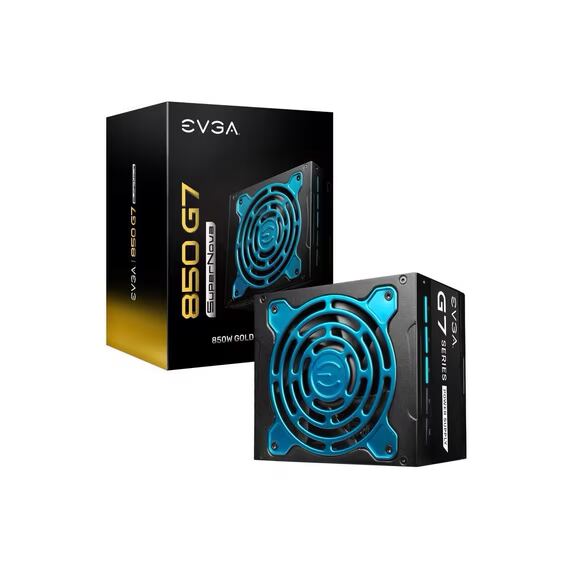
The Corsair RM850e offers a more affordable entry point into the RM series compared to the RM850x, but lacks the 10-year warranty and fluid dynamic bearing fan. It's less efficient than the EVGA SuperNOVA 850 G7 and doesn't match the premium build quality of the be quiet! Dark Power Pro 12 850W, though it does provide native 12V-26 support like the latter.
Rating sources
“Rating: 8 /10.”
“The RM850e units overall performance is notably lower than the new RM850x, making the second a one-way road if you are after top performance in this market segment.”
Our 3.8 score is the average of the 3 scored reviews above; 1 more reviewed it without printing a score and is not in the average. Ratings marked * were derived from the reviewer’s written analysis or video transcript — the publisher didn’t print an explicit numeric score, so we inferred one from their own words. Click through to verify. More about methodology.