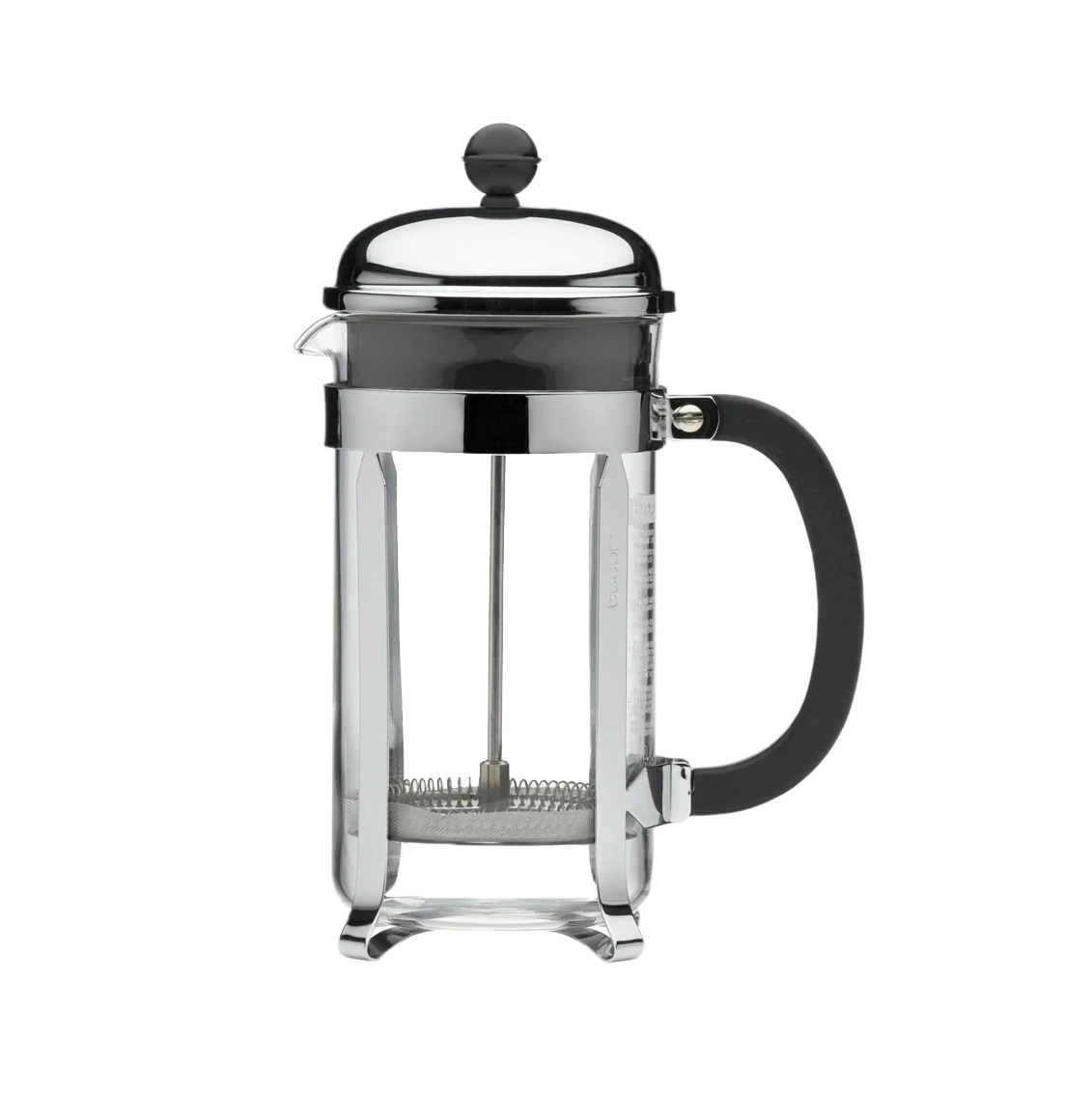
The Chambord is the press every coffee shop tries to sell you, and there is a reason: it brews a recognizably great old-school French press cup, it costs $40, and the chrome-and-glass design still looks right on every kitchen counter. It does not retain heat well, it does not filter as cleanly as the Espro line, and the glass will eventually break, but for the buyer who wants a classic French press at a classic price, nothing else in this category competes.
Full review
Real-World Performance
The Chambord is the original French press, designed in the 1950s and named for the domed towers of Chateau Chambord. America's Test Kitchen named it a Best Buy and Highly Recommended pick, with the verdict that it 'reliably brews very good old-school full-bodied French press coffee.' That sentence captures the product: this is the cup that defines what most coffee drinkers expect from the French press method — full bodied, oily, recognizable French press flavor, plus a layer of fine silt at the bottom of the mug.
Heat retention is its biggest practical weakness. America's Test Kitchen rated it for an approximate 30-minute hot window, which is consistent with what you would expect from any single-wall borosilicate carafe sitting on a counter. If you brew, decant into mugs, and drink within 20 minutes, the Chambord performs exactly as designed. If you sip slowly or come back for a second cup an hour later, the cup will be lukewarm.
The plunging action itself is the easiest of any press on this list. The three-part stainless mesh sits in the carafe with a generous tolerance, which means the plunger glides down with almost no resistance even with a fine grind. Bodum's design philosophy has always favored ease-of-use over filter precision, and the trade-off is visible in the cup — easier press, more silt. For drinkers who associate French press with the satisfying smooth-press ritual rather than with squeezing every milligram of grit out of the brew, the Chambord delivers exactly the experience they expect.
Build Quality and Design
The aesthetic is the real product here. Chrome-plated stainless frame, borosilicate glass carafe, black plastic handle with the Bodum debossed logo — it has been on coffee shop counters for 70 years and still looks right. Bodum manufactures the Chambord at their own factory in Portugal, which is unusual at this price point and shows up in genuinely good fit and finish for $40. The borosilicate is the heat-resistant lab-glass variant, which is why FrenchPressCoffee.com's review specifically called out that it is 'designed to withstand pressure and extremely hot temperatures.'
The recent design update added a locking lid with an open/close pour spout. The lock keeps the plunger oriented for even pressure (older Chambords notoriously could be plunged crooked, which lets grounds bypass the screen on one side), and the closeable spout slows heat loss when the carafe sits. These are small but meaningful upgrades over earlier Chambord generations.
Bodum also offers the Chambord in matte black, copper, gold, and cork-handle variants for buyers who want to coordinate with kitchen finishes, and each variant uses the same underlying glass-and-frame system. The serviceability story is strong by category standards — replacement carafes, lids, and filters are all sold through bodum.com and through major housewares retailers, which means a broken carafe is a $12 fix rather than a $40 full-press replacement. Few presses at any price tier match that parts-availability story.
What Reviewers Loved
The recurring praise across America's Test Kitchen, Verve Coffee, La Colombe, and the dedicated French press review sites is the same triad: classic cup quality, classic look, classic price. Reviewers consistently note that the Chambord is the press they keep recommending to friends because it brews great coffee at a price almost anyone can justify. Verve Coffee's product page calls out the 'updated locking lid for a more stable and even plunge,' a refinement that addresses the main historical Chambord complaint.
Where It Falls Short
Three real weaknesses. First, the glass will eventually break. Reddit and Amazon reviews are consistent that the typical Chambord lasts 2-4 years before a knock against a faucet or a pan edge cracks the carafe. Bodum sells replacement carafes for around $12, which softens the blow, but anyone who has owned a Chambord has replaced glass. Second, the single-screen filter lets through visibly more sediment than the Espro dual-filter or the Frieling two-stage. If grit at the bottom of the mug bothers you, this press will frustrate you over time.
Third, the chrome-plated frame is the lightest-gauge metal on this list. It is sturdy enough for normal use, but pulling the carafe out roughly can flex the frame. There are also long-standing reports of counterfeit Chambord units sold through third-party Amazon listings (one reviewer in 2022 reported receiving 'a plastic cylinder that you cannot get clean'), so buying from Bodum direct or from a reputable retailer is worth the small extra effort.
Who It's Best For
The Chambord is for the buyer who wants the original French press experience at the original French press price, and who values the look on the counter as much as the cup in the mug. It is also the right press for a beginning French press drinker who is not yet sure how much they care about sediment or heat retention — start with a Chambord, and if you find yourself wishing for cleaner coffee, upgrade to the Espro P3 or P7. Heavy daily drinkers who refill over a long morning should buy the Frieling or Stanley; the Chambord's 30-minute heat window will leave you with a half-warm carafe.
How It Compares to Alternatives
Against the Espro P3 at the same $40 price point, the Chambord wins on aesthetics and on the warm familiarity of the classic design; the P3 wins clearly on cup clarity (dual micro-filter versus single screen) and on a sturdier twist-locked frame. Honest read: if you only care about cup quality, buy the P3; if you also care about how the press looks on your counter and want the classic experience, buy the Chambord.
Against the Frieling 36 oz, the Stanley 48oz, or the Espro P7, the Chambord is in a different price tier and is not really a direct competitor — it costs a quarter as much and serves a different buyer. The right framing is that the Chambord is the baseline French press experience; the premium presses on this list are upgrades along specific axes (filter clarity for the P7, heat retention for the Stanley, build quality for the Frieling) for buyers who care about that specific axis.
Value at This Price
At $39.99 for a Made-in-Portugal press with an 8-cup borosilicate carafe, lifetime-replaceable glass, and the most recognizable French press silhouette on the market, the Chambord remains the value pick of the category in 2026. The cup it produces is genuinely good — America's Test Kitchen 'Highly Recommended' levels of good — and the design is iconic. The Espro P3 is the smarter buy if you want better cup clarity at the same price, but the Chambord is the better buy if you want the classic French press object on your counter.
Long-Term Durability
Durability is the Chambord's most honest weakness. The borosilicate carafe will eventually break — a knock against a faucet, a thermal shock from cold water hitting a hot carafe, an accidental countertop slide off the edge. Most owners report 2-4 years of normal use before the first crack. The mitigation is that Bodum sells replacement carafes for around $12 (and replacement filters for around $8), so a broken glass does not retire the whole press. The chrome frame, plastic handle, and stainless screen routinely outlive multiple carafes.
The other durability footnote is the chrome plating. On the original chrome finish, scratches and small dings reveal duller metal underneath, and after several years of dishwasher cycles the chrome can start to show wear at the handle joint. Bodum's matte black, copper, and gold finishes hide this better. None of these wear issues affect coffee quality, but if you keep your kitchen gear visibly perfect, plan to replace the unit every 4-5 years; if you treat scuffs as character, a Chambord with replacement glass can last more or less indefinitely.
Strengths
- +The classic French press design — chrome frame and borosilicate glass — first launched in the 1950s and effectively unchanged
- +America's Test Kitchen 'Highly Recommended' Best Buy; testers said it 'reliably brews very good old-school full-bodied French press coffee'
- +Made in Portugal at Bodum's own factory, with replacement glass carafes sold separately when the original cracks
- +Three-part stainless steel mesh filter is the original French press standard — simple to clean, easy to find replacement screens for
- +At $40 retail it is one-quarter the price of the premium presses on this list while still producing recognizably great coffee
Watch-outs
- −Glass carafe will eventually crack from a knock against a faucet or pot edge — most owners report 2-4 years of typical life
- −Heat retention is the second-worst on this list (after the Espro P3); coffee is meaningfully cooler within 30 minutes
- −Single-screen filter lets visibly more sediment through than the Espro dual-filter or Frieling two-stage setup
- −Steel frame is the lightest-gauge of any press here and can flex if the carafe is removed roughly
How it compares
Best value-and-aesthetic combination in the lineup. The Espro P3 brews a noticeably cleaner cup at a similar price; the Frieling 36 oz and Espro P7 offer better heat retention and build at 3-4x the cost. Worse filter than every other press here.
Who this is for
At a glance: Buyers who want a classic French press cup at a classic price and care more about aesthetics and tradition than about peak filter clarity or hour-long heat retention.
Why you’d buy the Bodum Chambord 8-Cup French Press (34 oz)
- The classic French press design — chrome frame and borosilicate glass — first launched in the 1950s and effectively unchanged.
- America's Test Kitchen 'Highly Recommended' Best Buy; testers said it 'reliably brews very good old-school full-bodied French press coffee'.
- Made in Portugal at Bodum's own factory, with replacement glass carafes sold separately when the original cracks.
Why you’d skip it
- Glass carafe will eventually crack from a knock against a faucet or pot edge — most owners report 2-4 years of typical life.
- Heat retention is the second-worst on this list (after the Espro P3); coffee is meaningfully cooler within 30 minutes.
- Single-screen filter lets visibly more sediment through than the Espro dual-filter or Frieling two-stage setup.
Rating sources
“Best Buy; reliably brews very good old-school full-bodied French press coffee”
“Heat-resistant borosilicate glass designed to withstand pressure and extremely hot temperatures”
“Updated locking lid for a more stable and even plunge; bold robust coffee”
Our 4.3 score is the average of these published ratings. Ratings marked * were derived from the reviewer’s written analysis or video transcript — the publisher didn’t print an explicit numeric score, so we inferred one from their own words. Click through to verify. More about methodology.