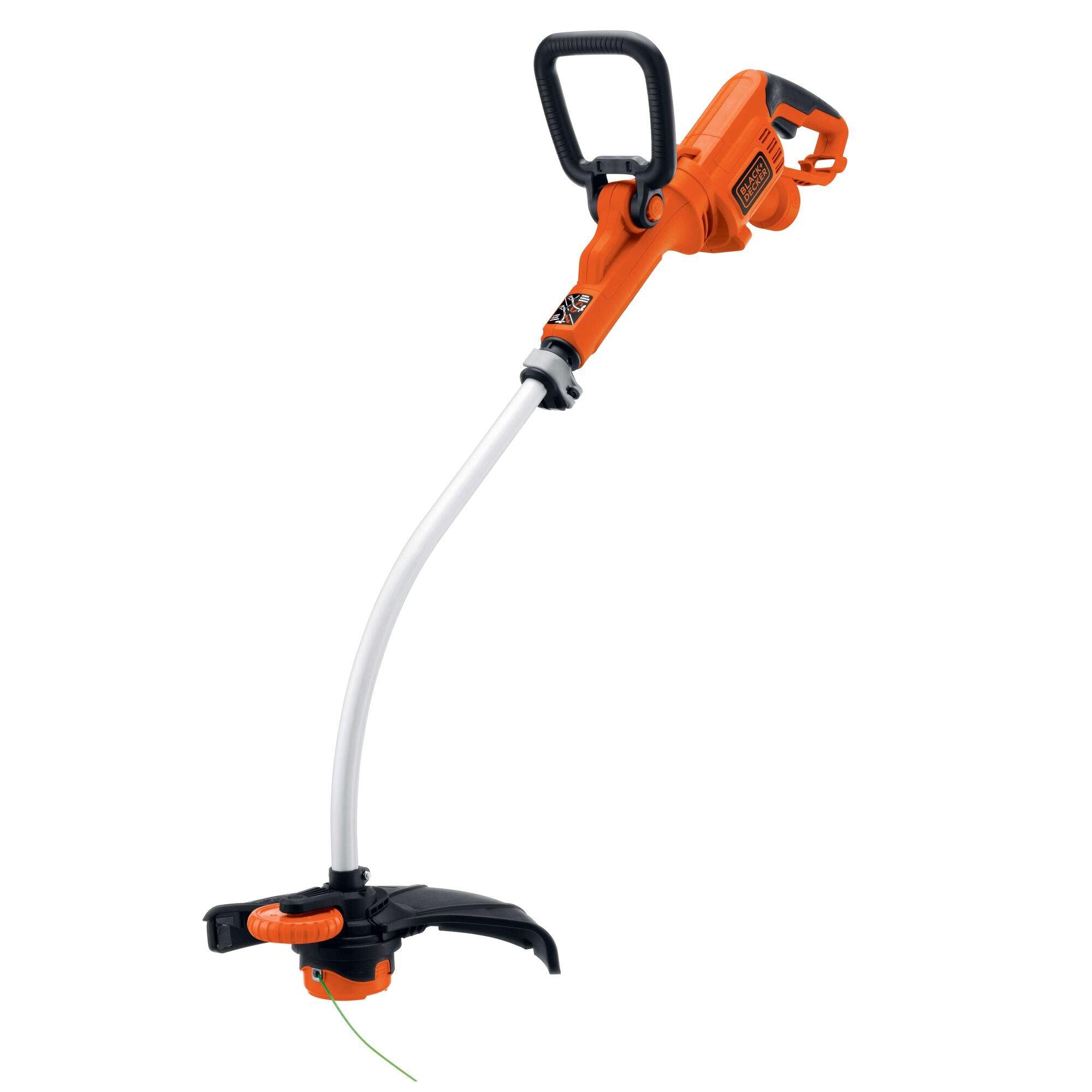
The Black+Decker GH3000 is the steady-power, no-batteries-no-fuel pick for owners of small flat suburban lots within extension-cord reach of an outlet. Top Ten Reviews rated it 4/5 and Consumer Reports has it in their string-trimmer test program. The 7.5-amp corded motor never fades partway through a job — unlike battery picks above, which trade runtime for portability. The trade-offs are obvious: you're tethered to a cord, the line is thinner (0.080-inch), and the curved shaft loses some reach. For under $70 with no battery to charge or fuel to mix, it's the best entry point into the category.
Full review
Cutting Power and Real-World Use
The GH3000's 7.5-amp corded motor produces steady, unfading power. Brush Cutter Central reported it cuts through weeds and grass quite well, though it takes a while to get through thicker or wetter spots. Top Ten Reviews rated it 4/5 overall and called it easy to trim really precisely with — useful when working around landscaping where you want to preserve some plants while removing others. The continuous-duty rating means you can trim for an hour straight without the power tapering off the way battery picks do as voltage sags.
The 14-inch cutting swath is wider than the Worx WG170 above and means fewer passes. Spin speed of 7,500 rpm on the 0.080-inch line is enough for grass and light weeds, but the thinner line wears faster than the 0.095-inch line on the battery picks. Operators dealing with rocks, sidewalk edges, or heavy material will go through spools more often than they'd like. For pure lawn-grass maintenance on a typical suburban quarter-acre, the lighter line is actually an advantage — it cuts cleaner with less ragged tearing of the grass blade.
Build Quality and Materials
Construction is plastic-heavy and unapologetically homeowner-grade, but Black+Decker's gear-drive transmission is genuine metal and the motor itself is rated for continuous duty within its amperage envelope. The 2-year limited warranty is standard for the price tier — about half what EGO offers but adequate.
Brush Cutter Central noted the GH3000 warms up during extended use, which is normal for corded electric motors but a reminder that this isn't a tool for marathon sessions. For typical 15-30 minute homeowner trimming routines it'll outlast the average mortgage. The handle geometry and trigger feel are unchanged from the original 2013 release, which is itself evidence of a design that didn't need iteration. Black+Decker also sells direct-replacement housings, motors, and switch assemblies through online parts suppliers, so even a catastrophic failure 5+ years in is usually fixable for under $40.
Line Feed and Refilling
The Automatic Feed Spool (AFS) advances line automatically when needed — no bumping the head, no button to press. Consumer Reports specifically called out the automatic line feed as a usability win. When the system works it's transparent and fast.
The downside, per Consumer Reports' notes: when it's time for fresh line, winding the AFS spool by hand is difficult. Many owners buy pre-wound replacement spools (Black+Decker sells them for a few dollars) rather than fight with the cap and bobbin. Plan on stocking a few extras.
Weight and Ergonomics
At 6.9 lb the GH3000 is lighter than every battery-cordless pick on this list and matches the Worx WG170 with a battery installed. The motor sits at the top of the shaft (not in the head), which Brush Cutter Central praised for distributing weight better than head-heavy designs. Top-mounted motors also keep the head cooler and let the air vents around the housing run clear.
The curved shaft is the major ergonomic compromise. It works fine for general lawn trimming but loses reach under hedges, along fences, and especially for taller users who'd benefit from a straight-shaft layout. The D-loop handle is unpadded, which Brush Cutter Central flagged but didn't consider a deal-breaker. The auxiliary handle slides along the shaft for fit adjustment, and the telescoping main shaft accommodates users from roughly 5'2" to 6'2" comfortably.
Cord Management Reality
Corded trimmers live or die by your willingness to manage an extension cord. Brush Cutter Central was explicit: this trimmer is difficult to use without a proper extension cord with adequate reach. Plan on a 50-foot 14 AWG outdoor extension at minimum; 100 feet for typical suburban lots.
There's also a cord retention clip on the rear of the housing to keep accidental yank-outs from happening, which works as advertised. Stepping over the trailing cord while trimming becomes second nature — the trade is that you never charge a battery, never mix fuel, and the tool is ready to use the moment you plug it in.
Cord-walking technique matters: experienced users start at the outlet end and work outward, keeping the cord behind them rather than dragging it across freshly trimmed lawn. After a few sessions the rhythm becomes automatic and the cord stops being a conscious thought. The included cord retention loop on the rear handle is a small but useful detail that prevents an accidental pull from yanking the extension cord plug out of the tool's receptacle mid-trim — a frustration on cheaper corded trimmers without the feature.
Where It Falls Short
Three real limitations. The cord tether genuinely restricts where and how you can trim — a non-starter for anyone with a property too big or shaped wrong for cord reach. The 0.080-inch line is thinner than other picks and wears faster. And the spool reload, when it comes, is reportedly painful to wind.
The curved shaft also costs you reach, which matters more if you have hedges, deep fences, or other obstacles. And while the motor never fades partway through a job, it also doesn't have the peak torque to bull through heavy weeds the way a Husqvarna 525L gas trimmer or even the Ryobi 40V can.
Who It's Best For
Owners of small lots (under 1/8 acre) within extension-cord reach of an exterior outlet, who want the lowest possible entry price into the category and zero ongoing maintenance — no batteries to replace, no fuel to mix, no spark plugs or air filters. Owners who trim infrequently and don't want a battery sitting flat for months between uses.
Skip it if your lot is too big or odd-shaped for cord management, if you have heavy weed pressure, or if you'd rather pay more once for the cordless freedom of the Worx WG170 above. For anyone trimming once or twice a month on a small flat suburban yard, this is the smartest $70 in the category.
How It Compares to Alternatives
Against the Worx WG170 GT Revolution at $129, the GH3000 wins on continuous cutting power and saves you $60 — but loses the cordless freedom and the 3-in-1 mini-mower conversion. For anyone whose yard works with a cord, this is the better entry buy. For anyone who values cordless, the Worx WG170 is the right step up.
Compared to the Ryobi RY402110, EGO ST1623T, and Husqvarna 525L picks above, the GH3000 is a different category of tool entirely. It's not trying to compete on raw output — it's trying to be the cheapest, simplest, most reliable way to keep a small lawn neat.
Long-Term Durability and Value
Corded electric tools are the simplest mechanical category — no batteries to age, no fuel system to gum up, no spark plug to foul. The GH3000 has been in continuous production since 2013 and the basic design is unchanged for a reason: there's almost nothing to fail. Long-term Amazon and Walmart reviews report units still working after 8-10 years of seasonal use, with replacement of the spool cap as the main wear item.
Black+Decker's spare parts ecosystem is wide — the SF-080 replacement spool fits multiple trimmer models and is stocked at every Home Depot, Lowe's, and Walmart in the US. The whole-tool replacement cost of about $70 is low enough that some owners just buy a new unit rather than service an old one, which keeps the long-term effective ownership cost predictable. For a tool in this price tier, that combination of simplicity and parts availability is the most defensible long-term value in the category.
Strengths
- +7.5-amp motor delivers the steadiest continuous power of any pick in this list
- +Automatic Feed Spool (AFS) eliminates bump-feed entirely — no button to press
- +6.9 lb working weight is lighter than every battery cordless on this list
- +Converts to edger via wheeled guide with no tools
- +Under $70 puts it inside reach of any homeowner budget
Watch-outs
- −Corded operation limits range to the length of your extension cord
- −0.080-inch line is thinner than other picks and wears faster in hard material
- −Curved shaft sacrifices reach under hedges and along fences
- −AFS spool is reportedly difficult to wind when it's time for fresh line
How it compares
The only non-battery/non-gas pick in this category — the trade-off is freedom from charging or fueling for the cost of being tethered to a cord. Lighter than the Worx WG170 GT Revolution (6.9 lb vs 5.5 lb battery-included is closer than you'd think) and outcuts it in heavier grass thanks to the 7.5-amp continuous draw. Cuts a wider 14-inch swath than the Worx's 12-inch.
Who this is for
At a glance: Small-yard owners (under 1/8 acre) within extension-cord reach of an outlet who want zero battery management, no fuel storage, and the lowest entry price into the category.
Why you’d buy the Black+Decker GH3000 7.5-Amp Corded 14-Inch
- 7.5-amp motor delivers the steadiest continuous power of any pick in this list.
- Automatic Feed Spool (AFS) eliminates bump-feed entirely — no button to press.
- 6.9 lb working weight is lighter than every battery cordless on this list.
Why you’d skip it
- Corded operation limits range to the length of your extension cord.
- 0.080-inch line is thinner than other picks and wears faster in hard material.
- Curved shaft sacrifices reach under hedges and along fences.
Rating sources
“We were also happy to note that the GH3000 is not too heavy, with a nicely balanced weight distribution that makes for easy mowing.”
“Tested by Consumer Reports against trimming, edging, tall-grass, noise, and ease-of-use criteria.”
“Powerful 7.5 Amp motor with gear drive transmission provides highest performance trimming.”
Our 4.0 score is the average of these published ratings. Ratings marked * were derived from the reviewer’s written analysis or video transcript — the publisher didn’t print an explicit numeric score, so we inferred one from their own words. Click through to verify. More about methodology.