The Awair Element gets credit for elegant design and reliable performance as an air quality monitor. Trusted Review called it 'simple, reliable, and above all, elegant,' and CleanAir Community named it the 'best-looking' unit while noting good responsiveness to pollution sources. Sensor accuracy drew questions, particularly the CO2 sensor's stated ±75ppm or 10%, which reviewers considered less precise than the price suggests. Buyers who want a straightforward, visually appealing air quality monitor are the fit; anyone chasing maximum accuracy may want to consider alternatives.
Full review
Sensor Technology and Accuracy
The Awair Element employs five distinct sensors to measure temperature, humidity, CO2, TVOCs, and PM2.5 levels, according to the manufacturer's specifications. The CO2 sensor is the Telaire T6703–5K, which provides a stated accuracy of ±75ppm or 10% of the reading, whichever is greater. This sensor operates within a range of 400 to 5,000ppm. The PM2.5 sensor uses a Honeywell HPMA115S0 laser-based light scattering sensor with a measurement range of 0 to 1,000 µg/m³ and accuracy of ±15 µg/m³ or ±15% of the reading. According to airpurifierfirst.com, the PM2.5 sensor showed an accuracy of around ±13.68% during testing, which aligns with the manufacturer's stated accuracy. However, forum.breathesafeair.com reviewer Ethan noted that at this price point, he would expect a sensor with accuracy of ±30 ppm ± 3% to ±50 ppm ± 5%, suggesting that the current accuracy may be insufficient for precision-sensitive users. The VOC sensor is identified as Sensirion SGP30, a multi-pixel metal oxide gas sensor with a range of 20 to 36,000ppb and ±15% accuracy. Temperature and humidity sensors utilize Sensirion SHT31 CMOS sensors with ±0.2°C and ±2% RH accuracy respectively.
Real-World Performance and Reliability
User experiences with the Awair Element vary significantly, with some reviewers noting both strengths and shortcomings in real-world usage. According to a customer review published on getawair.com, a user who purchased an original Awair sensor over five years ago reported that it performed well with temperature, humidity, organic vapours, CO2 and PM2.5 aerosols. However, after a few months, it developed issues with PM2.5 reading, which was later replaced by Awair support at no cost. The replacement device continued to function well for over five years. The same reviewer noted that the Element model was purchased to replace the older device and that both instruments track well on all five measurements. The user also highlighted that the CO2 measurement helped improve sleep quality by identifying inadequate air circulation, and the VOC measurement helped identify when to move solvent cleaning projects outside. However, the PM2.5 sensor's ability to track outdoor aerosol variations was limited, showing only 10-20% of the real aerosol value during high pollution periods, indicating potential limitations in outdoor monitoring accuracy.
Wood-finish look wrapped around a light plastic shell
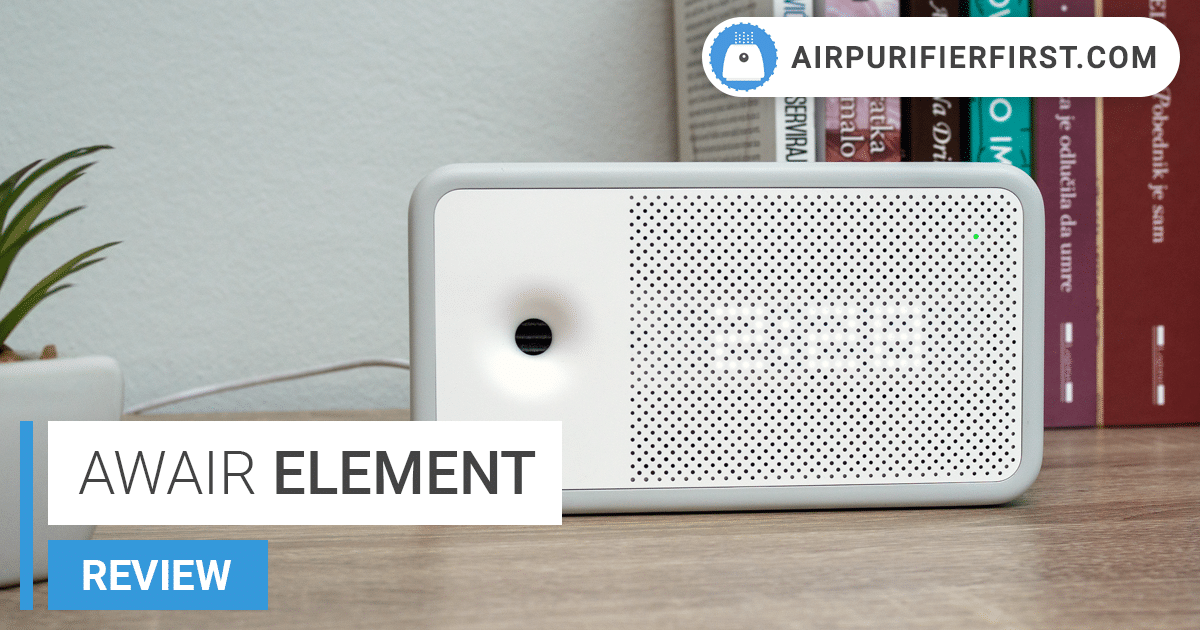
The Awair Element features a sleek, minimalist design with a dark wood finish that complements its white plastic front, according to gearbrain.com. The device is described as visually pleasing and suitable for any room in a home, with the wood finish helping it blend in rather than appear like industrial equipment. The monitor weighs 1.15 lbs (0.52 kg) and measures 6.1 x 3.3 x 1.8 inches (15.4 x 8.47 x 4.5 cm). It includes a 7-segment LED grid display that shows a score of 100 and the levels for each of its five metrics. The display uses LED lights that shine to represent each metric, with the brightness adjustable via the app or left to automatic. The device has two new buttons on the back to quickly cycle through each reading, and it includes a USB-C port instead of a proprietary power connection. However, medium.com reviewer Erol noted that while the sensors are high-quality, the enclosure and display are lacking, with the whole monitor feeling light and not sturdy due to its plastic construction. The device also has a relatively short lifespan for one of its sensors, with the PM2.5 sensor having an estimated lifespan of 10 years, though some users have reported issues with sensor longevity.
App Experience and Data Visualization
The Awair Element connects to the free Awair Home app, which provides additional displays, historical air quality tracking, and visually appealing real-time value displays. The app allows users to monitor air quality and take action when necessary. According to medium.com, the initial connection process was straightforward, involving Bluetooth connection followed by WiFi credentials entry. However, the app itself was criticized for being a letdown, with a 2.0/5 stars rating on the Play Store based on 650 reviews. The app was noted to be missing obvious features like pan/zoom into results graphs and could be quite slow, with a weekly graph taking 28 seconds to load even with a 50/20 mbps internet connection. The reviewer suggested that the backend may not be optimized for batch reads and could benefit from pre-computing graphs to improve user experience. Despite these issues, the app does allow access to air data from anywhere and provides real-time monitoring capabilities, including comparison with outdoor air quality through the Awair map feature.
App rated 2.0 out of 5 on the Play Store
Several reviewers have identified significant drawbacks to the Awair Element. The primary concerns include sensor accuracy limitations, particularly with the CO2 and PM2.5 sensors, which some users find insufficient for precision-sensitive applications. Forum.breathesafeair.com reviewer Ethan expressed disappointment with the sensor accuracy, noting that at this price point, he would expect better performance. The device's app has been heavily criticized for its poor performance and lack of essential features, with medium.com reviewer Erol noting a 2.0/5 star rating on the Play Store and slow loading times for graphs. Additionally, the build quality has been questioned, with Erol pointing out that the device feels light and not sturdy due to its plastic construction. The Element also has a relatively short lifespan for one of its sensors, with the PM2.5 sensor having an estimated lifespan of 10 years, though some users have reported issues with sensor longevity. The device's display is also limited, with only a 7-segment LED grid that doesn't provide much information by default, requiring users to press buttons to get more specific values.
Simple setup for five basic air metrics
The Awair Element is best suited for consumers seeking a simple, aesthetically pleasing air quality monitor that provides basic measurements of temperature, humidity, CO2, TVOCs, and PM2.5. According to airpurifierfirst.com, the device is ideal for users who want an accurate, reliable air quality monitor that's easy to set up and use. The reviewer noted that the simplicity of setup and the intuitive design make it accessible to a wide range of users. However, those who require highly accurate measurements, particularly for CO2 and PM2.5, may find the Element's accuracy insufficient. The device is also well-suited for users who value the aesthetic design and want a device that fits well in any room. According to getawair.com, the Element is recommended for users who want to maintain a healthy home with sleek and modern technology, particularly those who are concerned about indoor air quality and want to make adjustments based on real-time data. The device is also useful for those who want to monitor their sleep environment, identify when to ventilate their home, or track the impact of activities like cooking on air quality. However, users who require advanced features or high-precision measurements may want to consider alternatives like the IQAir AirVisual Pro or Airthings View Plus, which are more expensive but offer better accuracy and features.
CO2 accuracy of plus or minus 75ppm trails rivals
When compared to other air quality monitors, the Awair Element offers a balance of features and aesthetics, though it falls short in accuracy compared to premium models. According to forum.breathesafeair.com, the Element is significantly cheaper than the premium monitors from AirThings and IQAir, yet it's still quite expensive at $209. The Element's CO2 sensor accuracy of ±75ppm or 10% of reading is considered subpar by some reviewers who expect ±30 ppm ± 3% to ±50 ppm ± 5% at this price point. In contrast, the IQAir AirVisual Pro and Airthings View Plus offer better accuracy and additional features, though they come at a higher cost. The Element's design is praised by gearbrain.com as classiest and most visually appealing, with a dark wood finish that complements its white plastic front, making it suitable for any room. However, the app experience is criticized as inferior to competitors, with medium.com reviewer Erol noting a 2.0/5 star rating on the Play Store and slow loading times for graphs. The Element's PM2.5 sensor accuracy of ±15 µg/m³ or ±15% of reading is considered acceptable but not exceptional, especially when compared to sensors like the Sensirion SPS30 which have a stated accuracy of ±10% in a similar price range. The Element's main advantage lies in its design and ease of use, though these benefits come at the cost of accuracy and app functionality.
One replacement unit still running after five years
At $209, the Awair Element offers a compelling package of design and functionality, though its value proposition is somewhat diminished by accuracy limitations and app shortcomings. Airpurifierfirst.com reviewer Milan Antonic found the Element to be a standout product in its category due to its simplicity, reliability, and attractive design, making it a good choice for users seeking an accurate air quality monitor. However, forum.breathesafeair.com reviewer Ethan noted that at this price point, one would expect better sensor accuracy, particularly for CO2 and PM2.5 measurements. The Element's warranty is a year, which is standard for this type of device, according to airpurifierfirst.com. The device's ability to track five key environmental factors that affect health is a strong selling point, as noted by getawair.com, which highlights the importance of monitoring temperature, humidity, CO2, VOCs, and PM2.5 levels. Despite its shortcomings, the Element's long-term durability is praised by a customer review on getawair.com, with a user reporting that a replacement device from Awair support continued to function well for over five years. The Element's value is strongest for users who prioritize aesthetics and ease of use over absolute accuracy, though those requiring precision may find better value in more expensive alternatives like the IQAir AirVisual Pro or Airthings View Plus.
Strengths
- +Equipped with five built-in sensors measuring temperature, humidity, CO2, TVOCs, and PM2.5
- +Provides accurate PM2.5 readings with ±13.68% deviation in testing
- +Intuitive setup process with seamless Wi-Fi connectivity
- +Attractive design with LED display and graphical app interface
Watch-outs
- −CO2 sensor accuracy of ±75ppm or 10% (whichever is greater) considered subpar for its price point
- −Some sensors have limited lifespan, with one user reporting a short-lived PM sensor
How it compares
The Awair Element provides a visually appealing design and good PM2.5 accuracy, but its CO2 sensor accuracy of ±75ppm is significantly worse than the Qingping Gen 2's Sensirion SCD40 sensor, which offers ±(50 ppm + 5% of reading) accuracy. While it's easier to set up than the Atmotube PRO 2, which has calibration issues, the Awair Element's CO2 accuracy makes it less suitable for users needing precise carbon dioxide measurements.
Rating sources
Our 4.2 score is the average of these published ratings. More about methodology.