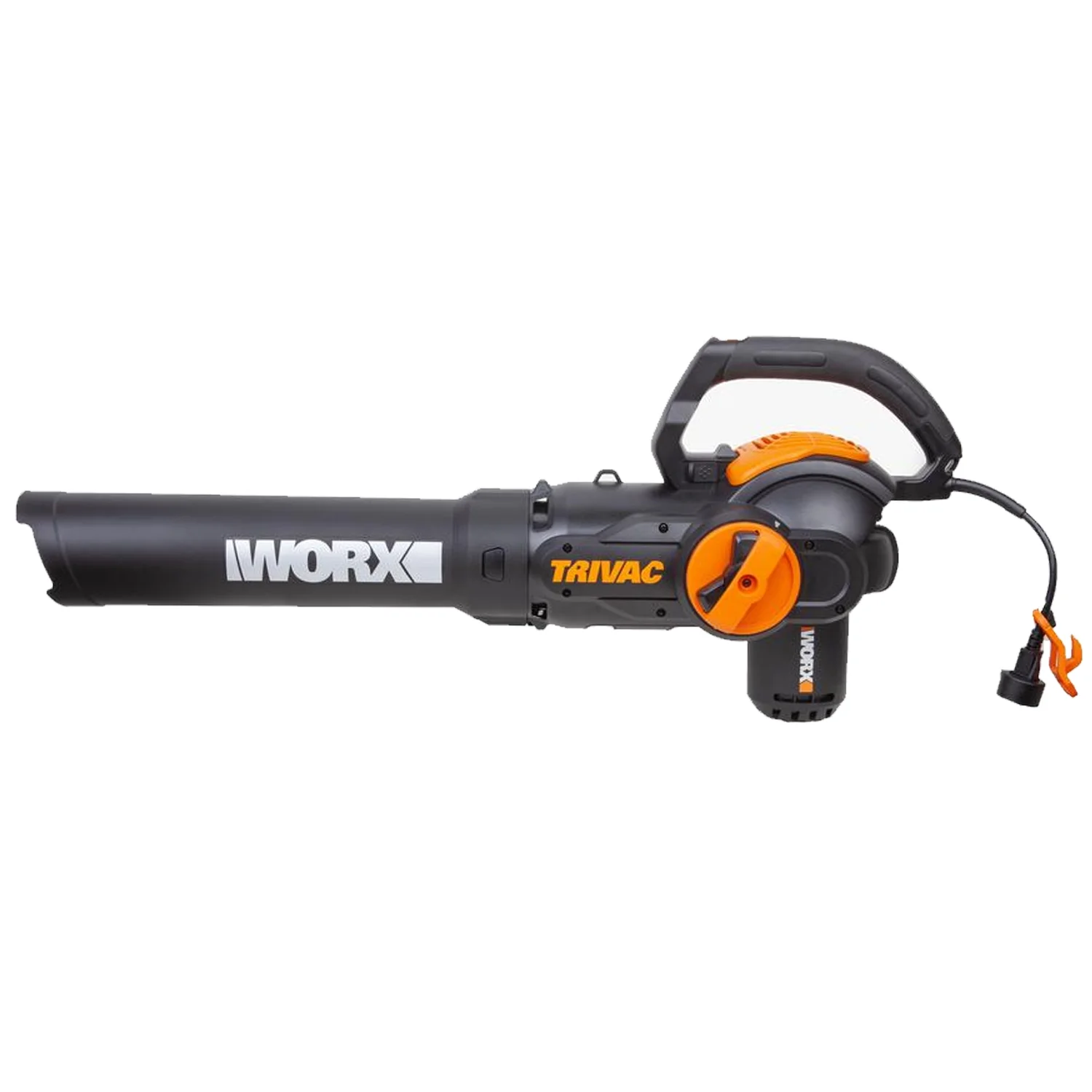
The WORX Trivac WG512 delivers robust 600 CFM airflow in blower mode and effectively mulches leaves into a fine compost using its metal impeller. Enjoy our yard reported significant volume reduction that minimizes disposal trips. However, the corded design restricts mobility to extension cord length, and TheLittleWoodHouse noted that vacuuming large leaves often causes clogs at the intake nozzle requiring manual clearing. Additionally, the mesh collection bag allows dust to escape during operation, necessitating the use of a face mask for safety. This lightweight unit suits small-to-medium yards with manageable debris, but users with large properties or heavy twig accumulation should look elsewhere.
Full review
600 CFM airflow in blower mode
The WORX WG512 Trivac delivers a robust 600 cubic feet per minute of airflow, which moves leaves efficiently across lawns and driveways. The unit features two distinct speed settings to match power to task; low speed is gentle enough for tidying around plants without scattering mulch or light garden materials, while high speed provides the concentrated push needed for dense leaf piles and heavier debris. This configuration allows users to clear sidewalks, patios, and tight corners with a focused stream of air.
The maneuverability remains comfortable due to the unit's moderate weight of approximately 8.9 pounds, which permits one-handed operation for most cleanup tasks. However, long continuous runs can become physically tiring despite the ergonomic grip. While it lacks the raw power of bulkier backpack models, the combination of high airflow and manageable weight makes it a capable tool for clearing large areas quickly without excessive fatigue.
Vacuum mode struggles with large leaves
TheLittleWoodHouse noted that while vacuuming works well on flat, hard surfaces and mowed lawns, larger leaves can cause significant issues at the intake nozzle. Large pieces sometimes get stuck rather than being sucked in immediately, requiring the user to bump the unit against the ground to create additional suction around the edges. In contrast, smaller leaf fragments are ingested quickly without obstruction, making a pre-raking or sweeping step highly recommended for optimal performance.
Clogging remains a persistent challenge when processing twigs and small branches that have fallen from trees. The metal impeller mulches debris simultaneously as it is vacuumed, meaning foreign objects can damage the internal mechanism if they are not avoided. When clogs do occur, clearing them requires unplugging the unit, detaching the bag or attachment, and manually removing the obstructing debris through an opening in the housing.
Mulching ratio exceeds 16:1 claims
enjoy our yard reported that the metal impeller condenses leaf volume significantly, effectively reducing disposal trips. During a one-hour vacuuming session, they filled three thirty-gallon garden containers with mulched leaves; without the mulching feature, those same leaves would have required approximately six bags.
The unit achieves this through a sturdy metal propeller that chops up debris as it passes through the housing. While WORX rates the mulching ratio at 16:1, user experience suggests the actual volume reduction is highly effective even if precise mathematical ratios vary based on leaf size and moisture content. The resulting mulch is finely shredded, though some larger pieces may remain depending on the initial debris condition.
Mesh bag allows dust to escape
The collection system utilizes a mesh-style bag that attaches via a quick-release mechanism. While convenient for emptying, TheLittleWoodHouse highlighted that this design allows significant amounts of fine dust and debris particles to fly out from the sides during operation. This creates a dusty environment around the user, making it highly advisable to wear a face mask to avoid breathing in concentrated particulate matter while mulching leaves.
Corded power limits mobility
As a 12-amp corded electric device, the WORX WG512 requires a continuous connection to an extension cord, which dictates its operational range. TheLittleWoodHouse found that for large yards spanning several acres, standard short cords are insufficient, necessitating the purchase of longer 100-foot, 14-gauge extension cords capable of handling the high amperage. This adds to the overall cost and logistical effort required before operation can even begin.
Mode switching uses a dial switch
Transitioning between blower, vacuum, and mulcher modes is handled by a simple dial switch located on the main housing. TheLittleWoodHouse described this mechanism as intuitive; users push down on a lever and twist to lock the unit into the desired configuration. This double-lever system prevents accidental changes during operation.
Strengths
- +Three-in-one functionality allows switching between blower, vacuum, and mulcher modes with a simple dial switch.
- +High airflow of 600 CFM efficiently moves leaves across lawns and driveways in blower mode.
- +Lightweight design at approximately 8.9 lbs makes it easy to maneuver for one-handed operation.
Watch-outs
- −Corded electric power requires an extension cord and limits mobility based on cord length.
- −Mesh collection bag allows dust to escape, necessitating the use of a face mask during operation.
- −Vacuum mode can clog when processing large leaves or twigs, requiring manual clearing.
How it compares
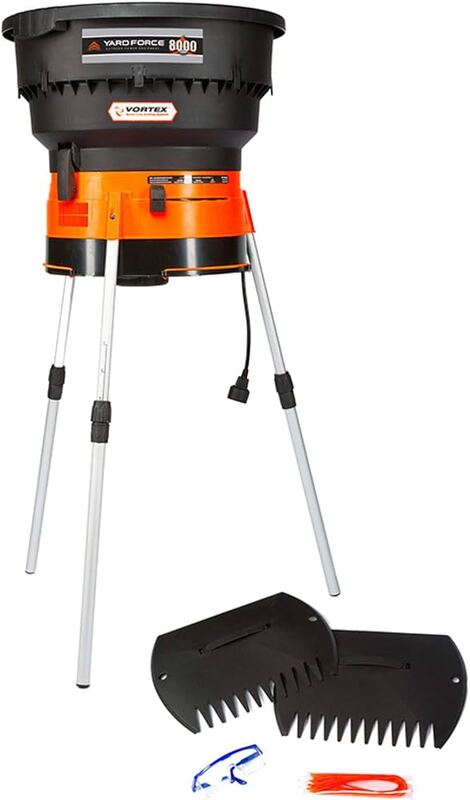
With an airflow of 600 CFM, this unit moves leaves more efficiently in blower mode than the stationary Yard Force YF8000LS. It shares a 16:1 mulch ratio with the Ryobi 40V but is significantly lighter at 8.9 lbs compared to the Ryobi's 12.7 lb weight.
Rating sources
“Would I buy this again? Well, yes and no.”
“it's my second season of using it and basically a game changer”
Our 3.8 score is the average of the 2 scored reviews above; 2 more reviewed it without printing a score and are not in the average. Ratings marked * were derived from the reviewer’s written analysis or video transcript — the publisher didn’t print an explicit numeric score, so we inferred one from their own words. Click through to verify. More about methodology.