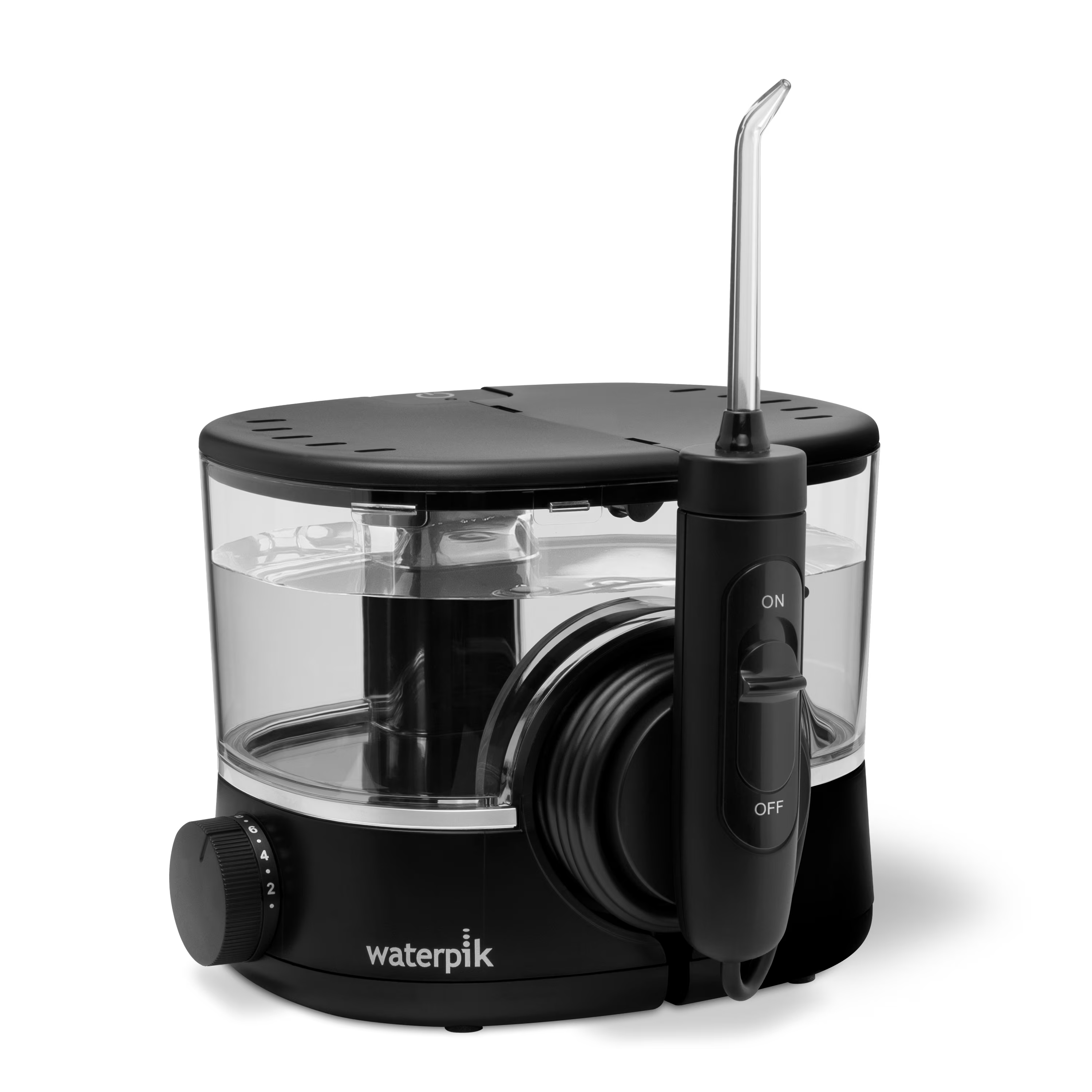
The Waterpik ION Professional (WF-12) is a countertop water flosser with a built-in rechargeable battery, so it works without a power outlet by the sink. Electric Teeth got 30 minutes of use per charge at the highest of its ten pressure settings and reports great cleaning results, but found the small handle slightly trickier to hold, the nozzle harder to rotate than on the Waterpik Aquarius, and the unit too bulky to be a real travel flosser. Dr. Joshua Austin, writing in Dental Economics, recommends it for patients who will not use string floss and those with orthodontics, bridges or implants.
Full review
A countertop flosser with a battery
Electric Teeth's Jon Love describes the ION as a cross between the two usual types: it has the tank, hose and pressure range of a countertop unit but runs from an internal lithium-ion battery. He says it appeals most to people with no power outlet in the bathroom, himself included, and to families who move one unit between bathrooms. Both Electric Teeth and Dental Economics put it at about 30% smaller than a regular countertop flosser.
Electric Teeth separates two versions. The standard ION (WF-11) has a rotating pressure dial and a 22-ounce tank; the ION Professional (WF-12), the one in its hands-on photos, has a sliding pressure control, a 20-ounce (591ml) tank, a tongue-cleaner tip and a slightly smaller footprint. The reviewer finds the Professional cleaner looking but the WF-11's dial more practical.
Battery life and charging
Waterpik claims 28 minutes of running time, or four weeks at one minute a day. Electric Teeth ran the flosser at pressure level 10 and got 30 minutes from a full charge. A full recharge took 4.5 to 5 hours through a magnetic cable that ends in a USB Type-A plug, and the unit can also be used while plugged in.
In Dental Economics, Dr. Joshua Austin frames the same battery as a tidiness feature: with up to four weeks between charges, the power cord needs to come out about 12 times a year.
Cleaning and run time per tank
Love writes that he could feel and see food particles being removed and was impressed with the results; he uses level 6 or 7 and calls level 10 very powerful. From the ION Professional's tank he got 1 minute 50 seconds at the highest setting and 5 minutes 40 seconds at the lowest, longer than he gets from the Aquarius. The flosser pauses at 30 and 60 seconds as a pacer and switches itself off after 3 minutes of continuous use.
Austin's recommendation is aimed at dentists' patients: he calls it a better option for people who do not floss and says it suits those with orthodontics, bridges, implants and veneers. He repeats Waterpik's figure that the pressure removes up to 99.9% of plaque from treated areas. Electric Teeth notes that Waterpik has clinical evidence for its products but that many dental professionals still recommend string floss.
Handling, noise and price
The handle attaches to the base magnetically and has about 3 feet of hose. Electric Teeth found it smaller than most countertop handles and fractionally more awkward to grip, and the rotating tip collar, which has no ridges, less easy to turn than the Aquarius's. It measured the unit at up to about 79 decibels and suggests closing the bathroom door.
Electric Teeth gives retail prices of $89.99 for the ION and $99.99 for the ION Professional, at the higher end for a cordless flosser, and judges that the features justify some premium. Its overall verdict is that the ION is very versatile and cleans well, but is 'perhaps a little too big to be a real travel friendly option'.
Strengths
- +Built-in rechargeable battery: Electric Teeth measured 30 minutes of use per charge at the highest pressure setting, against a claimed 28
- +About 30% smaller than a regular countertop unit, per Electric Teeth and Dental Economics
- +Ten pressure settings from 10 to 100 PSI, with a 30- and 60-second pacer
- +Magnetic handle cradle that keeps the hose neatly wound, a feature Dental Economics singles out
Watch-outs
- −Compact but not really travel friendly: Electric Teeth calls it still quite bulky, and it has no travel case
- −The smaller handle is slightly trickier to hold and the nozzle harder to rotate than on the Aquarius, per Electric Teeth
- −Up to about 79 decibels in use, which Electric Teeth describes as quite loud
- −At the higher end of the price scale for a cordless water flosser, according to Electric Teeth
How it compares
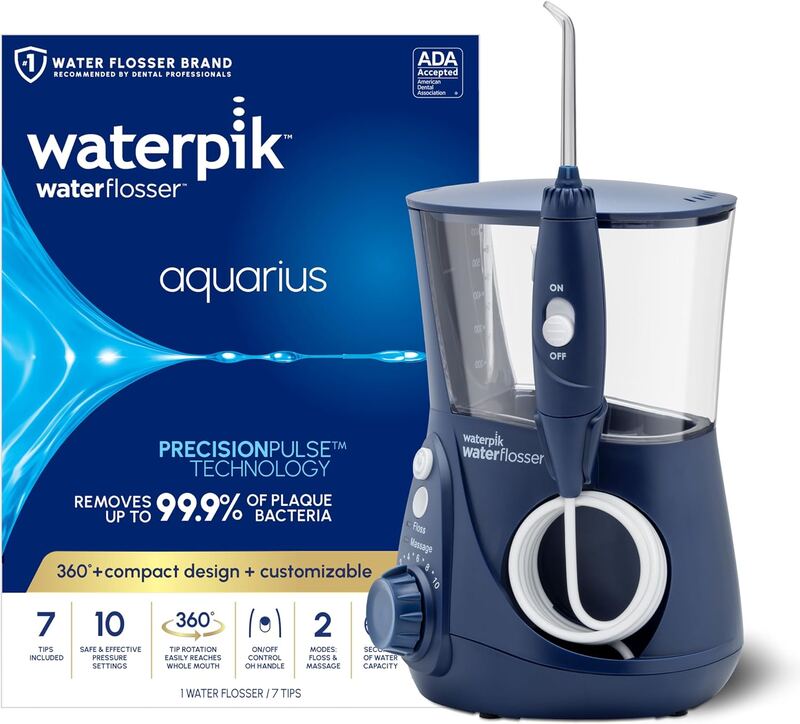
The Waterpik ION Professional Water Flosser (WF-12) runs from a rechargeable battery, where the Waterpik Aquarius has to stay plugged in. Electric Teeth, which reviewed both, makes the Aquarius its first choice for a countertop flosser and found the ION's nozzle harder to rotate; the ION Professional's tank holds 20 ounces against the Aquarius's 22.
Rating sources
“The Ion Cordless Water Flosser is an amazing device that gives your nonflossing patients a better choice for interproximal plaque control.”
Counts as 3.72/5 in our score — this publisher's 7 scores on the site average 4.64, so its scores are adjusted down to compare fairly with other publishers.
Our 3.7 score is the average of the 1 scored review above, each adjusted for how strictly its publisher scores; 1 more reviewed it without printing a score and is not in the average. More about methodology.