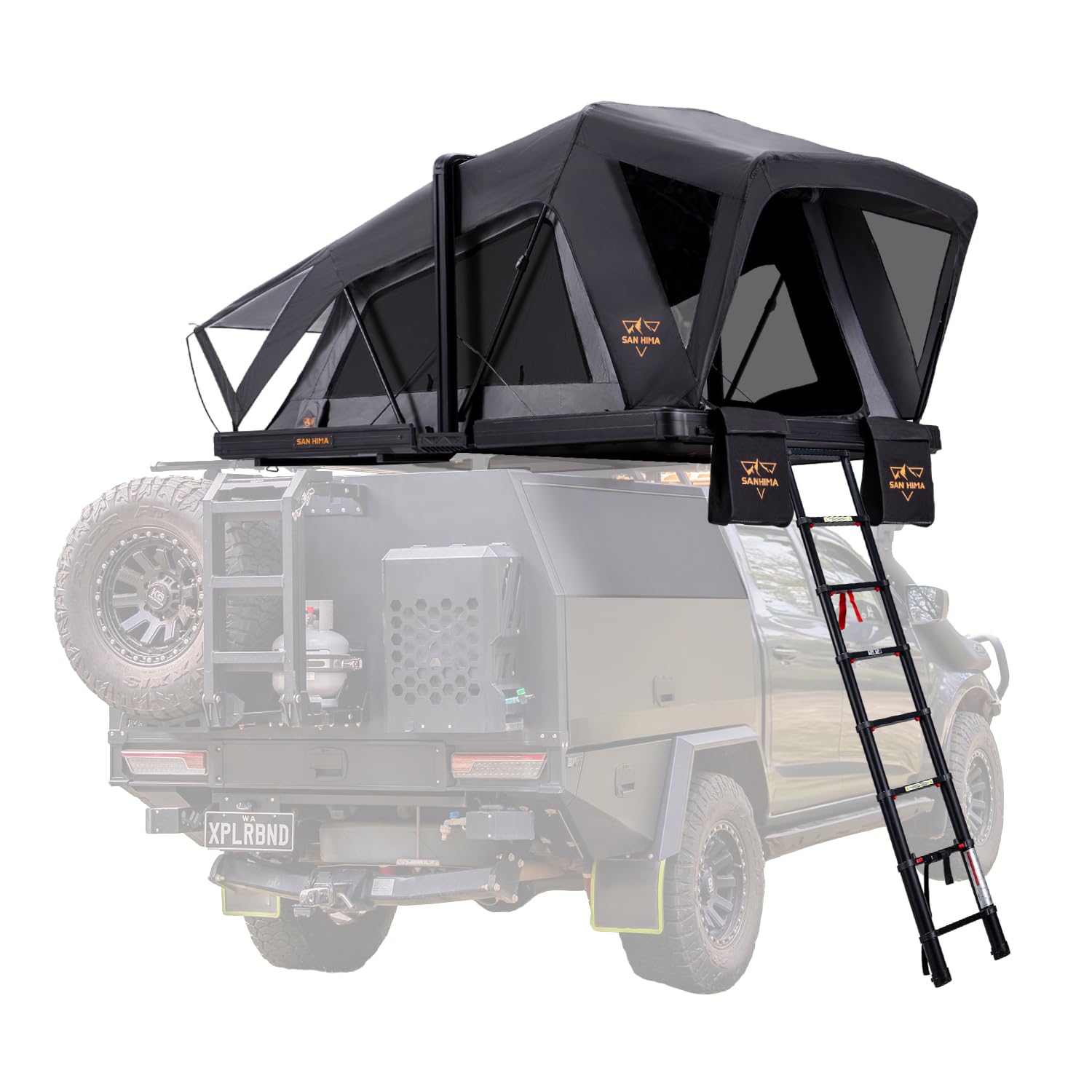
The SanHima Hotham Rooftop Tent offers a slim 5.43-inch profile that reduces wind drag and allows garage storage, with thebest-campgear noting its rapid 30-second deployment via gas struts. While OverlandZAM confirmed the ease of setup, The Traveling Together Journal noted that the heavy weight negatively impacts vehicle fuel efficiency and handling, and both reviewers found solo installation difficult without assistance. The Traveling Together Journal found the included memory foam mattress thin and lacking in plushness for extended comfort, and OverlandZAM noted that flat ladder rungs are uncomfortable when climbing barefoot. This hard-shell tent fits overlanders prioritizing quick setup and aerodynamic storage but may disappoint those seeking premium sleep comfort or easy solo mounting.
Full review
Slim profile and rapid deployment mechanics
The SanHima Hotham Rooftop Tent packs down to a remarkably slim 5.43 inches, a dimension that thebest-campgear notes allows it to fit easily into standard garages or undercover parking spaces while significantly reducing wind drag on the highway. This low-profile hard shell design is not merely aesthetic; it directly addresses one of the most common complaints about rooftop camping gear: the aerodynamic penalty and visual bulk of traditional soft-shell tents. By maintaining a tight, enclosed exterior when folded, the tent minimizes turbulence that can cause rattling or increased fuel consumption at highway speeds.
Once parked, the transition from travel mode to campsite shelter is engineered for speed. Thebest-campgear reports that the tent opens in approximately 30 seconds, a timeframe made possible by internal gas struts that handle the heavy lifting of the hard shell lid. OverlandZAM confirmed this ease of use during his installation and first-night experience, noting that the setup process requires minimal physical exertion compared to traditional pole-based systems. This rapid deployment is particularly valuable for overlanders who may need to set up camp quickly as daylight fades or weather conditions deteriorate.
The internal mechanism relies on a series of latches and hinges that are accessible from the outside, allowing users to secure the tent before climbing the ladder. The Traveling Together Journal observed that this external operation is intuitive, requiring only the unfastening of side latches followed by the lifting of the lid. This design ensures that the user does not need to be inside the tent to deploy it, a safety and convenience feature that distinguishes hard-shell models from their soft-sided counterparts.
Mounting complexity and weight distribution challenges
Despite the quick setup once mounted, the installation process itself presents significant hurdles for solo users. OverlandZAM documented a real-world scenario where he struggled to position the tent on his Jeep Wrangler's roof rack because he had installed the crossbars prior to receiving the heavy unit.
The Traveling Together Journal echoed this sentiment, noting that while he managed to struggle the tent onto his camper shell crossbars solo, having assistance is highly recommended. The universal mounting system uses aluminum extrusions and plastic hand-cranked knobs, which OverlandZAM found secure enough for standard driving but advised swapping for lock nuts if planning any off-road rock crawling or rough terrain use. This modification highlights a gap between the factory hardware and the demands of serious overlanding.
Weight distribution is another critical factor that reviewers emphasized. Thebest-campgear warns that while the integrated crossbars are rated to carry 220.5 pounds, users must verify their vehicle's specific roof load limits. OverlandZAM had to shift his forward and rear crossbars closer together to support the majority of the tent's weight in the middle, demonstrating that standard rack spacing may not be optimal for this specific model. Improper balancing can lead to stress on the mounting points or uneven handling while driving.
Interior space and comfort limitations
The interior dimensions of the Hotham are designed to sleep three people, but reviewer experiences suggest that comfort varies significantly based on user height. OverlandZAM, who is six feet tall, found ample room to stretch out fully without his toes touching the end wall, indicating that the internal length is sufficient for most average-to-tall adults. The Traveling Together Journal also noted the generous headroom and spaciousness when the tent is fully deployed, allowing for easy movement inside.
However, the included mattress has drawn mixed reactions regarding long-term comfort. In contrast, OverlandZAM and The Traveling Together Journal both found the standard mattress to be thin and lacking in plushness. The Traveling Together Journal specifically mentioned that while the dense foam prevents users from feeling the aluminum floor directly, it is not the most comfortable sleeping surface for extended trips.
To mitigate this, many owners opt to replace the stock mattress with thicker self-inflating alternatives. OverlandZAM noted that he replaced the included foam with a self-inflating mattress to accommodate his bedding more comfortably, suggesting that while the base tent is functional, upgrading the sleep system is often necessary for optimal comfort. The anti-condensation mat provided underneath helps add a layer of softness and thermal insulation, but it does not fully replace the need for a higher-quality foam pad.
Ventilation trade-offs in wet conditions
The Hotham features three doors and four windows, providing excellent airflow when all openings are utilized. Thebest-campgear highlights this ventilation system as a key feature for maintaining interior comfort and reducing condensation buildup during cooler nights. OverlandZAM appreciated the ability to watch the stars through the mesh ceiling panels, describing it as a romantic and immersive camping experience that enhances the feeling of being outdoors.
However, The Traveling Together Journal pointed out a significant functional trade-off when weather turns severe. While the side doors have mosquito screens, they lack rainflies; only the rear door has a full rainfly cover. In a tropical rainstorm or heavy wind-driven rain, users are forced to close all side openings to stay dry, which drastically reduces air circulation and can lead to a sweaty, stuffy interior environment.
This limitation is inherent to the hard-shell design where side panels cannot be covered without detaching them entirely. OverlandZAM noted that while the tent held up well in wind with minimal noise from the rainfly flapping, the inability to have both ventilation and full weather protection on all sides simultaneously is a compromise shoppers must accept. The blackout capability of the fabric helps keep the interior cool during sunny days, but it does not solve the airflow issue when windows are sealed against precipitation.
Ladder ergonomics and material durability
The included telescopic ladder is a functional component that reviewers found adequate for standard use but lacking in ergonomic refinement. OverlandZAM specifically noted that the rungs are flat rather than angled, making climbing barefoot uncomfortable due to the pressure on the arches of the feet. This detail, while minor, impacts the daily experience of entering and exiting the tent, especially during early morning departures or late-night returns.
Durability testing in harsh environments has been positive so far. The Traveling Together Journal took the tent through hundreds of miles of dirt roads on the Baja Peninsula, where it was coated in sand, silt, and salt. Despite this abuse, the aluminum construction showed no signs of frame fatigue or structural play after repeated opening cycles. The 5,000 mm waterproof rating held up under sustained spray tests described by thebest-campgear, with taped seams showing no leaks.
One quality control issue was identified by OverlandZAM during his initial setup inspection. He discovered a rip in one of the interior mesh panels right out of the box, which he attributed to shipping damage rather than a manufacturing defect. This incident highlights that while the materials themselves are robust, careful inspection upon arrival is necessary to ensure no transit-related damage has occurred before relying on the tent for extended trips.
Storage capacity and accessory integration
The top of the Hotham features integrated crossbars that are rated to carry up to 220.5 pounds, offering substantial utility for carrying additional gear such as solar panels, traction boards, or luggage. OverlandZAM mounted a solar panel and traction boards on these racks, demonstrating their practical application for overlanding setups where every pound of payload matters. This external storage capability allows users to keep the interior of the tent uncluttered by moving bulky items outside.
Inside the tent, storage is managed through ceiling pockets and side compartments. Thebest-campgear notes eight storage pockets and a dedicated shoe bag that slides into an aluminum extrusion on the exterior. OverlandZAM praised the shoe bag for its spaciousness and buckling clips, which prevent it from flapping in the wind. These organizational features help keep small items like headlamps, books, and water bottles within easy reach without taking up valuable sleeping space.
The Traveling Together Journal found the ceiling pockets convenient for storing frequently used items, though he noted that thick blankets or bedding can make closing the tent difficult if stored inside during travel. This suggests that users need to be strategic about what remains in the tent while driving versus what is packed away on the roof racks. The integration of these storage solutions contributes to a tidy interior but requires disciplined packing habits.
Strengths
- +Slim 5.43-inch packed height reduces wind drag and allows undercover garage storage
- +Rapid ~30-second setup using gas struts for quick deployment
- +Strong weather protection with a 5,000 mm waterproof rating and insulated honeycomb floor
- +Integrated crossbars rated to carry up to 220.5 lbs of rooftop gear
Watch-outs
- −Heavy weight (160.9 lbs without the ladder) negatively impacts vehicle fuel efficiency and handling
- −Standard ladder rungs are flat, causing discomfort when climbing barefoot
- −Included memory foam mattress is thin and may lack sufficient comfort for some users
How it compares
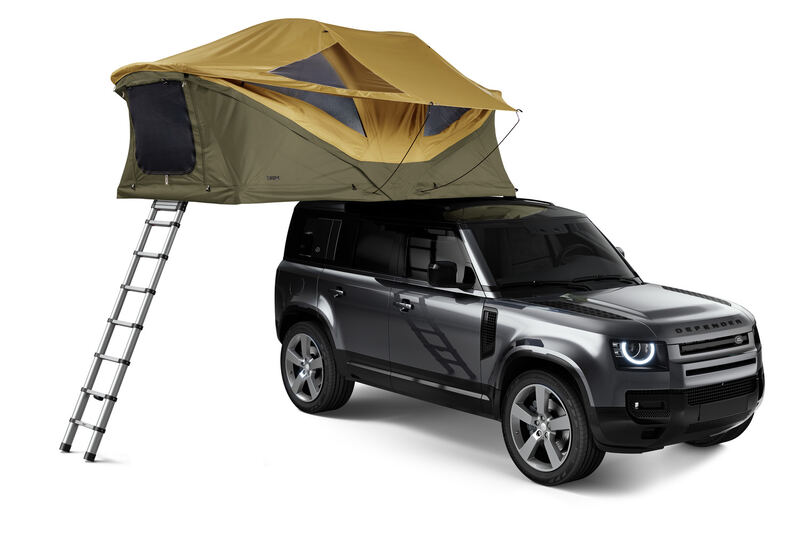
It also deploys in roughly 30 seconds via gas struts, which is faster and more automated than the manual fabric unfolding required by the Thule Approach M.
Rating sources
“I love it it serves the purpose that I want it to serve... The Neighbors were saying that it's super cool the kids love it Amanda loves it”
“I'd say that sanima has accomplished this with the calari Gen 2 tent while offering a nice amount of internal space and features at a very competitive price”
Our 4.3 score is the average of the 2 scored reviews above; 1 more reviewed it without printing a score and is not in the average. Ratings marked * were derived from the reviewer’s written analysis or video transcript — the publisher didn’t print an explicit numeric score, so we inferred one from their own words. Click through to verify. More about methodology.