Purple's Harmony takes an engineering-first route to cooling. Rather than PCM fabrics or gel coatings, it wraps a 360-degree GelFlex Hex polymer grid around a ventilated Talalay latex core, moving air through the whole pillow body. Reviewers consistently rate it 5/5 for temperature regulation. The feel is unusual and not for everyone, but cooling performance ranks among the best in the category.
Full review
Airflow-driven cooling for consistent temperature control
Purple's approach to cooling is the most structurally different in this lineup. Where Coop and Slumber Cloud use cool-touch covers and Saatva relies on shredded latex airflow, the Harmony pairs a ventilated Talalay latex core (full of pin-hole channels) with Purple's signature Hex GelFlex grid wrapped around it. The grid alone contains more than 1,500 open-air channels, and the mesh cover is engineered to move sweat off your skin rather than absorbing it.
Mattress Nerd reviewer Becca Fair gave the cooling a perfect 5/5: 'Every element of this pillow has cooling features, making it a great choice for hot sleepers. The cover is punctured with hundreds of tiny air holes that promote breathability.' Sleep Advisor's Julia Forbes reached the same conclusion: 'The pillow is unlikely to retain heat or warm you, so I consider it a good option for those who sleep hot.' Tom's Guide was more measured — their tester, despite acknowledging all the cooling engineering, said they 'still slept warm most nights' — which underscores that personal heat tolerance still varies.
Where the Harmony's cooling story differs from PCM-coated competitors is that it doesn't rely on a temperature-saturating buffer — instead, it just gets out of the way and lets air move. The 1,500+ open-air channels in the Hex grid create direct paths for warm air to escape from under your head, and the latex pinhole structure underneath does the same job through the support layer. There's no thermal capacity to saturate, so the cooling effect is essentially constant across an entire night, but it's also not as aggressive on initial contact as a PCM cover. Reviewers who've tested both styles describe this as 'cooler all night, less cold at first.'
Responsive grid provides dynamic pressure relief
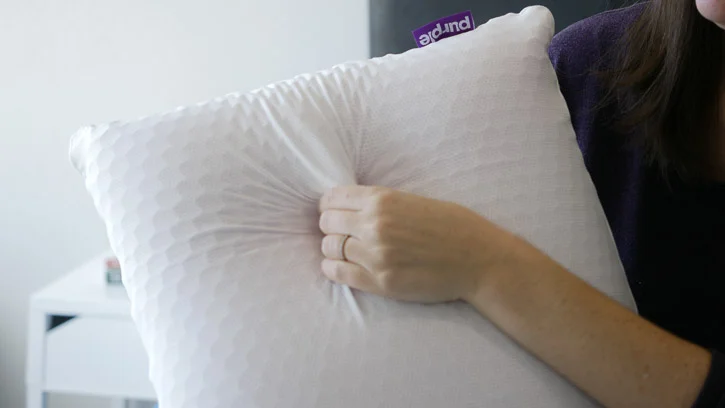
The Harmony feels nothing like a traditional pillow. The Hex grid gives it a responsive, buoyant push-back that's closer to a memory-foam mattress than to a fiberfill or down pillow. Your head doesn't sink in; it gets cradled by the grid flexing around your shape. Some reviewers love this — they describe it as weightless or pressure-free — and some find it odd or springy.
Sleep Advisor's Julia Forbes captured the unique feel: 'The cover of the Purple Harmony has pin-prick detailing reminiscent of a jersey and a polymer grid design that allows air to flow freely through this pillow.' The mesh cover has a noticeable texture you can feel through a thin pillowcase. If you've slept on Purple's mattresses you'll recognize the sensation; if you haven't, it's worth using the trial period to know whether the feel works for you before committing.
The grid's flexing action delivers a kind of dynamic pressure relief that fixed-fill pillows can't replicate. As you shift positions overnight, the Hex polymer flexes independently under each pressure point — so a pillow set up for back sleeping cradles your skull, then re-shapes when you roll to your side and need shoulder clearance. This continuous reshaping is part of why the Harmony scores so well for combo sleepers; static-fill pillows require you to manually punch and reshape between positions.
A Hex grid made from Purple's mattress material
The Hex grid is made from Purple's proprietary Hyper-Elastic Polymer, the same material in their mattresses. It's a stretchy, durable thermoplastic that flexes individually under each pressure point — so the grid cradles your skull while letting air move freely between channels. Wrapped around a solid ventilated Talalay latex core, it gives you three layers of cooling: the moisture-wicking mesh cover, the Hex grid airflow, and the latex pin-holes.
The cover is 92 percent nylon, 8 percent spandex — a moisture-wicking stretch knit that's washable on its own but not removable from the pillow in the way most cooling pillow covers are. That's a downside on cleaning, but the trade-off is that the cover stretches with the grid rather than fighting against it.
Fixed loft heights require careful selection
Purple offers the Harmony in three fixed loft heights — Low 5.5 inch, Medium 6.5 inch, Tall 7.5 inch — across Standard and King sizes. Picking the right loft is more important than with an adjustable pillow because there's no way to dial it after the fact. Most back and stomach sleepers want Low; most side sleepers want Medium or Tall depending on shoulder width.
The fixed-loft design is divisive. Reviewers who want set-and-forget appreciate it; reviewers who want to customize feel the lack of adjustability is a real miss at this price point. There's no shredded-fill option in the Harmony line — for Purple's adjustable take, you'd look at the Purple Cloud pillow instead.
Tom's Guide found pulls in the mesh cover
The mesh cover is removable and machine-washable; the latex core and Hex grid are spot-clean only. The grid is the most durable component — Hyper-Elastic Polymer is rated for years of nightly use without breaking down, and it doesn't compress over time the way memory foam does. The ventilated latex core has the typical 5-7 year lifespan of any Talalay latex product.
Tom's Guide's month-long test surfaced one concern: 'the pillow had some pulls in the mesh cover.' The cover is thin by design — that's how it stays moisture-wicking — but it's not invincible to fingernails or rough sheets. If you're hard on bedding, expect to need a replacement cover at some point during the pillow's lifetime.
Testers reported feeling warm despite the engineering
At $179 for the Standard Medium, the Harmony is the most expensive pillow in this lineup. The 1-year warranty is also the shortest — Saatva offers lifetime, Coop 5 years, Slumber Cloud no formal warranty but a long replacement track record. The combination means you're paying premium for premium cooling tech without a long-term insurance policy.
The grid feel is the bigger functional gamble. Some hot sleepers love the springy, weightless cradle; others find it too responsive and miss the conforming feel of foam or latex shredded fills. Tom's Guide noted some testers 'still slept warm most nights' despite all the cooling engineering — a reminder that no pillow fully overcomes a hot bedroom or heavy bedding.
The most aggressive whole-pillow airflow design
Pick the Harmony if you want maximum overnight airflow and you're open to a pillow that feels nothing like the foam, down, or fiberfill pillows you grew up with. It's the best fit for hot sleepers who've tried every other cooling pillow and still wake up overheated — Purple's whole-pillow airflow design is the most aggressive answer to that problem in the category.
Skip it if you prefer the conforming feel of memory foam or shredded latex, if you have a strict budget cap under $150, or if you need an adjustable loft. For those buyers, the Coop Cool+ (adjustable foam) or Saatva Latex (shredded latex feel) will be a more familiar experience with most of the cooling benefit.
More cooling than the Saatva, minus the warranty
Versus the Saatva Latex Pillow, the Harmony is the more cooling option because of the Hex grid, but the Saatva has a more familiar feel and a lifetime warranty. Versus the Coop Cool+, the Harmony wins on whole-pillow airflow but loses on adjustability and on initial cool-to-touch sensation.
Versus the Slumber Cloud UltraCool, the two pillows perform roughly equivalently on overnight temperature, but the Harmony's responsive bounce-back support is a different feel from the UltraCool's soft fiberfill cradle. Versus the Cozy Earth Silk Pillow, the Harmony is in a different universe — Cozy Earth is for buyers who want a passive, naturally-breathable luxury pillow; the Harmony is for buyers who want engineered cooling at any feel cost.
Strengths
- +GelFlex Hex grid contains 1,500+ open-air channels for industry-leading airflow
- +Ventilated Talalay latex core has thousands of pin-holes that further amplify cooling
- +Three loft heights (Low 5.5", Medium 6.5", Tall 7.5") fit any sleep position
- +Moisture-wicking nylon-spandex mesh cover wicks sweat away rather than absorbing it
- +Sleep Advisor scored cooling 5/5 — 'every element of this pillow has cooling features'
Watch-outs
- −Most expensive pillow on this list at $179 standard medium
- −Hex grid feel is polarizing — some find it cradling, others find it springy and odd
- −Mesh cover developed pulls in Tom's Guide's month-long test
How it compares
The most engineering-forward cooling pillow in this lineup — the Hex grid and ventilated latex deliver more raw airflow than the Coop Cool+ or Slumber Cloud UltraCool, both of which lean on surface cooling tech. The trade-off is feel: Purple's responsive bounce-back is unique. Saatva Latex shares a latex core but uses shredded latex (more conforming) while Purple uses solid latex with a polymer grid wrapped around it (more buoyant). Coolest on whole-pillow airflow, less cool on contact than the Cool+ or UltraCool. Cozy Earth Silk feels like a different category entirely.
Rating sources
“Every element of this pillow has cooling features, making it a great choice for hot sleepers.”
“The pillow is unlikely to retain heat or warm you, so I consider it a good option for those who sleep hot.”
Our 4.3 score is the average of these published ratings. More about methodology.