Tech Floww found that Philips Hue utilizes CSP micro LED technology to create a seamless, uniform light source without visible hot spots, while NotebookCheck confirmed this effect is enhanced by a premium silicone diffuser. The RGBWWIC configuration delivers punchy saturated colors and true white illumination with brightness scaling up to 4,500 lumens on the longer variants for functional room lighting. However, Hueblog.com reported that the integrated double-sided adhesive is weak and often requires aftermarket mounting aids like Tesa Powerbond to prevent failure. Additionally, the protective film is interrupted every 20 centimeters, making installation tedious compared to continuous liner designs. This strip suits users seeking high-quality visible ambient lighting who can manage its fixed length and mounting challenges, but those needing easy ceiling attachment or flexible extension options should look elsewhere.
Full review
CSP technology eliminates visible LED dots
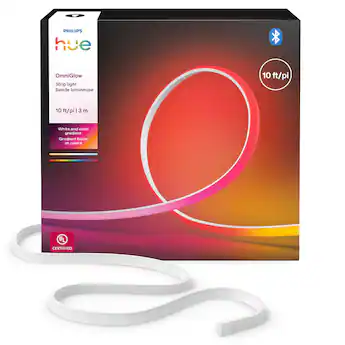
The defining characteristic of this light strip is its ability to produce a completely seamless line of illumination without the distracting hot spots common in traditional LED strips. Tech Floww explains that Philips Hue achieved this by utilizing CSP, or chip-scale packaging, technology which mounts micro LEDs directly onto the circuit board rather than using bulky plastic SMD packages. The result is a uniform wash of color and white light that looks more like a solid neon tube than a string of individual bulbs.
notebookcheck.net confirms that all three available lengths utilize this CSP technology paired with a diffuser to ensure individual light sources remain undetectable. This high density is further smoothed out by a premium white silicone sleeve that wraps the entire strip, acting as a final diffusion layer before the light exits. Because the LEDs are so densely packed and physically covered, the strip can be mounted in highly visible locations such as open stairwells or along coving without needing to hide it inside opaque aluminum profiles, which is a significant departure from how traditional smart lighting strips must be installed.
RGBWWIC setup delivers true white light quality
Beyond simple color rendering, the internal architecture of this strip uses an RGBWWIC configuration to manage both saturated colors and high-quality white illumination. This dedicated dual-white setup prevents the sickly, artificially mixed whites that cheaper strips produce when they rely solely on blending RGB channels together. The inclusion of true white diodes ensures that functional lighting tasks are supported by proper color temperature accuracy rather than just aesthetic ambiance.
Brightness scales with length for room illumination
The product is available in three fixed lengths, and the brightness output varies significantly between them to accommodate different spatial requirements. The 3-meter version peaks at 2,700 lumens; stepping up to either the 5-meter or the 10-meter variant raises the peak brightness to 4,500 lumens while maintaining a 60-watt draw across both lengths. This means the longer strips distribute that high lumen output over a greater distance rather than increasing total intensity.
Slim profile allows visible surface mounting
The physical dimensions of the strip are specifically engineered to be unobtrusive when mounted on surfaces. Tech Floww highlights that this slim form factor, combined with the smooth silicone sleeve, removes the absolute necessity for external mounting tracks or diffusers that are typically required to hide LED dots on standard strips.
Weak adhesive compromises ceiling installation
Despite the premium build quality of the lighting elements themselves, the mechanical attachment method has drawn sharp criticism from users attempting visible installations. Hueblog.com reports that a reviewer installing a 10-meter strip in a stairwell found the integrated double-sided tape to be entirely insufficient for permanent mounting on ceilings. The adhesive failed within minutes, forcing the user to resort to heavy-duty aftermarket alternatives like Tesa Powerbond to keep the strip attached to the wall or ceiling.
Interrupted protective film creates tedious setup
The installation process is further complicated by the design of the adhesive backing's protective liner. Hueblog.com notes that the plastic film covering the glue is not continuous; instead, it is interrupted every 20 centimeters with small gaps in between. For a long run such as an 8.75-meter stairwell installation, this forces the user to peel off and discard dozens of tiny individual strips of liner rather than pulling one long sheet away. This design choice makes the initial setup feel unrefined and unnecessarily tedious for what is otherwise positioned as a high-end product.
Short controller distance limits hidden placement
A persistent hardware limitation affects how cleanly this strip can be integrated into furniture or tight spaces. Because the OmniGlow is designed to be seen, hiding the small white controller box away from view becomes difficult when it must sit immediately adjacent to the illuminated section. While third-party retailers offer extension cables to bridge this gap, Philips Hue does not provide an official solution for increasing this distance out of the box.
Non-extendable design restricts length flexibility
Unlike other models in the updated Hue lineup that can be physically extended with connectors, the OmniGlow is sold only as fixed-length units. This means buyers must accurately measure their space and purchase the exact required length upfront, with no ability to add more segments later if they misjudge the dimensions.
Strengths
- +Uses CSP (chip-scale packaging) micro LED technology to deliver seamless, uniform light with no visible individual LEDs or hot spots.
- +Offers high brightness levels up to 4,500 lumens on the 5 m and 10 m variants, making it suitable for functional room lighting rather than just ambiance.
- +Features an RGBWWIC color setup that provides punchy saturated colors alongside dedicated warm and cool white LEDs for true white light quality.
- +Designed with a slim profile (17 mm wide) and a premium silicone sleeve that allows for visible installation without needing hidden profiles.
Watch-outs
- −The integrated double-sided adhesive tape is reported to be weak, often requiring additional mounting aids like Tesa Powerbond to prevent the strip from falling off.
- −The protective film on the adhesive backing is interrupted every 20 centimeters, creating a tedious installation process with many small strips to peel off.
How it compares
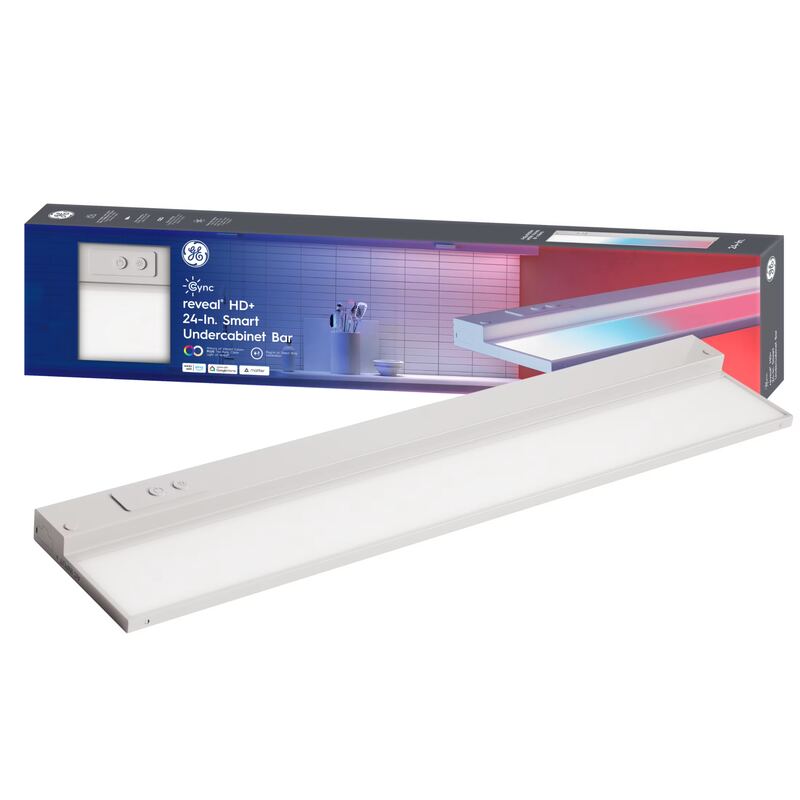
With brightness scaling up to 4,500 lumens and a color temperature range of 1000K-20000K, this strip vastly outperforms the GE Cync Reveal (1150 lm) and WOBANE (~1500 lm) in both output and white light versatility. It uses CSP micro LED technology for uniform illumination without hot spots, a feature not highlighted in the other products' specs. However, its fixed, non-extendable lengths and weak adhesive tape present different installation challenges compared to the modular or daisy-chainable designs of the WOBANE and GE Cync kits.
Rating sources
Counts as 4.42/5 in our score — this publisher's 195 scores on the site average 4.25, so its scores are adjusted down to compare fairly with other publishers.
“That's exactly what the Philips Hue Omniow promises to do. And in this video, you'll see how easy it is to set up, and whether it's worth the price.”
Not in the average — we derived this score from the review's words, and a publisher printed a score for this product, so the printed number counts instead.
Our 4.4 score is the average of 1 of the scored reviews above, each adjusted for how strictly its publisher scores; 2 more reviewed it without printing a score and are not in the average. 1 derived score above is not in the average because a publisher printed a score for this product. Ratings marked * were derived from the reviewer’s written analysis or video transcript — the publisher didn’t print an explicit numeric score, so we inferred one from their own words. Click through to verify. More about methodology.