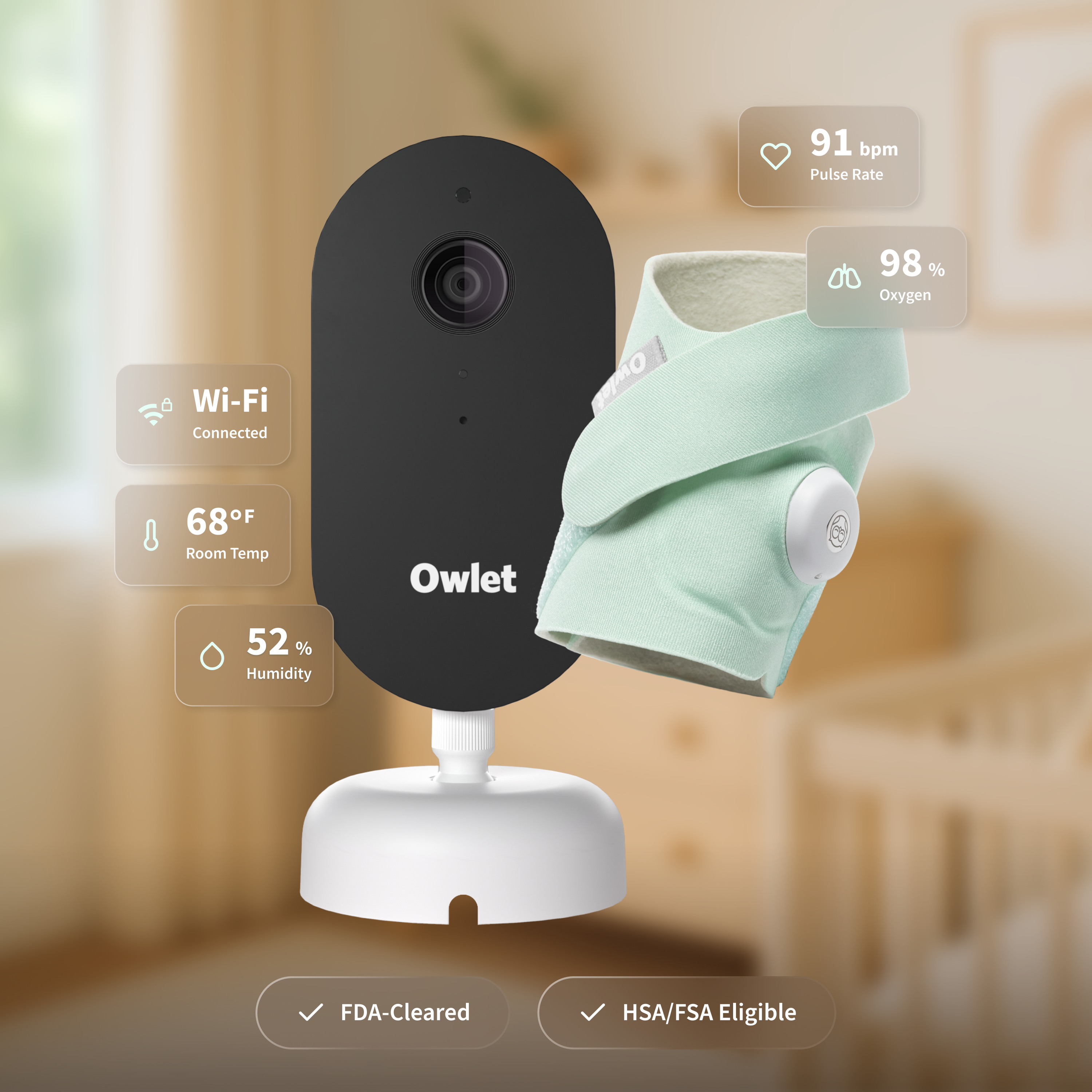
Only one consumer baby monitor carries FDA-cleared pulse oximetry: the Owlet Dream Duo 3, which pairs a wearable Dream Sock tracking oxygen + heart rate with a 2K HD camera. It costs more than anything else on this list, and it justifies that best for anxious newborn parents who want vital-sign data rather than just an image. The Wi-Fi requirement and the sock-outgrowth window are the structural trade-offs.
Full review
Oxygen readings within 3 percent of hospital-grade tests
The Owlet Dream Duo 3 is the only product in this category that gives parents direct, FDA-cleared physiological data about their baby. The Dream Sock — a soft fabric foot wrap with embedded pulse oximetry sensor — measures oxygen saturation and heart rate continuously through the night, with alerts that fire if either reading drops below the FDA-defined safe range. The clearance as a Class II medical device is meaningful: it means the FDA reviewed the device's accuracy data, not just its safety. Owlet publishes that the Sock reads 'within +/- 3% of gold-standard arterial blood gas measurements,' which is genuinely good consumer-device accuracy.
The 2K HD Dream Sight camera that ships in the Duo bundle is the camera-only piece — 2K resolution (3840×2160 capable but typically streamed at 2K), 130-degree wide-angle lens, color night vision rather than IR. Tom's Guide and Reviewed both ranked it among the better-performing cameras tested, though both noted that Wi-Fi reliability and app latency are the limiting factors more than image quality.
Sock fully charges in 20 minutes for 8 hours
The Dream Sock is a deceptively well-engineered piece of soft goods — washable fabric exterior, integrated sensor pod that snaps in and out for charging, and a sock-cuff design that stays on through normal sleep movement. Owlet ships size options 0-18 months, and parents on the product forums consistently report the sock is comfortable enough that most babies tolerate it without complaint. The standout build claim is the rapid-charge battery: 8 hours of runtime in a 20-minute top-up, which is the difference between 'unusable when you need it' and 'always ready.'
The camera itself is a standard tabletop/wall-mount design, similar in form to the Nanit Pro but smaller. Mounting hardware is included for both wall and floor stand configurations.
Core vital-sign alerts work without any subscription
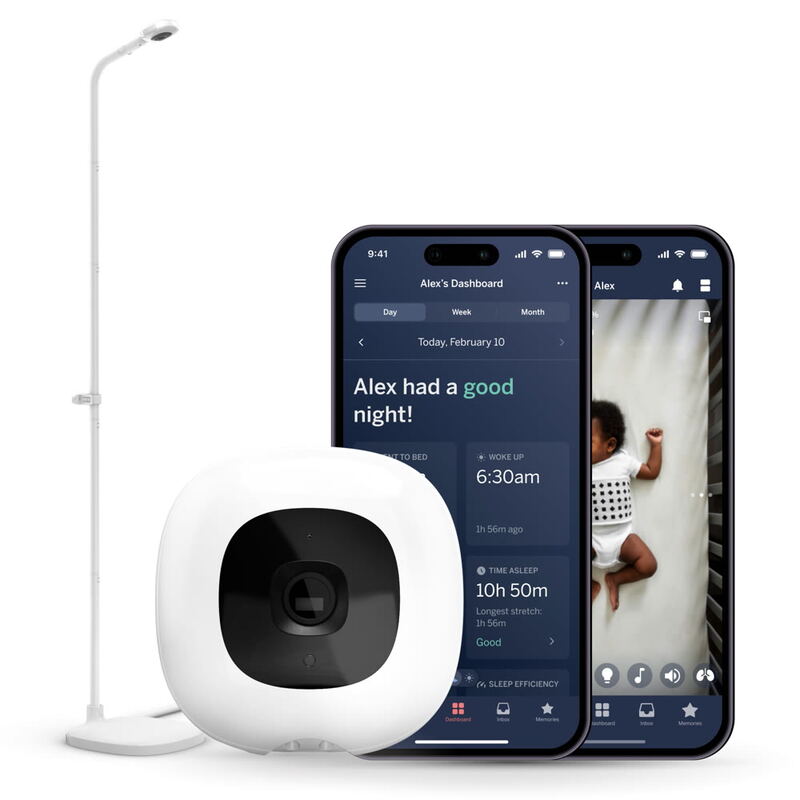
Owlet's Dream App handles both the camera stream and the Sock vitals data in a single interface. Setup walks through Bluetooth pairing for both devices, then hand-off to home Wi-Fi (the system supports dual-band 2.4 and 5 GHz). The dashboard displays real-time oxygen percentage, heart rate, sleep state (deep/light/awake), and a movement timeline.
Owlet360 ($9.99/month) is the optional subscription tier that unlocks 'Predictive Sleep Insights' — algorithmic recommendations based on multi-night pattern data. Core monitoring, including the vital-sign alerts that are the actual reason most parents buy the Owlet, works fully without a subscription. This is a meaningfully better subscription posture than the Nanit Pro's $99/year gating of all sleep analytics.
Parents say it helped them sleep through the night
Reviewed.com called out the app specifically — 'easy to use yet provided a lot of detail parents may want when not with their child' — and noted that the peace-of-mind value for first-time parents in the newborn window is substantial. Best Buy customer reviews on the Dream Duo 2 (the previous-gen bundle) average 4.5+ stars across thousands of reviews, with the consistent theme being 'this helped me sleep through the night for the first time since the baby came home.'
The FDA clearance carries weight even for parents who never need an alert to fire — it's the structural difference between a consumer-grade sleep tracker and a regulated medical device. For parents of preterm or NICU-graduate babies, this is often the only consumer monitor a pediatrician will recommend.
False low-oxygen alerts when the sock shifts
Reviewed's framing is fair: 'impresses but it's not flawless.' The two recurring complaints in user reviews are occasional false low-O2 alerts when the sock loses skin contact during active sleep (resolvable by repositioning, but disrupts sleep), and Wi-Fi-dependent reliability that breaks the entire system during internet outages. Owlet has improved the false-alert rate substantially with Dream Sock firmware updates over the years, but it's not zero.
The Dream Sock is sized for 0-18 months, which means the most useful component of this bundle has a finite useful life. After the baby outgrows the sock, you're left with a $150-equivalent camera and an app that can no longer offer health tracking. Parents planning to use the same monitor through age 2-3 should weigh that calendar against the upfront $380. Some parents on Best Buy reviews also flagged that the Wi-Fi pairing process can be finicky on dual-band routers where the Sock and camera need to negotiate between 2.4 and 5 GHz bands — though Owlet's support team is responsive when this happens.
Recommended for parents of preterm or NICU graduates
Buy the Owlet Dream Duo 3 if you want vital-sign monitoring and the peace of mind that comes with FDA-cleared pulse oximetry — particularly worth it for first-time parents in the newborn window, parents of preterm/NICU-graduate babies, or parents with a family history of cardiac or respiratory conditions where early-detection alerting is meaningfully valuable.
Skip it if you're comfortable with computer-vision breathing tracking (the Nanit Pro is $80 cheaper and uses no wearable), if you specifically want airgap privacy (Infant Optics DXR-8 Pro), or if you're past the newborn-anxiety window and just want a basic monitor. The Dream Duo's premium is justified by the medical-grade tracking; if you don't need that, you're overpaying for features you won't use.
Redesigned after a 2021 FDA warning letter
Owlet has had a turbulent regulatory history that's worth understanding before buying. The original Owlet Smart Sock 2 was effectively pulled in 2021 after an FDA warning letter required the device to be cleared as a medical device. The current Dream Sock is the post-clearance redesign and is sold as an FDA-cleared Class II medical device — meaning the regulatory questions that haunted earlier generations have been resolved. The Dream Duo 3 ships under this updated regulatory framework, and the company has stabilized considerably since the 2021 incident.
From a product longevity standpoint, the camera component will outlast the Sock — the Dream Sight camera is sized for the room, not the baby, and works as a standalone Wi-Fi cam after your child outgrows the wearable. Owlet's app ecosystem has been improved iteratively over the past few years and the current Dream App is the most stable release the company has shipped. Firmware update cadence has stabilized at roughly quarterly, with most updates focused on alert-accuracy refinement and additional sleep-insight metrics rather than disruptive UI redesigns — a meaningful shift from the chaotic 2021-2022 period when Owlet was navigating both the FDA process and a public-company merger.
The only monitor here with FDA clearance
The Owlet Dream Duo 3 is the only consumer baby monitor on this list with FDA-cleared health monitoring. The closest functional equivalent for breathing alerts is the Nanit Pro's Breathing Band, which uses computer vision to track chest movement — meaningfully less precise than pulse oximetry, and not regulated as a medical device, but completely passive (no wearable, no skin contact). For pure peace-of-mind value, the Nanit Pro is genuinely an alternative; for clinical-grade vital tracking it isn't.
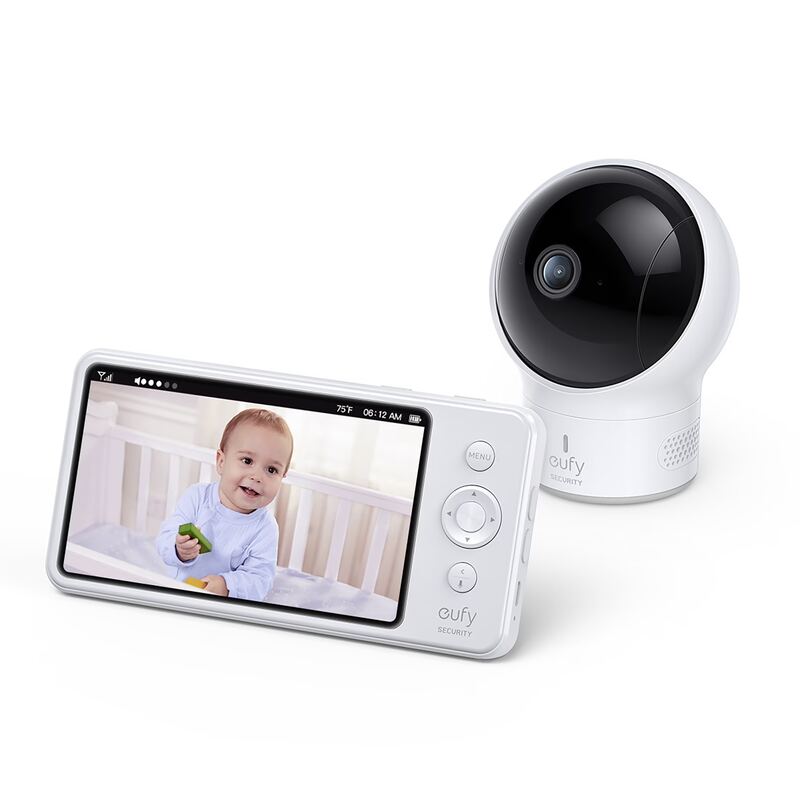
Against the Eufy SpaceView Pro and Infant Optics DXR-8 Pro, the Owlet is a fundamentally different product category — those are video monitors that don't measure anything about the baby's body, while the Dream Duo is a medical-adjacent monitoring system that happens to also include a camera. The right way to think about the Dream Duo is as a hospital-style monitoring kit for the home, with a baby cam included; the right way to think about the closed-loop monitors is as glorified intercoms with cameras. Both have a place — the question is which one matches your specific anxiety: is it 'I can't see the baby' (the closed-loop monitors solve that) or 'I can't tell if the baby is breathing' (only the Owlet directly answers that)?
Strengths
- +FDA-cleared as a Class II medical device for pulse oximetry — the only consumer baby monitor with this clearance
- +Dream Sock tracks oxygen levels, heart rate, sleep cycles, movement, and waking events directly from the baby
- +2K HD Dream Sight camera with 130-degree wide-angle lens, 4x digital zoom, and color night vision
- +No subscription required for core monitoring features (optional Owlet360 upgrade is $9.99/month)
- +Dream Sock battery: 16 hours of runtime with an 8-hour full charge in just 20 minutes
Watch-outs
- −Premium price — $380 puts it at the top of the consumer baby monitor range
- −Requires Wi-Fi for both the camera stream and the Dream Sock health alerts
- −Dream Sock outgrows the baby — sized for 0-18 months, so the wearable component has finite useful life
- −Some parents report occasional false low-O2 alerts when the sock loses skin contact during active sleep
How it compares
Only product on this list with FDA-cleared health vital tracking — the Nanit Pro tracks breathing via computer vision but doesn't measure oxygen or heart rate directly. More expensive than the Nanit Pro by ~$80 and shares the Wi-Fi dependency. Fundamentally different from the Infant Optics DXR-8 Pro and Eufy SpaceView Pro, which don't measure anything about the baby's body.
Rating sources
“Owlet Dream Duo impresses but it's not a flawless baby monitoring system. The app was easy to use yet provided a lot of detail parents may want when not with their child.”
Our 3.3 score is the average of these published ratings. Ratings marked * were derived from the reviewer’s written analysis or video transcript — the publisher didn’t print an explicit numeric score, so we inferred one from their own words. Click through to verify. More about methodology.