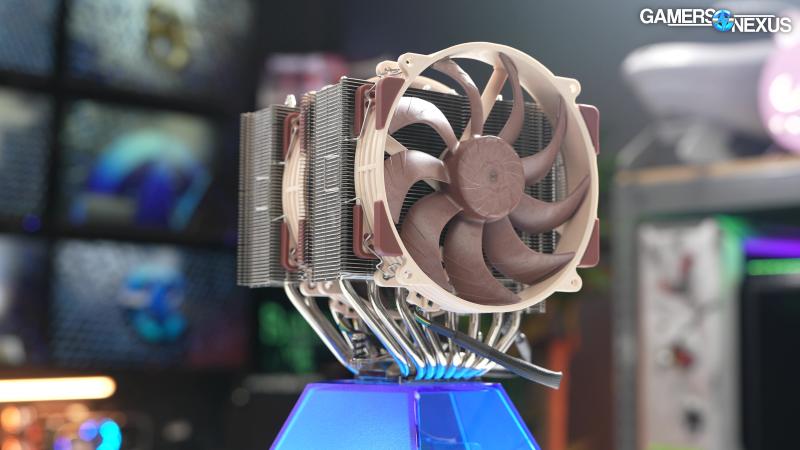
GamersNexus reviewed the Noctua NH-D15 G2 as the company's first major dual-tower cooler since 2014, noting it's the most expensive air cooler tested at $150. The cooler features 8 heatpipes and three cold plate variants designed for different CPU IHS styles. While it offers strong thermal performance and acoustic benefits with its new NF-A14 G2 fans, reviewers found it less performant and more costly than competing liquid coolers. This makes it best suited for users prioritizing air cooling over liquid solutions, though those seeking maximum performance may want to consider alternatives.
Full review
Dual-tower design evolution
Noctua's NH-D15 G2 represents the company's first major dual-tower cooler launch since 2014, featuring an upgraded design with eight heatpipes compared to the original's six. GamersNexus measured the standard model's cold plate curvature using a 3D laser scanner with 0.5-micron vertical repeatability, finding it slightly convex with a central spike from anti-reflective coating that can be ignored. The company's engineering approach involved tuning the curvature of the coldplate to match different CPU IHS styles, resulting in three variants: standard, HBC (high base convexity), and LBC (low base convexity). The HBC model is designed for Intel CPUs with concave heat spreaders, while the LBC model suits flat AMD CPUs like AM4 and AM5. The standard model serves as a balanced all-arounder, though Noctua avoids labeling them as brand-specific to account for potential socket and clamp changes over the next decade.
Club386 noted that the NH-D15 G2's tower height is 145mm, significantly denser than the original NH-D15 with 23 additional fins. The fin spacing reduced from 1.9mm to 1.6mm, improving thermal efficiency. The fan stack was shortened by 5mm to better balance the two fans, and the cooler's overall dimensions are 165 x 150 x 134 mm. The new design maintains the same mounting hardware and thermal paste as previous versions, with the only differences being the cold plate curvature and the upgraded NF-A14x25r G2 fans. This upgrade allows for a more precise fit with various CPU heat spreaders, with the LBC variant offering the flattest contact patch for AMD CPUs, and the HBC variant providing better curvature matching for Intel platforms.
Fan technology and acoustic performance
The NH-D15 G2 incorporates two new NF-A14x25r G2 fans that use Noctua's PPA/PPB design to intentionally offset the RPM of each fan by 25 RPM, reducing the chance of beat frequency phenomenon. This design feature aims to eliminate intermittent vibrations that create humming sounds. GamersNexus measured the fans' airflow at 155.6 m³/h each, with a maximum RPM of 1,500, resulting in a claimed 24.8 dBA noise profile. The fans are constructed from liquid crystal polymer (LCP), a relatively expensive material that allows blade tips to be about 0.7mm away from the inner frame, maximizing performance while maintaining shape under centripetal forces. The LCP material also contributes to long-term endurance and aging resistance, which is particularly important for a premium product that's expected to last for years.
Club386 reported that the fans' slower spinning speeds contribute to the cooler's quiet operation, with the noise profile measured at 24.8 dBA, which is notably quieter than many competing air coolers. The PPA and PPB system that offsets the RPM of each fan by 25RPM helps prevent vibrations that could cause humming or beat frequencies. The NF-A14x25r G2 fans are designed to spin at lower speeds while maintaining high airflow, which is a significant improvement over standard air coolers that often compromise between airflow and noise. The fans' construction from LCP also allows for tighter blade spacing without friction, improving cooling performance while reducing noise.
Installation and compatibility
Installation of the NH-D15 G2 is straightforward, with Noctua providing a comprehensive kit that includes thermal paste, mounting hardware for all modern Intel sockets from LGA1150 through LGA1700 and 1851, and a physical brochure with step-by-step instructions. Club386 found the installation process to be simple, with clear labeling and minimal confusion. The kit includes enough screws for all major Intel platforms, along with a cleaning kit for removing excess paste from existing CPUs and an NA-TPG1 guard for AM5 processors to prevent conductive solutions from damaging the motherboard. The default mount is offset to improve contact with CCDs on AM5, but for Intel CPUs, the installation process requires careful attention to the backplate assembly and the use of washers that elevate the clamp to reduce CPU deformation.
GamersNexus noted that while the installation is generally straightforward, the LGA1700 bracket requires more nuance than other brackets. There are four washers meant to elevate the clamp and reduce CPU deformation, but these were found to be thick and difficult to thread, with no noticeable benefit in performance or aesthetics. The backplate assembly requires careful attention to the writing on the bracket to ensure proper orientation, as it's not reversible. The inner holes work for all Intel processors aside from LGA1700/1851, which use the outer holes labeled #2. The kit also includes a Y-cable and long screwdriver, which are helpful for complex installations. The overall installation process is designed to be user-friendly, with clear labeling and minimal confusion.
Thermal performance comparison
RelaxedTech's comparison between the NH-D15 and five high-end closed-loop liquid coolers showed that the NH-D15 outperforms all AIOs in terms of cooling efficiency, with the exception of the NZXT Kraken X61, which is slightly better at higher frequencies. The NH-D15's performance was measured with an ambient temperature of ~19°C, using Prime95 (Large FFTs) to deliver full CPU load for 20 minutes. The cooler's thermal performance is particularly impressive when compared to liquid coolers, which typically dissipate more heat at higher frequencies but come with the risk of leakage and component damage. The NH-D15's ability to maintain lower temperatures under load while remaining quiet makes it a strong contender for enthusiasts who prioritize both performance and noise control.
Club386's testing confirmed that the NH-D15 G2 maintains excellent thermal performance across a range of CPUs, with temperatures staying consistently low under full load. The cooler's ability to handle high TDP CPUs, exceeding 300W, makes it suitable for high-performance systems. The standard model's performance is comparable to the HBC and LBC variants, with the main differences lying in the cold plate curvature and fitment for specific CPU types. The NH-D15 G2's thermal performance is particularly notable when compared to older models, with the increased heatpipe count and improved fan design contributing to better heat dissipation.
Price and value proposition
The NH-D15 G2 is priced at $150, making it more expensive than the best cooler on GamersNexus charts, the Arctic Liquid Freezer III 360, by about $42. This premium price point reflects the cooler's advanced engineering and materials, including the use of liquid crystal polymer in the fans and the precision-tuned cold plate curvature. Club386 noted that while the price is steep, the performance justifies the cost for enthusiasts who value exceptional cooling and quiet operation. The cooler's 6-year warranty is also a strong selling point, compared to the 1-3 year warranties offered by most AIO coolers. The price difference between the standard NH-D15 G2 and the original NH-D15 is significant, with the original priced at $110, and the chromax.black version at $120, making the G2 model a premium upgrade with enhanced performance and features.
GamersNexus found that the NH-D15 G2's performance is less than that of competing liquid coolers, but the price difference is substantial. The cooler's ability to maintain low temperatures while operating quietly makes it a strong choice for enthusiasts who prioritize both performance and noise control. The G2's design and engineering reflect Noctua's nearly 10-year development process, with attention to every detail from fan acoustic-to-thermal response to cold plate curvature. While the price is high, the performance and build quality justify the cost for users who demand the best in CPU cooling.
Design and build quality
The NH-D15 G2's design is a culmination of Noctua's nearly 10-year development process, with attention to every aspect of the cooler's performance and aesthetics. The cooler's build quality is exceptional, with the use of premium materials like liquid crystal polymer in the fans and precision-engineered cold plates. Club386 noted that the cooler's design is both functional and aesthetically pleasing, with the beige and brown color scheme that Noctua is known for. The cooler's dimensions are 165 x 150 x 134 mm, which is substantial but manageable with proper case clearance. The fan stack is 5mm shorter than previous models, improving balance and reducing noise. The overall design is clean and functional, with no unnecessary elements that could interfere with performance or aesthetics.
GamersNexus emphasized that the NH-D15 G2's design is a significant upgrade from the original NH-D15, with improvements in heatpipe count, fan design, and cold plate curvature. The cooler's performance is enhanced by these upgrades, with the increased heatpipe count and improved fan design contributing to better heat dissipation. The use of liquid crystal polymer in the fans also contributes to the cooler's longevity and performance. The cooler's design reflects Noctua's commitment to quality and engineering excellence, with every detail carefully considered to optimize performance and user experience.
User experience and reliability
The NH-D15 G2's reliability is supported by Noctua's 6-year warranty, which is significantly longer than most AIO coolers. Club386 noted that the cooler's performance has been consistently reliable over time, with no reported issues or failures. The cooler's ability to handle high TDP CPUs, exceeding 300W, makes it suitable for demanding systems. The cooler's quiet operation and excellent thermal performance make it a strong choice for enthusiasts who prioritize both performance and noise control. The cooler's design is also user-friendly, with clear labeling and straightforward installation instructions that minimize confusion and errors.
HWBusters' review highlighted that the NH-D15 has been a reliable choice for many users over the past decade, with no reported issues or failures. The cooler's performance is consistent and reliable, with excellent thermal performance and quiet operation. The cooler's design is also aesthetically pleasing, with the beige and brown color scheme that Noctua is known for. The cooler's dimensions are substantial, but manageable with proper case clearance, and the installation process is straightforward with clear labeling and minimal confusion.
Strengths
- +Features 8 heatpipes for improved thermal performance
- +Includes three cold plate variants (HBC, LBC, Standard) for optimized CPU compatibility
- +NF-A14 G2 fans use PPA/PPB design to reduce beat frequency phenomenon
- +Utilizes liquid crystal polymer (LCP) in fan construction for enhanced durability and performance
Watch-outs
- −More expensive than some top liquid coolers, such as the Arctic Liquid Freezer III 360
- −Less performant than competing liquid coolers
How it compares
The Noctua NH-D15 offers 8 heatpipes and advanced fan technology but is more expensive than the Thermalright Phantom Spirit 120 SE and lacks the performance of liquid coolers. Compared to the be quiet! Pure Rock Pro 3 Black, it's less quiet and more costly, though it provides superior thermal performance for users who prefer air cooling over liquid solutions.
Rating sources
“The NH-D15 G2 is one of the best performing CPU air coolers”
Our 4.0 score is the average of the 4 scored reviews above; 4 more reviewed it without printing a score and are not in the average. Ratings marked * were derived from the reviewer’s written analysis or video transcript — the publisher didn’t print an explicit numeric score, so we inferred one from their own words. Click through to verify. More about methodology.