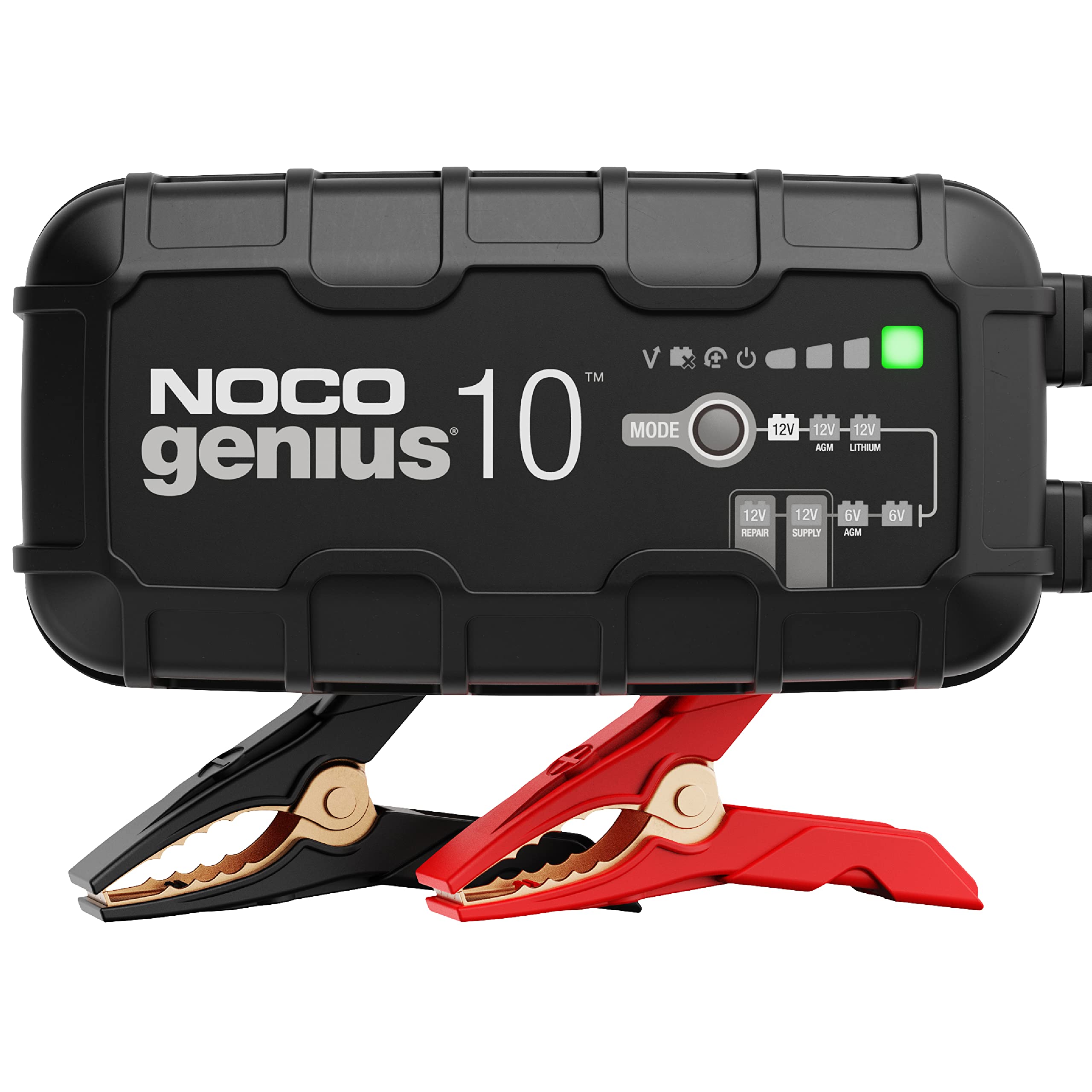
The NOCO Genius 10 is a compact 3.3-pound battery charger for lead-acid, AGM, and lithium batteries, with multiple charging modes and 131 inches of cable to work with. Reviewers found it effective in cold weather and easy to use, though the build quality of the included accessories drew complaints. It carries an IP65 rating for dust and water resistance and ships with a mounting bracket but no storage case. Anyone maintaining batteries in cold climates, or looking after a vehicle that sits unused, is the right buyer.
Full review
One reviewer found a misaligned connector pin
The NOCO Genius 10 presents a substantial 3.3-pound design that feels solid in hand, according to [thisandthattech.com] reviewers. The unit comes with a 72-inch AC power cord, a X-Connect 56 cable with both positive and negative clamps, and a plastic mounting bracket with a strap, offering over 10 feet of working space. [bowtie6.com] noted the charger's heavy construction and ease of use, though they criticized the flimsy packaging that lacks a storage case, which must be purchased separately for $24.95. The device features a single button interface with multiple charging modes, and the battery clamps are described as easy to use with integrated eyelets, though [jeepgladiatorforum.com] users found one connector pin slightly misaligned requiring adjustment. The unit is rated IP65, offering protection from dust and water jets from any direction, though [thisandthattech.com] reviewer questioned mounting it in the engine bay due to cold weather concerns.
Charging Performance and Modes
The NOCO Genius 10 supports multiple battery types including 12V Charge, 12V AGM Charge, 12V Lithium Charge, 6V Charge, 6V AGM Charge, 12V Supply, and 12V Repair modes. [bowtie6.com] reported that the charger successfully charged both lead-acid and AGM batteries, with the 12V AGM setting taking longer but eventually reaching the done state. [jeepgladiatorforum.com] detailed the charger's multilayered charging profiles, noting it operates as a constant-current charger with six charging currents and voltage cutoffs ranging from 14.60V to 15.05V. The device cycles through different current levels, starting with 9.66A and dropping to 0.32A, with the final voltage reaching 15.05V at 50-55F. [candlepowerforums.com] found the charger delivered a charging current of approximately 10A, with the 4-LED meter indicating charge levels but noted the display was not accurate for battery state of charge. The device also features Force Mode for deeply discharged batteries and Repair mode for sulfated batteries, though [carsensorhub.com] noted that Repair mode is not a fix for every failed battery.
Took 5000 seconds to charge at 0.32A
[jeepgladiatorforum.com] provided detailed measurements of the NOCO Genius 10's performance, showing it took about 2000 seconds to charge at 1.39A and 5000 seconds at 0.32A to reach 15.05V. The charger's behavior was observed over several days, with the device entering a dormant state when battery voltage fell to 12.875V and re-initiating charging cycles. [thisandthattech.com] reviewer tested the unit in cold weather conditions and found it capable of charging and restoring batteries, though they noted the 12V Repair mode requires disconnecting the battery first, limiting its usefulness for some users. [carsensorhub.com] confirmed the device's ability to charge deeply discharged batteries through Force Mode, which proved helpful during winter mornings when batteries dropped near 0V. The unit also functions as a power supply mode up to 10A, producing 13.85V open circuit and 13.25V with 10A load, though [jeepgladiatorforum.com] noted it won't enter power supply mode while connected to a battery.
Revived a Red Top Optima after sitting idle
[thisandthattech.com] reviewer appreciated the Genius 10's ability to charge and restore batteries, particularly in cold weather conditions, and praised its substantial build quality. [bowtie6.com] user found the charger effective for their vintage car collection, noting it successfully brought their Red Top Optima battery back to life after prolonged inactivity. [carsensorhub.com] highlighted the device's fast charging capabilities, with 10A output shortening charge times for cars, SUVs, and small trucks, and praised its ability to handle both lead-acid and 12V lithium batteries. [candlepowerforums.com] reviewer was impressed with the robust construction of the battery clamps and the unit's ability to charge quickly, especially when compared to traditional trickle chargers. All reviewers noted the device's safety features, including no-spark and reverse polarity protection, which make it suitable for home use.
4-LED meter shows false readings near full charge
[jeepgladiatorforum.com] users criticized the NOCO Genius 10 for its lack of float stage and its tendency to pull batteries up to 15V about 30 times a day, which they found excessive. The device's minimum current of 320mA was also deemed higher than desired, as typical charge acceptance of lead acid batteries that have sat awhile falls below 300mA at 13.8V float. [candlepowerforums.com] noted that the 4-LED meter doesn't provide useful information about battery state of charge, showing false readings even when batteries were above 95% SoC. [thisandthattech.com] reviewer pointed out the absence of a storage case, which they considered egregious for a premium product. [carsensorhub.com] noted that the device is not waterproof and not designed for permanent marine mounting, limiting its use in harsh environments. Additionally, [jeepgladiatorforum.com] found that the charger's algorithm doesn't seem to be temperature-compensated for the voltage threshold, potentially leading to overcharging in hot conditions.
Good for parasitic-drain issues in older cars
[carsensorhub.com] recommends the NOCO Genius 10 for daily drivers and weekend cars, citing its 10A output that charges fast and maintains safely. The device is ideal for motorcycles, ATVs, and lawn equipment due to its gentle, smart charging that prevents overcharge. [thisandthattech.com] reviewer found it particularly useful for those with older vehicles that experience parasitic drain issues. [bowtie6.com] user recommended it for car enthusiasts with multiple vehicles in their stable who need a reliable charger for occasional use. The device is best suited for users who store vehicles for extended periods and want a smart charger that can revive flat batteries and then maintain them. [jeepgladiatorforum.com] noted that while it's not ideal for permanent marine mounting, it's excellent for home use and garage storage. The unit is not recommended for users who need to charge multiple batteries simultaneously or require waterproofing for marine applications.
Charges faster than 2A or 4A trickle units
[carsensorhub.com] compared the NOCO Genius 10 to NOCO's onboard marine units, noting that while the Genius 10 charges faster than many 2A or 4A trickle units, the GENPRO10X1 is better suited for permanent marine installations with its waterproof design and hard-mount capabilities. [carsensorhub.com] also noted that the GEN5X2 2-Bank marine charger offers dual-battery support, which the Genius 10 lacks. [thisandthattech.com] reviewer found the Genius 10 superior to large 60-amp chargers for preventing overcharging and smoke issues, though they noted the lack of a storage case as a significant drawback. [bowtie6.com] user found the Genius 10 more reliable than borrowing a neighbor's charger, though they criticized its packaging. [candlepowerforums.com] reviewer appreciated the Genius 10's ability to handle lithium phosphate batteries, which some competitors cannot, though they noted the lack of a low current charging mode for smaller batteries.
Priced around $100, discounted direct from NOCO
[carsensorhub.com] priced the NOCO Genius 10 at approximately $100, which they considered reasonable for a smart charger with multiple battery support and safety features. [bowtie6.com] user found the price was discounted from the NOCO website, making it a good value for the features offered. [candlepowerforums.com] reviewer noted that while the device comes with a simple cardboard box, the premium features justify the cost, though they criticized the lack of a storage case. [thisandthattech.com] reviewer found the Genius 10 to be a worthwhile investment for those who experience battery issues in cold weather or have vehicles with parasitic drains. [jeepgladiatorforum.com] user found the device's performance worth the price, particularly for its ability to handle multiple battery types and its smart charging algorithms, though they noted the lack of a float stage as a limitation. Overall, the reviewers generally agreed that the Genius 10 offers good value for its features and performance, especially when compared to basic trickle chargers.
Strengths
- +Effective for charging and restoring lead-acid batteries in cold weather conditions
- +Multiple charging modes including 12V Charge, 12V AGM Charge, 12V Lithium Charge, 6V Charge, 6V AGM Charge, 12V Supply, and 12V Repair
- +Battery clamps are easy to use with integrated eyelets for permanent mounting options
- +IP65 rating provides protection from dust and water jets from any direction
Watch-outs
- −No storage case included with the product
- −One connector pin was slightly misaligned requiring adjustment during setup
How it compares
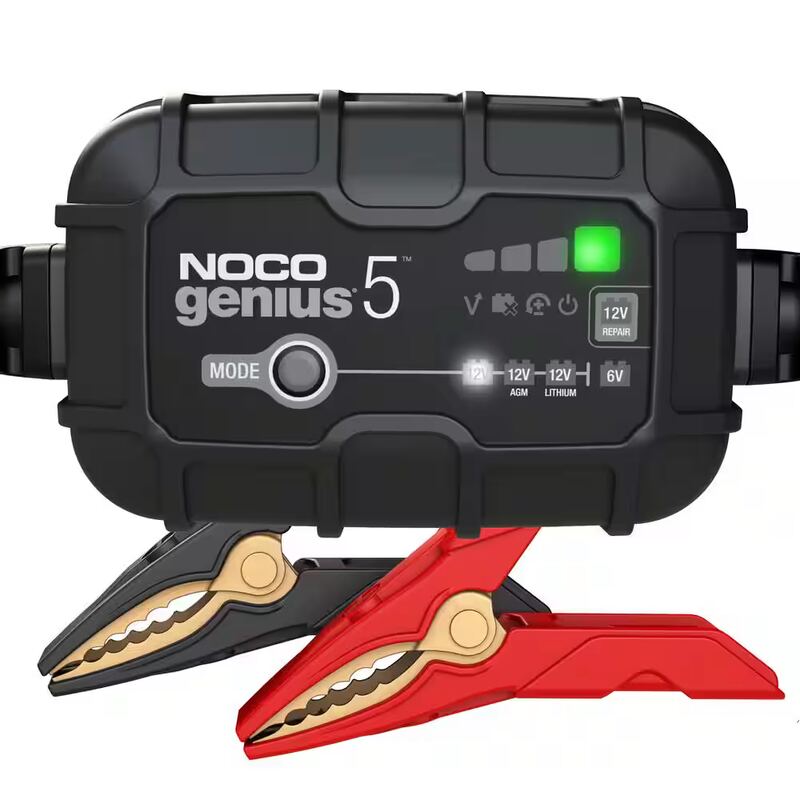
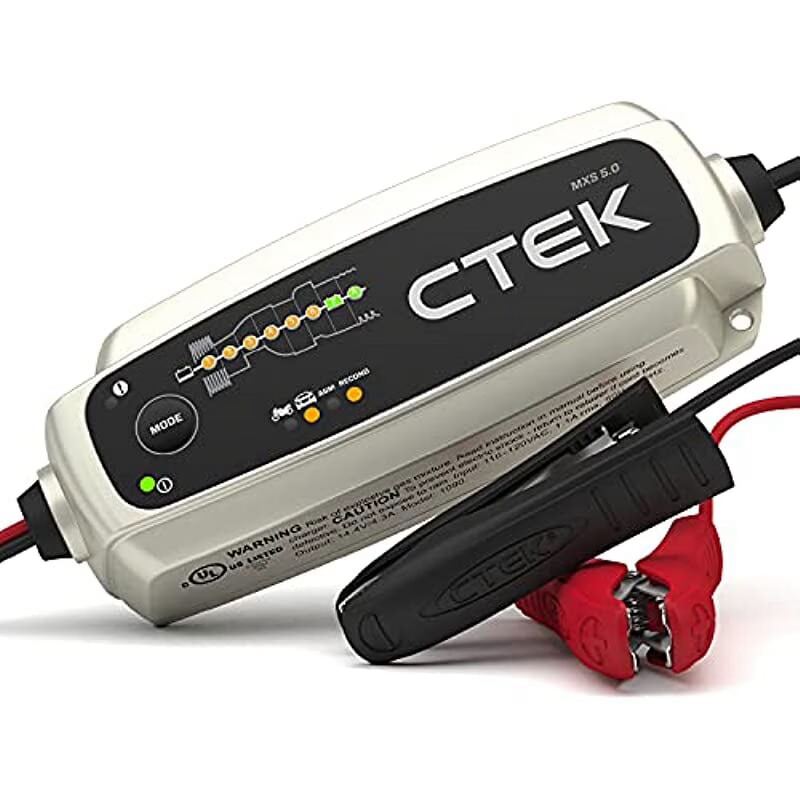
Doubles the NOCO Genius 5's output to 10A for faster charging of larger batteries; costs more than the Genius 5 but still undercuts the CTEK MXS 5.0 on amperage per dollar.
Rating sources
“The NOCO Genius 10 is effectively a 3.3 pound charging brick that feels substantial in the hands.”
Our 4.6 score is the average of these published ratings. Ratings marked * were derived from the reviewer’s written analysis or video transcript — the publisher didn’t print an explicit numeric score, so we inferred one from their own words. Click through to verify. More about methodology.