Reviewers describe the Nitecore NU25 UL as a functional, lightweight headlamp that's a good match for backpacking and outdoor activities. They point to the waterproof build, the essential feature set, and a surprisingly low price. The 400-lumen output struck some as modest, but the consensus is that it performs solidly for ultralight users. Hikers and campers who want reliable, budget-friendly headlamp functionality are the fit.
Full review
55 grams, with an elastic cord instead of a strap
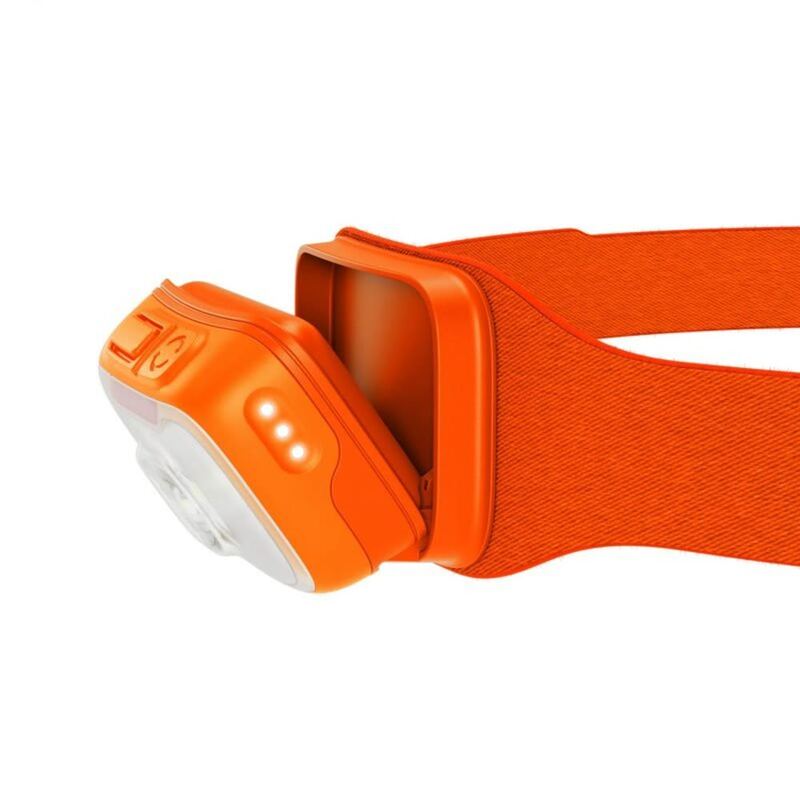
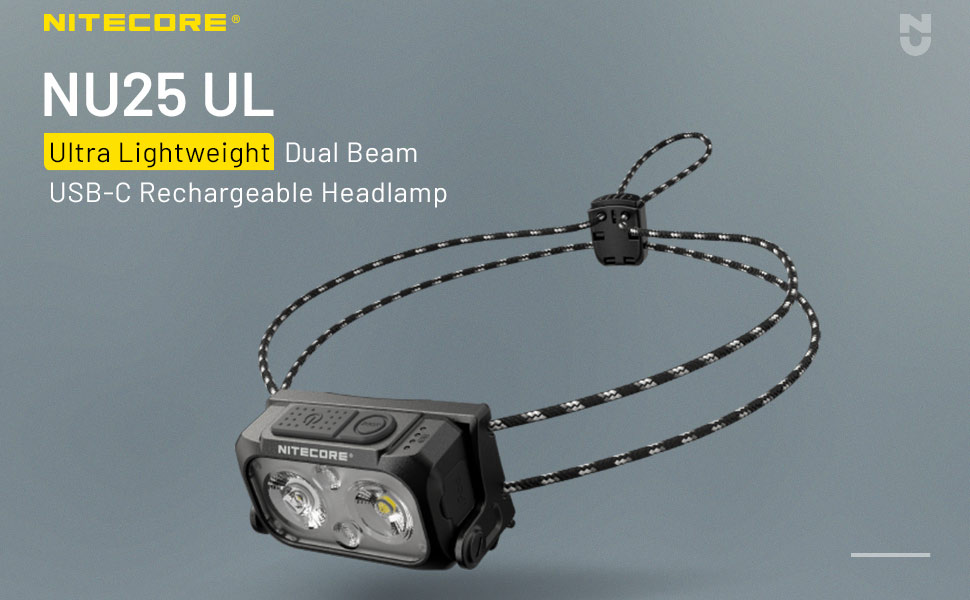
The UL version swaps the standard headband for a thin elastic cord with reflective strands, which is where most of its weight saving comes from: 55 grams complete. The lamp body is plastic, the tilt adjusts in steps and holds position while running, and a rubber flap covers the USB-C port. The cord catches light from behind, a small safety feature that costs nothing to include.
Three levels in dual-beam mode, plus a 6-lumen crawl
Dual-beam mode steps through 60, 200 and 400 lumens, with a 6-lumen setting below that for reading and camp chores, plus red and strobe. Spot and flood can also be run separately. Rated beam distance is 64 meters, enough for trail finding at a walk and short of what fast descending wants. CleverHiker calls it the unsung hero of ultralight headlamps, largely on this feature-per-gram basis.
Two hours 27 minutes at full output
Fell Running Guide ran the lamp flat at maximum and got 2 hours 27 minutes before it dropped into reserve, with a further 50 minutes at low output after that. That is a realistic figure for a lamp this size, and it is enough for a night run or an early start rather than a full night at full power. Charging is over USB-C from a built-in cell.
Buttons too small for gloves
Two small buttons sit flush with the body, and with gloves on they are hard to find and harder to tell apart, as Fell Running Guide notes. Bare-handed there are tactile bumps on the power button to distinguish it. The mode logic takes a few outings to internalize, and reviewers describe taking the lamp off their head to work out which emitter was lit. Red has no dedicated shortcut and has to be cycled to.
IP66 and a sealed cell
The IP66 rating covers heavy rain and hosing rather than immersion, which suits a running or hiking lamp. The cell is built in, so there is no field swap and no carrying spares; on a long trip the answer is a power bank rather than a second set of batteries. For the weight and the price that is a reasonable trade, and it is why the lamp keeps appearing on ultralight lists.
Strengths
- +Bright and lightweight design ideal for backpacking, per CleverHiker
- +Loaded with essential features including waterproofing, per CleverHiker
- +Rechargeable battery with good functionality
- +Surprisingly affordable for its quality and features, per We Are Explorers
Watch-outs
- −Red light has no dedicated control — you cycle to it through the mode button
How it compares
Against the Silva Trail Runner Free H it is cheaper and lighter, but it gives up the Silva's hybrid battery system and its simpler brightness switching. Among ultralight rechargeable lamps its strength is feature count per gram rather than raw output.
Price history
5 daily reads from amazon.com since Oct 29, 2026. Lowest $36.95 (Oct 29), highest $36.95 (Oct 29), latest $36.95 (Nov 8). We call whether it's a good price once there are 7 days of reads at one store.
Rating sources
Counts as 4.30/5 in our score — this publisher's 60 scores on the site average 4.49, so its scores are adjusted down to compare fairly with other publishers.
“Nitecore NU25 and NU25UL are essentially the same torch with a different headband. The UL shaves around 10g off by just using elastic cord rather than a cord and strap combination on the NU25.”
Not in the average — we derived this score from the review's words, and a publisher printed a score for this product, so the printed number counts instead.
Our 4.3 score is the average of 1 of the scored reviews above, each adjusted for how strictly its publisher scores; 1 more reviewed it without printing a score and is not in the average. 1 derived score above is not in the average because a publisher printed a score for this product. Ratings marked * were derived from the reviewer’s written analysis or video transcript — the publisher didn’t print an explicit numeric score, so we inferred one from their own words. Click through to verify. More about methodology.