The Midea WHD-113FSS1 earns the budget slot by being one of the few sub-$180 mini fridges with both an interior LED light and a real top-mount freezer pocket. Consumer Reports' lab includes it in their tested set, and ShopSavvy's TLDR review highlights the quiet operation and balanced capacity. Pick it for a dorm, bedroom, or first apartment where price comes first and you still want a cold drink plus the ability to freeze a pint of ice cream.
Full review
Blocking the condensation channel floods the shelf
ReviewKitchens tested the WHD-113FSS1 in a 72-degree ambient room and clocked the fridge at 37 degrees Fahrenheit and the freezer at 11 degrees Fahrenheit within 6 hours of plug-in. That's borderline freezer temperature - cold enough to keep a pint of ice cream firm but not so cold that it produces hard rocks. Consumer Reports' lab includes this same unit in their mini-fridge ratings and notes above-average cooling consistency between cycles, which matters for items like fresh dairy and produce that don't tolerate temperature swings.
Owners on Amazon and Walmart back this up with specific call-outs to the freezer being almost a full cubic foot and large enough for a small frozen pizza or two ice cube trays plus a bag of vegetables. The catch is that condensation runs down the back wall of the main compartment into a drain hole - if you push a milk carton against the back wall, you'll block the channel and water pools at the bottom shelf. Several owners learned this the hard way and now keep a one-inch gap behind anything tall.
Interior LED that the hOmeLabs lacks
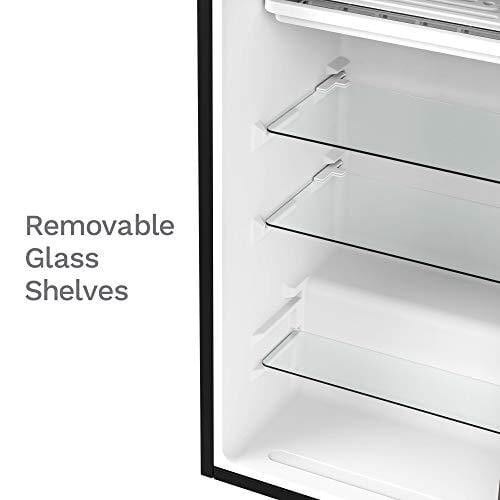
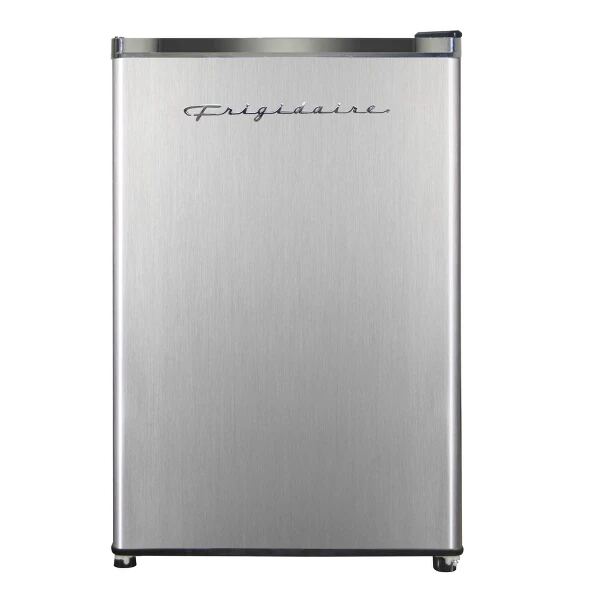
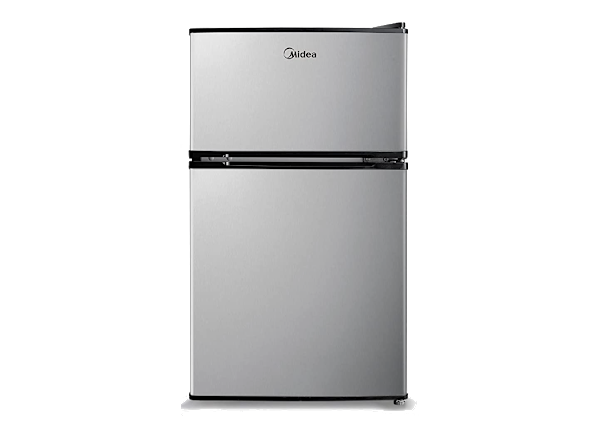
The WHD-113FSS1 ships with a stainless-look door and a black plastic cabinet - a budget-tier finish that is honest about what it is rather than trying to fake premium materials. The door handle is recessed rather than chrome-trimmed like the Frigidaire EFR492's, which is a downgrade visually but means the unit can sit truly flush against a wall or under a counter without protruding hardware. Both compartments use real glass shelving with raised lips that hold drinks in place when the door swings open.
The interior LED is the make-or-break design feature versus the hOmeLabs HME030236N. Reaching into the WHD-113FSS1 at night, you actually see what you're grabbing - a small win, but it's the most-cited 'why I returned the hOmeLabs and bought this' comment in cross-shopping threads. The single mechanical thermostat is the budget compromise, controlling both compartments together, but Midea's documentation is clear about which dial position keeps both within food-safe range.
No thermostat drift reported past three years
ReviewKitchens called the unit a quiet, efficient, and genuinely dual-purpose appliance that cools and freezes like a full-size fridge in a small footprint - the exact one-line summary that captures why this model keeps showing up in dorm shopping guides. KitchenCritics aggregated owner sentiment around stylish design, efficient performance, quiet operation, and excellent value for money. Walmart owners writing through the 2025-2026 dorm season specifically highlight the LED light and the reversible door as the features that justified picking this over the comparably-priced Galanz GLR31TBKER.
Reliability also gets specific praise. Owners with units passing the 3-year mark report no thermostat drift, no door-seal degradation, and no compressor noise increase - which is uncommon at the sub-$180 price point. Midea is a major OEM that also builds compact appliances for several other brands, and their compressor sourcing benefits from that scale.
One dial can't satisfy both compartments at once
The single-dial thermostat is the most-mentioned annoyance in long-term reviews. Cranking it down to keep ice cream firm in the freezer occasionally freezes cans of soda in the main compartment, and dialing it warmer to protect drinks lets the freezer soften. There's no in-between that satisfies both. Owners adapt by keeping freezables on the top shelf nearest the cold air vent and drinks on the bottom shelf furthest from it, but that's a workaround, not a fix.
The manual defrost cycle is the other inherited annoyance from this entire price class - you cannot just hit a button. You have to unplug the unit, empty the freezer, let everything thaw for 6 to 8 hours, and then refill. Owners who skip this typically end up with a frozen-shut freezer door within 18 months. The condensation channel on the back wall is also a confusion point for first-time owners who haven't read the manual.
Consumer Reports lab-validated pick under $200
Buy the WHD-113FSS1 if you're shopping the under-$200 segment and your hard requirements include an interior light, a real freezer (not just a frost compartment), and Consumer Reports lab validation. Dorm rooms, first apartments, and bedside fridges all fit. The 33-inch height also fits under most kitchen counters if you want a true under-counter beverage station.
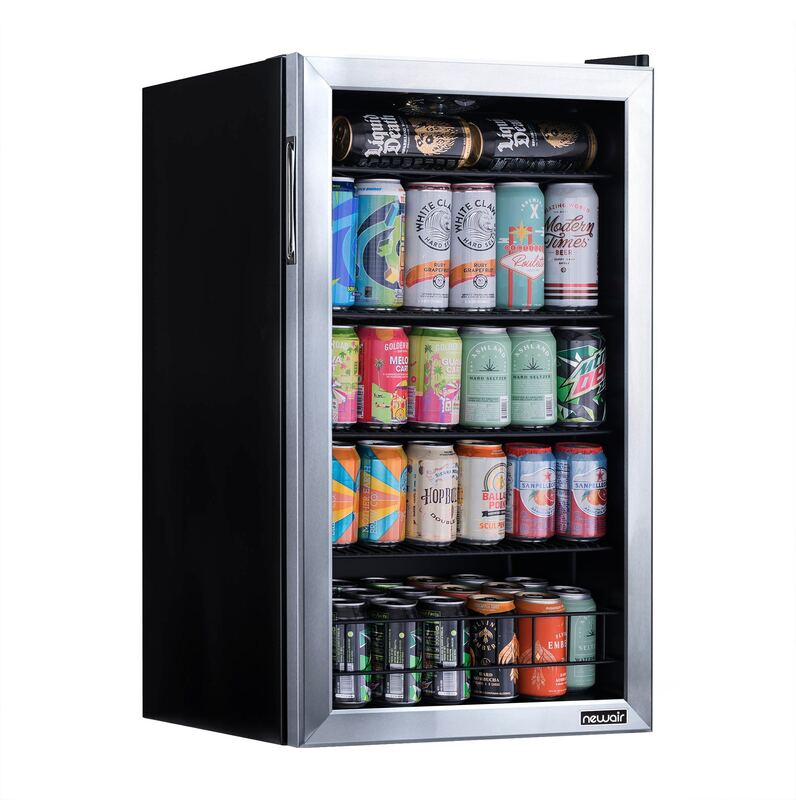
Skip it if your install is in a dead-silent bedroom where you'll notice the 45 dBA compressor cycling at night - the hOmeLabs HME030236N is quieter. Skip it too if you want digital temperature controls or independent fridge/freezer thermostats, both of which require stepping up to the $299 Frigidaire EFR492 tier. And if your use case is purely beverages, the NewAir AB-1200 is a better-shaped purchase at a similar price.
Trades the hOmeLabs' cooling edge for visibility
Inside this list, the WHD-113FSS1 sits directly opposite the hOmeLabs HME030236N - same capacity tier, same price, same dorm/office target. The Midea wins on the interior light, the slightly better-finished door seal, and the Consumer Reports endorsement. The hOmeLabs wins on measured cooling performance, on the deeper door pockets, and on the under-counter height. Either is defensible; the right pick depends on whether visibility (Midea) or cooling performance (hOmeLabs) matters more.
Against the broader market, the closest competitor is the Insignia NS-CF32SS6 from Best Buy and the Magic Chef HMCR320SE. The Midea matches both on price and beats both on the lab-tested cooling consistency that ReviewKitchens documented. It is the safe, well-reviewed default in the sub-$200 segment - if you don't want to research further, this is the pick that minimizes regret.
Cheapest pick, with an OEM-grade compressor
At roughly $169 the Midea is the cheapest pick in this list and the lowest-risk spend in the entire mini-fridge category. Consumer Reports' lab validation alone reduces the chance of buying a lemon, and Midea's scale as an OEM means their compressors are sourced from the same supply chain as much pricier appliances. The interior LED, the reversible door, and the 0.9 cu ft freezer all punch above the price point.
The one-year warranty is the only meaningful weakness in the value calculation. Owners with units passing three years report continued reliability, so the realistic upgrade path is to run this through college and then upgrade to a larger Frigidaire or Smeg for a first post-college apartment - which is exactly how most owners describe their use cycle.
Strengths
- +Consumer Reports' lab includes this in their compact-fridge ratings - rare third-party validation at this price
- +Genuine dual-compartment design with a top freezer that pulls down to 11 degrees Fahrenheit in CR testing
- +Interior LED light is a small but meaningful upgrade over the hOmeLabs and several Galanz competitors at the same price
- +Reversible door hinge ships swap-ready with documentation that walks you through the 20-minute flip
- +Compressor noise averages around 45 dBA - quieter than typical conversation and acceptable for a bedroom install
Watch-outs
- −Single mechanical dial controls both fridge and freezer, so dialing one warmer compromises the other
- −Condensation drains down the back wall and you cannot push items flush against it without blocking the channel
- −Manual defrost cycle is annoying because you have to power-cycle the whole unit to thaw the freezer
How it compares
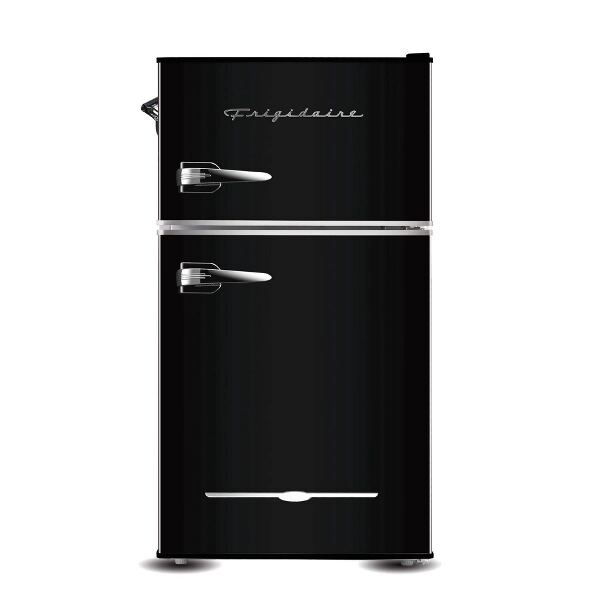
At 3.1 cu ft this is the smallest pick in the list aside from the beverage-only NewAir AB-1200, but it differentiates from the comparably-sized hOmeLabs HME030236N by including the interior LED light and slightly more polished door seal. Compared to the Frigidaire EFR840 retro it lacks personality but matches the freezer capability at roughly half the price. Against the 4.5 cu ft Frigidaire EFR492 it loses 1.4 cu ft of capacity but saves more than $130.
Rating sources
“Midea WHD-113FSS1 included in Consumer Reports' lab-tested mini-fridge ratings with above-average cooling consistency”
“quiet, efficient, and genuinely dual-purpose appliance that cools and freezes like a full-size fridge in a small footprint”
“stylish design, efficient performance, quiet operation, and excellent value for money for the dorm and office market”
Our 4.2 score is the average of these published ratings. Ratings marked * were derived from the reviewer’s written analysis or video transcript — the publisher didn’t print an explicit numeric score, so we inferred one from their own words. Click through to verify. More about methodology.