The Kalita Wave Dripper’s flat-bottom design and three small drainage holes create an even coffee bed that restricts water flow, allowing beginners to achieve smooth, clear-bodied extraction without advanced technique. Homegrounds found this geometry prevents channeling common in conical brewers, while Cornercoffeestore noted it minimizes bitter notes by separating the filter from the dripper walls. However, Coffeechronicler identified that the classic stainless steel model drains significantly slower than glass or ceramic versions, often leading to clogging and unpredictable brew times due to its restrictive design. Users requiring standard filters should look elsewhere, as the device demands proprietary Kalita Wave paper inserts for proper function.
Full review
Flat-bottom design ensures even extraction
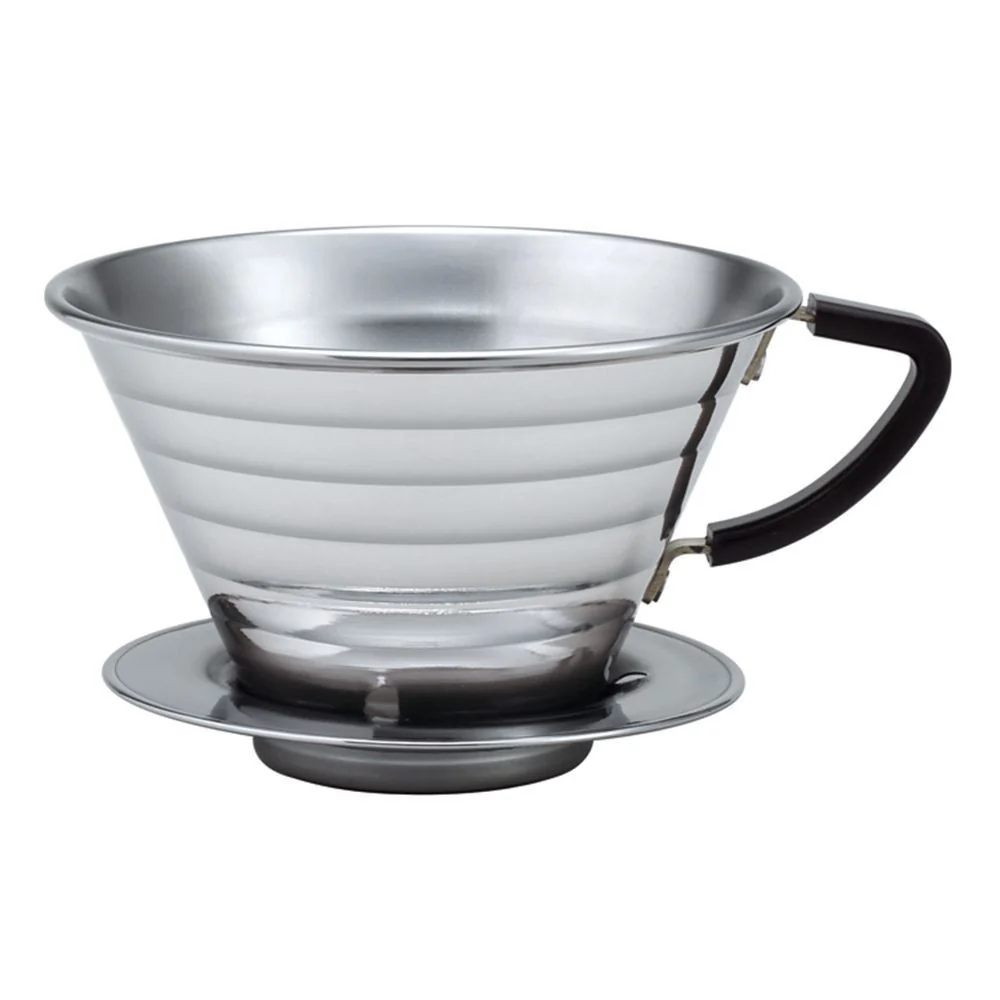
The Kalita Wave Dripper distinguishes itself from conical competitors through its flat, circular base and three small drainage holes. This geometry creates a level coffee bed that prevents the channeling common in V-shaped brewers. Homegrounds notes that this specific shape restricts water flow, allowing for a more controlled extraction process that yields consistently flavorful results without requiring advanced technique. The flat surface area ensures that hot water contacts all grounds evenly before draining through the restricted outlets.
Cornercoffeestore highlights how this structural design contributes to the coffee's flavor profile by minimizing contact between the filter walls and the dripper body. This separation prevents localized overheating or stagnation, which can introduce bitter notes into the final cup. The resulting brew is described as smooth with a clear body and complex aromatics, making it particularly well-suited for light roasts that highlight floral and fruity nuances without the heaviness associated with immersion methods.
Stainless steel model drains slowly
Coffeechronicler identified a significant performance discrepancy among different material versions of the dripper, specifically targeting the classic stainless steel 185 model.
Mino Yaki redesign solves flow issues
In response to widespread complaints about inconsistent drainage and clogging in earlier models, Kalita introduced the Mino Yaki Wave series. Coffeechronicler reports that this updated version features redesigned ribs and enlarged drain holes measuring 4mm instead of the original 2mm. The bottom now utilizes a protruding circular platform rather than the traditional Y-shaped ribs. These modifications have largely eliminated the stalling issues that plagued previous iterations, resulting in a much more consistent flow rate across batches.
Proprietary filters limit compatibility
The Kalita Wave Dripper requires specific paper filters with flat bottoms and unique wave-shaped edges that do not conform to the dripper walls. Cornercoffeestore points out that these proprietary filters are a necessary recurring cost, as standard cone or flat-bottom filters will not fit properly. This requirement restricts users who prefer generic brewing supplies and means they must purchase Kalita-branded replacements regularly to maintain optimal water flow and extraction consistency.
Handle size causes ergonomic discomfort
Cornercoffeestore notes that the curved plastic-coated handle arching from top to bottom can feel uncomfortably small for users with larger hands. While the overall construction is lightweight and durable, the grip dimensions do not accommodate all hand sizes comfortably during the pouring process. This ergonomic limitation may cause fatigue or reduced control when brewing larger batches in the 185 model, particularly if using a gooseneck kettle that adds weight to the system.
Size selection dictates brew capacity
The Kalita Wave comes in two distinct sizes: the 155 for single servings and the 185 for two to four cups. Homegrounds advises that flat-bottom brewers are unforgiving when brewing quantities below their design minimum, leading to shallow coffee beds and watery extraction. Lowkeycoffeesnobs confirms that attempting to brew large volumes in the smaller 155 results in filter messes and significant frustration due to overflow.
Material choice affects thermal retention
The dripper is available in glass, ceramic, stainless steel, copper, and the newer Mino Yaki variants. Homebrewedcoffeelab observes that metal versions like copper heat up faster and retain more heat than ceramic or plastic alternatives, which can impact extraction temperatures for dark roasts. Lowkeycoffeesnobs suggests that material selection often comes down to aesthetic preference and durability concerns, noting that glass models require careful handling during travel but offer the advantage of visual monitoring during the brewing process.
Strengths
- +Flat-bottom design ensures even extraction and a consistent coffee bed.
- +Three small holes restrict water flow, making it forgiving for beginners compared to single-hole drippers.
- +Produces smooth, clear-bodied coffee with complex flavors and minimal bitterness.
- +Simple one-piece construction is lightweight, compact, and easy to clean.
Watch-outs
- −Requires proprietary Kalita Wave paper filters which are not standard.
- −The classic stainless steel model drains very slowly and is prone to clogging due to small drain holes and Y-shaped ribs.
- −Small handle can be uncomfortable for users with larger hands.
How it compares
The Kalita Wave Dripper’s flat-bottom design and three small drainage holes create an even coffee bed that restricts water flow, making it more forgiving for beginners than the single-hole Hario V-60. However, its classic stainless steel model drains significantly slower than glass or ceramic versions of itself.
Rating sources
Counts as 4.40/5 in our score — this publisher's 8 scores on the site average 4.01, so its scores are adjusted up to compare fairly with other publishers.
Not in the average — we derived this score from the review's words, and a publisher printed a score for this product, so the printed number counts instead.
Counts as 4.21/5 in our score — this publisher's 4 scores on the site average 4.38, so its scores are adjusted down to compare fairly with other publishers.
Our 4.3 score is the average of 2 of the scored reviews above, each adjusted for how strictly its publisher scores; 2 more reviewed it without printing a score and are not in the average. 1 derived score above is not in the average because a publisher printed a score for this product. Ratings marked * were derived from the reviewer’s written analysis or video transcript — the publisher didn’t print an explicit numeric score, so we inferred one from their own words. Click through to verify. More about methodology.