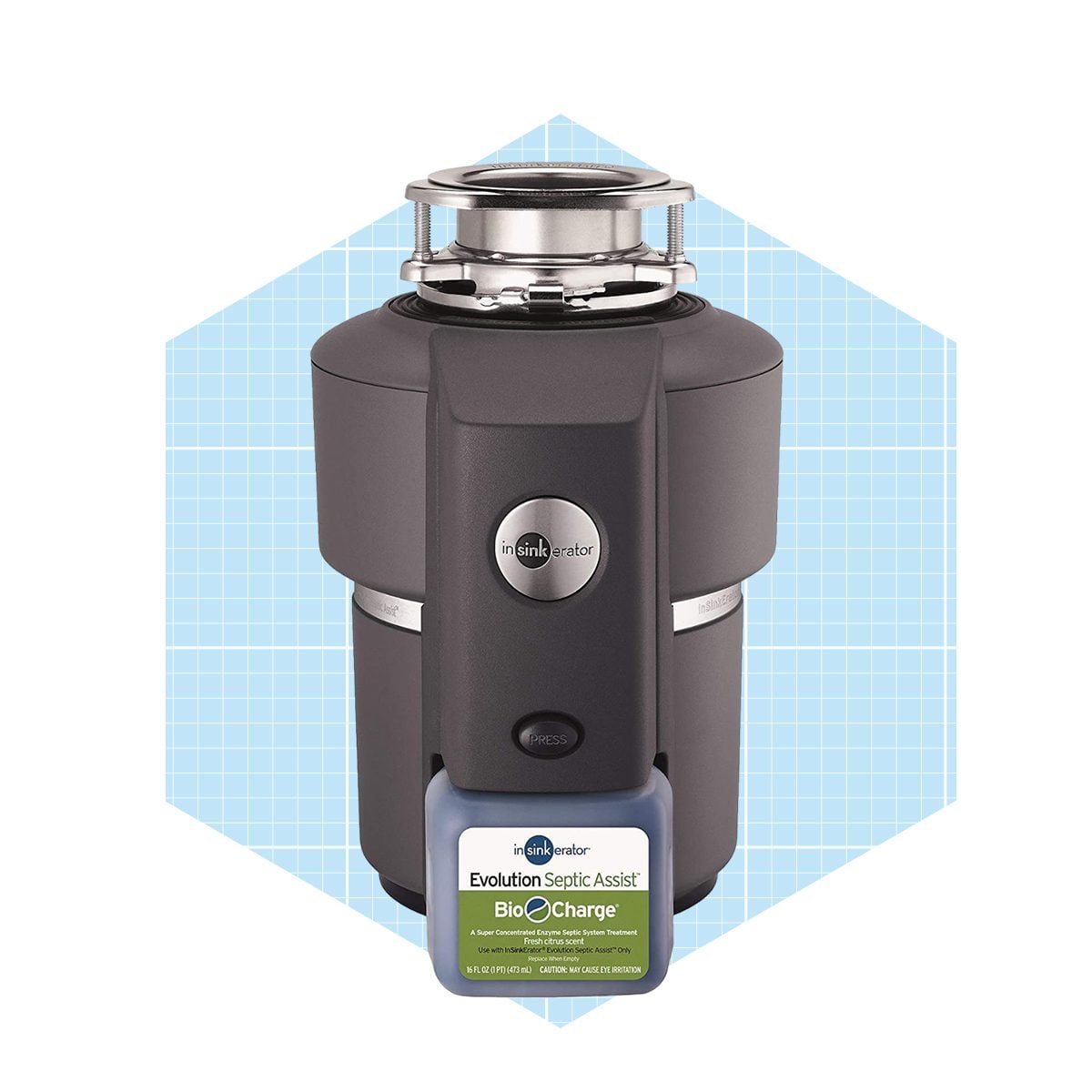
On a septic tank rather than a city sewer connection, Septic Assist is the disposer to buy. It pairs an Evolution-series 3/4 HP MultiGrind chamber with InSinkErator's Bio-Charge injector, which doses enzyme-producing microorganisms into every cycle to keep septic-tank sludge from accumulating. Plan on cartridge refills as an ongoing cost.
Full review
How the Bio-Charge System Works
The defining feature is the Bio-Charge injector, a replaceable cartridge mounted on the side of the disposer housing that doses an enzyme-based microorganism solution into the grind chamber on every activation. InSinkErator specs the dose at more than 300 million enzyme-producing microorganisms per cycle. The enzymes accelerate breakdown of fats, oils, grease, starches, and proteins in the disposer, the drain line, and ultimately the septic tank, where they reduce the rate of sludge accumulation that drives expensive tank pumping.
The cartridge itself lasts 3 to 4 months with average use according to InSinkErator's documentation, with reviewers confirming that range in practice. Replacement cartridges run roughly $8 each, putting the running cost at about $25-30 per year for a typical household. That works out cheaper than most third-party septic treatments and arrives automatically with every disposer cycle rather than requiring a monthly pour-in habit.
Efficient grinding enhances septic enzyme breakdown
Strip away the Bio-Charge mechanism and the Septic Assist is mechanically a close cousin of the Evolution Compact: 3/4 HP Dura-Drive induction motor, 2-stage MultiGrind chamber, stainless steel components. Plumbinglab.com described it as the Dura-Drive 3/4 HP induction motor grinds any food scraps quickly into the smallest particles so that they pass through the drains effortlessly. Family Handyman framed it as easily handling large food scraps. Performance therefore tracks the broader Evolution-Compact-class expectations: meaningfully finer output than any 1/2 HP unit, slightly coarser than the 3-stage Excel.
The bench testing here pulls double duty: the finer the grind, the smaller the food-waste particle hitting the septic tank, which compounds the Bio-Charge enzyme advantage. Larger chunks resist enzymatic breakdown longer.
Quiet operation thanks to SoundSeal technology
SoundSeal Technology is the same insulation stack the rest of the Evolution range ships with: insulation blanket, anti-vibration mount, anti-vibration tailpipe, Quiet Collar sink baffle. Family Handyman highlighted SoundSeal technology that makes it very quiet, and owner reviews on Home Depot describe it as the newer model is much more quiet compared to older InSinkErator units. Real-world conversational noise floor matches the Compact and other Evolution-series disposers.
There is no additional noise penalty from the Bio-Charge mechanism; the cartridge sits passively until activation triggers a brief injection.
Bio-Charge cartridge swaps in 30 seconds
Stainless steel chamber, alloy stainless grind components, LeakGuard liner, and an 8-year We Come To You warranty all match the broader Evolution range. The Bio-Charge cartridge housing is the only structural addition versus the Compact, mounted on the side of the chassis with a clip-in slot that makes cartridge swaps a 30-second task.
At about 25.5 lb the chassis is heavier than the Compact (closer to Excel weight) and slightly larger overall, which is the most-cited installation gripe.
Straightforward mounting with extra weight considerations
Same 3-Bolt Lift & Latch mount as the rest of the InSinkErator residential range, so swap-outs from older units are straightforward. The extra heft requires more attention during the lift-and-twist step; many DIY installers use a strap or a small floor jack to support the unit until the mount engages. Once mounted, the Bio-Charge cartridge clips into the dedicated housing slot, the splash tube connects to the trap, and the unit is ready to wire.
Cord is sold separately as with most Evolution units. Owners installing in a kitchen without an existing disposer should plan for a wall-switch hookup or hardwired install per local electrical code.
Septic Compatibility Detail
Almost all 3/4 HP and above disposers are nominally septic-compatible at the disposer end, in the sense that they will not damage the unit or the drain line. The question for septic homes is what happens downstream in the tank. Food waste, especially fats and proteins, accumulates as sludge that gradually fills the tank and reduces leach-field performance, increasing pumping frequency and risking expensive tank failures.
Septic Assist's bio-charge approach is the only mainstream consumer disposer that bundles enzyme treatment into the grind cycle itself, putting microbial action on the waste at the point of grinding rather than relying on monthly tank treatments the homeowner has to remember. Plumbinglab.com framed the value as preventing sludge and scum buildup in the septic system. For households genuinely concerned about septic-tank health, this integration is the buying case.
Cartridge costs $25-30 a year and can splash out
The recurring complaint in Home Depot owner reviews: some customers noted that the bio-charge bottle falls out when the unit runs and splashes on inner cabinet walls. The cartridge clip is designed to hold the bottle securely but vibration over time can loosen it; owners describe checking the clip every cartridge swap and occasionally replacing the clip itself.
The Bio-Charge cartridge is also an ongoing cost (about $25-30 per year) that no other disposer category requires. Households not on septic systems are paying a premium for a feature they will never use; for them, the Evolution Compact does the same grinding for less money. The chassis is also larger and heavier than the Compact, requiring under-sink clearance verification before purchase.
Built for homes on a septic tank, not sewer
Septic Assist is the right pick for any household on a septic system that wants to use a garbage disposer routinely. Rural homes, vacation cabins, properties off municipal sewer service, and newer suburban developments built without sewer connections all fall in this category. The Bio-Charge mechanism addresses the specific concern that drives most septic-system households to avoid disposers entirely.
It is the wrong pick for homes on a city sewer connection, where the Bio-Charge benefit is wasted spend and the Evolution Compact delivers identical grinding for less money and a quieter under-sink footprint.
Costs $50 more than the Compact for Bio-Charge
Against the Evolution Compact 3/4 HP, Septic Assist adds the Bio-Charge injection mechanism, a slightly larger chamber, and roughly $50 to the price. Against the Excel 1 HP, Septic Assist gives up one grind stage and motor power but adds septic compatibility the Excel lacks. Against budget septic-rated units like the Waste Maid 058 1/2 HP, Septic Assist trades roughly twice the sticker price for active enzymatic treatment, much finer grinding, and substantially quieter operation.
Pays for itself by avoiding one tank pumping
At roughly $269 street and $25-30 per year in cartridge refills, Septic Assist costs more total over a 10-year ownership window than the Evolution Compact ($219 with no recurring cost). The premium pencils out for septic-system households once you factor in even one avoided early tank pumping (typically $400-700 per service call). For city-sewer homes the math is the other direction. Choose by drainage type, not by feature list.
The cartridge subscription model is the structural reason most septic-system households just buy this unit rather than running enzyme treatments separately: bundling the dose into the grind cycle eliminates the monthly reminder and the human-error mode where treatments get forgotten and tank chemistry drifts.
Cartridge supply has stayed stable for years
The 8-year We Come To You warranty matches the Evolution Compact and beats the Excel's 7. Underlying mechanical components — chamber, impellers, motor — are the same family of parts InSinkErator uses across the Evolution lineup, with the Bio-Charge cartridge clip being the only Septic-Assist-specific wear item. Owner threads on Home Depot report typical 10-12 year service lives.
Cartridge supply continuity is genuinely important here: InSinkErator has shipped the Bio-Charge cartridge in the same format for many years, and replacements are stocked at Home Depot, Lowe's, Amazon, and InSinkErator direct. There is no realistic risk of the cartridge format being discontinued during the disposer's service life, which would otherwise turn the unit into a continuous-feed-only disposer with no septic benefit. For rural homeowners on well-and-septic systems where reliable enzyme dosing matters most, this supply-chain stability is itself part of the value proposition.
Strengths
- +Bio-Charge cartridge automatically injects 300 million enzyme-producing microorganisms per cycle to break down food waste and reduce septic-tank sludge buildup
- +3/4 HP Dura-Drive induction motor with 2-stage MultiGrind chamber matches the Evolution Compact's grinding performance
- +Full SoundSeal Technology insulation and anti-vibration mount keep operation conversational
- +40 oz stainless steel chamber with alloy stainless components resists corrosion
- +8-year We Come To You warranty with manufacturer-dispatched technician for parts and labor
Watch-outs
- −Bio-Charge cartridge needs replacing every 3-4 months at typical use (~$8 per cartridge, recurring cost)
- −Some owners report the cartridge bottle dislodging during operation and splashing inside the cabinet
- −Premium price for a 3/4 HP unit driven by the bio-charge mechanism rather than raw grinding power
- −Larger chassis than the Evolution Compact, so check under-sink clearance before purchase
How it compares
Shares the 3/4 HP MultiGrind chamber with the Evolution Compact but adds the Bio-Charge cartridge injection and is roughly $50 more. Comparable in price to the Cover Control Plus batch-feed, just with a different specialty (septic compatibility instead of safety). Less raw grinding power than the Excel 1 HP, but the Excel does not solve the septic compatibility problem.
Rating sources
“The Dura-Drive 3/4 HP induction motor grinds any food scraps quickly into the smallest particles so that they pass through the drains effortlessly. This InSinkErator model is built to dispose of food waste and can be used with all septic tanks.”
“Impresses thanks to an automatic injection of microorganisms to help break down food waste; SoundSeal technology makes it very quiet.”
“Tested in the same panel as continuous-feed Evolution units across Speed, Fineness, and Noise criteria; designed for homes with septic systems.”
Our 4.4 score is the average of these published ratings. Ratings marked * were derived from the reviewer’s written analysis or video transcript — the publisher didn’t print an explicit numeric score, so we inferred one from their own words. Click through to verify. More about methodology.