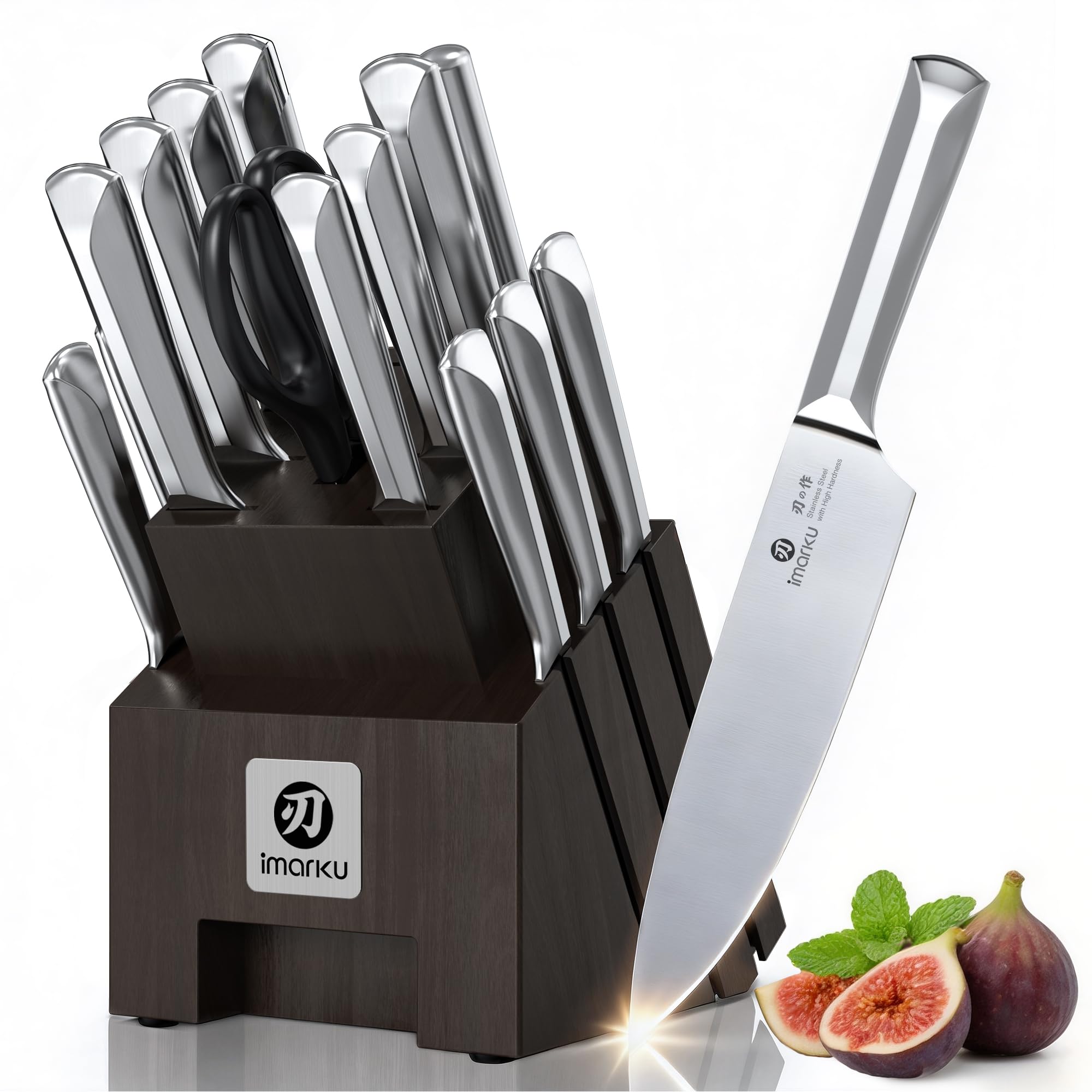
Nothingbutknives found that the ThyssenKrupp German steel blades hold their edge well at a moderate 58 HRC hardness without being overly brittle. Appetitomagazine reported that every knife arrived exceptionally sharp straight from the factory, requiring no initial sharpening or stropping for fair comparison. The set includes a large variety of tools with 16 pieces covering almost every kitchen cutting task and storage need, though Tedium pointed out that the wood storage block is quite large, taking up significant counter space in smaller kitchens. Vegananj highlighted durable Pakkawood handles providing an ergonomic grip that reduces hand fatigue during extended use, but Nothingbutknives observed minor rough transitions between the bolster and Pakkawood handles that can be felt by touch. Steak knives are constructed from a lower grade steel compared to the high-carbon stainless steel used for the main chef's knives. This comprehensive set fits home cooks seeking a complete upgrade with versatile performance, while those with limited counter space or expecting uniform premium fit-and-finish should look elsewhere.
Full review
ThyssenKrup steel hardness and edge retention
Nothingbutknives found that the ThyssenKrupp German Steel blades hold their edge well while maintaining a Rockwell hardness of around 58 HRC. This specific rating is hard enough to provide excellent edge retention, but not so high as to make the knives overly brittle or prone to chipping like harder 60 or 61 HRC alternatives. The relative softness compared to premium Japanese blades allows the manufacturer to grind these knives thinner behind the edge than most competitors at this price point. This thin geometry is a primary reason for their superior cutting performance, as it reduces friction and resistance when slicing through dense produce.
The decision to use German steel instead of traditional high-carbon Japanese alloys results in a blade that resists rust and corrosion without requiring meticulous oiling or drying after every single wash. Nothingbutknives noted that the 58 HRC rating strikes a practical balance for home cooks who want durability alongside sharpness. The blades are described as fairly tough, capable of handling standard kitchen tasks like chopping through small bones or hard squash without risking immediate damage to the edge.
Factory sharpness and initial out-of-box performance
Appetitomagazine reported that the knives arrived extraordinarily sharp, a quality evident both to the touch and in their effortless movement through food. The reviewer noted that even after over two months of regular use, the blades required very little effort to achieve precise slicing compared to older chef's knives. This factory edge was so keen that the reviewer had to consciously ease off on cutting pressure to avoid damaging wooden cutting boards during early reviews.
Nothingbutknives confirmed this initial sharpness by stating that no sharpening or stropping was needed before beginning their evaluation of the set. The blades were ready for immediate use, allowing a direct comparison with other products without the extra step of preparation. This out-of-the-box readiness is particularly valuable in knife sets where lower-tier brands often ship with dull edges that require significant maintenance before they become functional tools.
8 inch chef knife geometry and cutting action
Nothingbutknives described the 8-inch chef knife as a Gyuto style blade, which typically features a lighter weight and thinner profile than traditional Western-style knives. However, this specific model differs from standard Gyutos by possessing a fairly pronounced curve along its cutting edge. This curvature makes it highly effective for rock chopping motions, allowing the tip to remain planted while the heel lifts and drops repeatedly.
The trade-off for this curved edge is that push cuts are not as naturally facilitated as they would be on a blade with a straighter profile. Nothingbutknives suggested that users needing frequent push cuts should utilize the included 7-inch santoku knife, which features a straighter edge better suited for that specific technique. The hybrid nature of the chef's knife makes it versatile enough to handle both rocking and slicing motions effectively.
Steak knives sharpness versus steel quality
Tedium found that the six included steak knives are unusually sharp, performing as well for cutting vegetables as they do for carving meat. The serrated edges on these knives allow them to slice through fibrous materials with ease, making them surprisingly versatile beyond their intended use at the dinner table. Tedium noted that this level of aggression in a steak knife is almost overkill for casual dinners and might be intimidating for inexperienced users or children.
Despite their exceptional sharpness, Nothingbutknives identified a significant flaw: the steak knives are constructed from a lower grade steel than the high-carbon stainless steel used for the main chef's knives. This discrepancy means that while they cut beautifully initially, they may not hold their edge as long as the primary kitchen blades. The mismatch in material quality within a single set is a notable compromise for buyers expecting uniform performance across all 16 pieces.
Pakkawood handle ergonomics and fit
Vegananj highlighted the durable Pakkawwood handles, noting that they offer a stylish wood-like appearance combined with excellent grip stability. The material is designed to reduce hand fatigue during extended use, making it comfortable for prolonged prep sessions. The full tang design adds structural strength and balance, ensuring the knife feels secure in the user's hand rather than top-heavy or flimsy.
Nothingbutknives observed that while the handles are symmetrical and the blades straight, there is a noticeable rough transition where the bolster meets the Pakkawood handle. This imperfection can be felt when running a finger over the junction, even though no visible gaps exist. At this price point, such minor fit-and-finish issues are acceptable, but they prevent the set from feeling truly premium compared to higher-end options.
Knife block size and counter space requirements
Tedium pointed out that the wooden storage block is fairly large and imposing, taking up a significant amount of counter real estate. The reviewer described an incident where attempting to re-box the knife block after unboxing actually damaged the cardboard packaging because the block's dimensions were so substantial. For kitchens with limited workspace, this footprint can be a major drawback.
The sheer volume of 16 pieces necessitates a large storage solution, which Tedium noted competes directly with valuable counter space in smaller apartments or compact kitchens. While the knives themselves are highly functional and aesthetically pleasing on display, buyers must carefully measure their available surface area before committing to this specific set configuration.
Dishwasher compatibility versus hand washing
The stainless steel construction resists water spots and corrosion well enough to survive machine cycles. This durability makes the set convenient for households that prioritize ease of cleanup over traditional knife care rituals.
However, Appetitomagazine recommended hand washing despite this capability, noting that the blades clean so easily by hand that users can reuse them sooner rather than waiting for a dishwasher cycle. Hand washing also preserves the Pakkawood handles and maintains the edge longevity longer than abrasive detergent cycles would allow. The consensus among reviewers is that while machine washing works, hand care extends the product's lifespan.
Overall value compared to premium alternatives
Vegananj compared the Imarku chef knife favorably against premium brands like Wüsthof and Shun Classic, noting that it delivers a comparable experience at a fraction of the price. The reviewer emphasized that for home cooks who do not require professional-grade VG-MAX steel or hand-forged Japanese blades, this set offers exceptional performance without breaking the bank.
Nothingbutknives concluded that while the knives are not perfect, they offer better performance than most other brands in sets of this size. The combination of high factory sharpness, durable German steel, and a comprehensive 16-piece selection makes it a strong option for buyers who want a complete kitchen upgrade without investing in multiple individual premium knives.
Strengths
- +ThyssenKrup German steel blades hold their edge well at a moderate 58 HRC hardness without being overly brittle.
- +Knives arrive exceptionally sharp straight from the factory, requiring no initial sharpening or stropping for fair comparison.
- +The set includes a large variety of tools with 16 pieces covering almost every kitchen cutting task and storage need.
- +Handles are made of durable Pakkawood providing an ergonomic grip that reduces hand fatigue during extended use.
Watch-outs
- −The wood storage block is quite large, taking up significant counter space in smaller kitchens.
- −Steak knives are constructed from a lower grade steel compared to the high-carbon stainless steel used for the main chef's knives.
- −Fit and finish shows minor rough transitions between the bolster and Pakkawood handles that can be felt by touch.
Rating sources
“Overall I was mostly impressed with the set. The knives are not perfect, but they offer better performance than most other brand’s knives in sets of this size in the under $300 price range.”
“Ultimately, everything about the knives makes life in the kitchen and at the table easier and more precise.”
“For anyone looking to upgrade their kitchen arsenal without breaking the bank, I recommend Imarkus knives for those looking for a balance of performance, durability, and value.”
“In other words, it’s a pretty good set of knives that appear unlikely to threaten my life because of a handle incident.”
Our 4.3 score is the average of the 4 scored reviews above; 2 more reviewed it without printing a score and are not in the average. Ratings marked * were derived from the reviewer’s written analysis or video transcript — the publisher didn’t print an explicit numeric score, so we inferred one from their own words. Click through to verify. More about methodology.