Simplycookings found that the roll-top door effectively eliminates burn hazards by allowing unobstructed access to food without reaching over hot surfaces. However, TechGearLab measured significant temperature inaccuracies, noting the oven runs up to 65 degrees hotter than indicated and yields inconsistent results for baking and frozen foods. The compact 16 x 12-inch footprint restricts capacity to four slices of toast or a 9-inch pizza at one time. This model suits individuals in tight spaces who prioritize safety features over precision, while families needing higher throughput should look elsewhere.
Full review
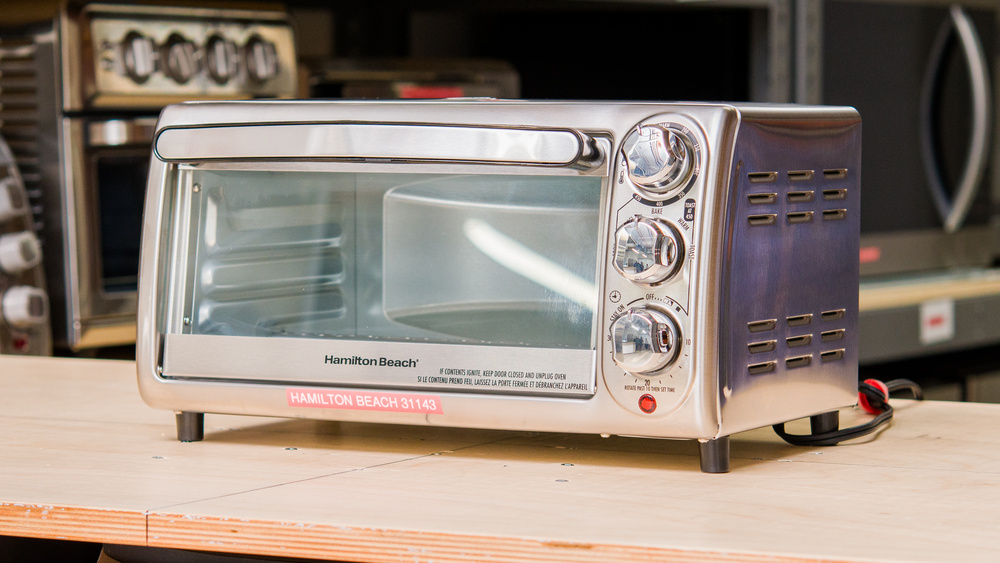
Roll-top door eliminates burn hazards
The defining engineering choice of the Hamilton Beach Easy Reach is its roll-top door, which slides upward and tucks back into the top housing rather than swinging down like a traditional oven. This mechanical difference creates an unobstructed front opening that allows users to place food inside or remove it without reaching over a hot metal surface. Simplycookings identifies this as the primary reason consumers select this appliance, noting that it completely solves the burn risk associated with standard drop-down doors. The design is particularly valuable for seniors, children, or anyone with limited mobility who might struggle to navigate around a swinging barrier.
Beyond safety, the roll-top mechanism offers practical advantages in tight spaces and maintenance. Because the door stays contained within the oven's footprint, it does not require extra clearance space in front of the unit, making it suitable for small kitchens, dorm rooms, or RVs where counter real estate is at a premium. The vertical sliding motion also changes how spills behave; grease and crumbs fall directly onto the slide-out crumb tray instead of pooling on a flat door surface. This configuration simplifies cleaning significantly compared to traditional models that require wiping down a horizontal exterior panel.
Temperature accuracy creates inconsistent results
TechGearLab measured the Hamilton Beach Countertop Oven and found it to be the worst performer in temperature accuracy among its competitors, earning a low score of 2 out of 10. The oven ran consistently hotter than the dial indicated, registering up to 50 degrees warmer at settings of 400°F or less, and reaching as much as 65 degrees above the target setting during peak deviations. At the highest setting of 450°F, the discrepancy dropped slightly but remained around 20 degrees off. This severe inaccuracy makes the temperature knob function more like a rough on/off switch rather than a precise control, forcing users to guess cooking times and adjust their expectations for how quickly food cooks.
Baking dries out smaller items
In baking tests conducted by TechGearLab, the Hamilton Beach Countertop Oven achieved a score of 6 out of 10. While it produced acceptable textures for larger items like drumsticks and cakes, the oven tended to dry out food significantly. Smaller items such as cookies ended up too dry and crumbly, with skins becoming overly crispy at the expense of moisture retention. This contrasts sharply with competitors that struggled more with texture but retained better internal moisture levels. The lack of a convection fan in this specific model means heat distribution relies on radiant elements, which can aggressively dehydrate smaller portions if left unattended.
Frozen food performance leaves centers underdone
The oven scored 7 out of 10 in frozen food preparation according to TechGearLab, placing it toward the top of its metric range. It excelled at crisping the exteriors of tater tots and creating a nice crust on frozen pizzas. However, this aggressive exterior heating often left the insides of these foods underdone. For consumers who prefer a doughy pizza center or soft-tender vegetables, this result was disappointing. The discrepancy between the crispy outside and raw inside suggests that users must carefully monitor cooking times to avoid serving food that is burnt on the surface but cold in the middle.
Toasting lacks consistency without specific functions
TechGearLab rated the toasting performance poorly, noting a lack of specific toast or bagel functions that would allow for consistent browning. Without dedicated elements or settings for bread products, the oven struggled with uniformity. It did manage to leave the backsides of bagels slightly less toasted than the fronts due to its heating element placement, which salvaged some points in an otherwise weak category. Users seeking reliable, even toast will find this manual dial system insufficient compared to models that offer dedicated browning levels or specific bread settings.
Missing preheat alerts complicate usage
Ease of use suffered significantly due to the absence of a preheat indicator. TechGearLab gave this category a score of 4 out of 10, highlighting that users must set the temperature and then assume the oven has reached heat after waiting for a suggested duration from the manual. Without an audible or visual alert when the target temperature is achieved, operation relies on guesswork. This lack of feedback makes the interface feel clunky and unrefined compared to modern appliances that signal readiness, adding friction to quick meal preparation.
Compact size restricts cooking capacity
While this capacity is sufficient for individuals or couples in small kitchens, it becomes a bottleneck for families or gatherings where larger meals need to be prepared simultaneously. The trade-off for saving counter space is a significant reduction in throughput, making it unsuitable as a primary oven for households that regularly cook full-sized dishes.
Basic controls limit versatility
The appliance offers three core cooking functions: bake, broil, and toast. It lacks advanced features such as air frying or convection fans found in higher-end models, restricting its utility to standard countertop oven tasks. The manual dial interface requires users to manage temperature, function, and time separately without digital precision. While this simplicity reduces the learning curve, it also means users cannot leverage faster cooking times from forced air circulation or more precise temperature control for delicate baking projects.
Strengths
- +Roll-top door slides upward and tucks back into the body, providing unobstructed access to food without reaching over a hot surface.
- +Compact footprint measures approximately 16 x 12 inches, making it suitable for tight countertops in small kitchens or RVs.
- +Includes three core cooking functions: bake, broil, and toast with a temperature range of 200°F to 450°F.
- +Removable roll-top door and slide-out crumb tray simplify cleaning by preventing food spills from pooling on the door surface.
Watch-outs
- −Small interior capacity restricts cooking to four slices of toast or a 9-inch pizza at one time.
How it compares
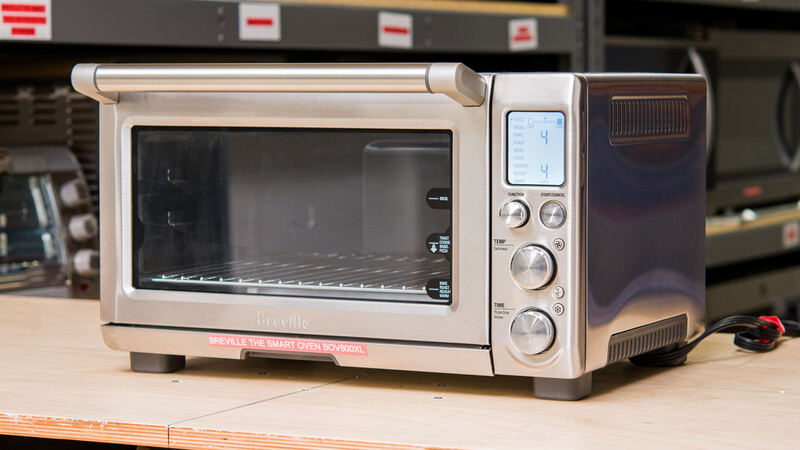
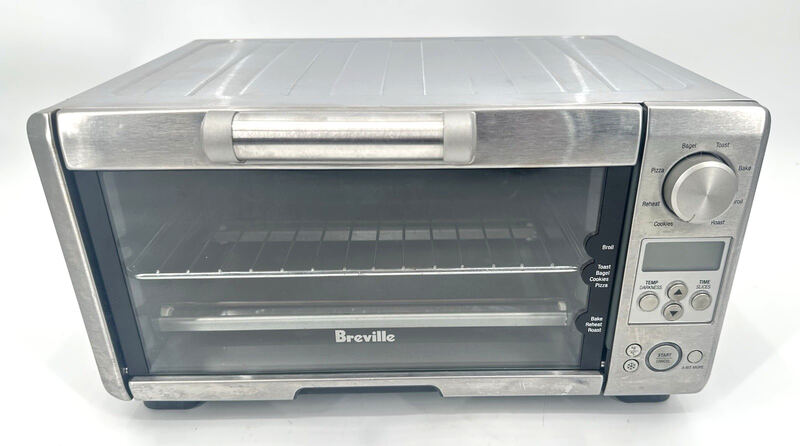
The Hamilton Beach Easy Reach 4 Slice Countertop Toaster Oven features a roll-top door that eliminates burn hazards, providing safer access than the front-opening doors of the Breville Compact Smart Oven.
Rating sources
Counts as 2.89/5 in our score — this publisher's 138 scores on the site average 3.66, so its scores are adjusted up to compare fairly with other publishers.
Our 2.9 score is the average of the 1 scored review above, each adjusted for how strictly its publisher scores; 2 more reviewed it without printing a score and are not in the average. More about methodology.