The ProX19 is the sprayer in this group actually designed for a whole-house exterior rather than scaled up to one. Its 0.38 GPM flow and 150 ft hose capacity mean you can park the cart, run hose around the building, and keep spraying unthinned latex without repositioning every twenty minutes. Bob Vila's team self-primed it and got a fine, uniform spray from the first test forward, naming it their pick for pros. Fine Homebuilding was harder on it, criticising noise, vibration, and a single-filter paint path. Both are right: this is a production tool with rough edges, and the edges matter less when the alternative is three weekends of brushwork.

Full review
Flow rate is what finishes a house
The specification that separates the ProX19 from the rest of this lineup is 0.38 gallons per minute. That sounds incremental against the Graco Magnum X7's 0.31 and the Graco Magnum X5's 0.27, but flow rate compounds across a job measured in hundreds of square feet. Bob Vila's testers, who ran the machine alongside the X5 and a Wagner unit, reported it self-primed and delivered a fine, uniform spray from the first test forward, and concluded it had everything a professional painter or enthusiastic DIYer needs to paint large projects quickly. On lap siding, where you are constantly re-aiming to keep a wet edge, the extra flow is what lets you keep moving instead of pausing for the pump to catch up.
The other half of that equation is hose. Bob Vila noted the ProX19 accommodates up to 150 feet, and Fine Homebuilding's tester independently confirmed the machine has the power reserve to push paint through an extended run. In practice this means the cart sits on the driveway and stays there. Sprayers that top out near 75 feet force you to move the whole rig, re-prime, and re-establish your pressure every time you round a corner — a tax that is invisible in a spec sheet and obvious by hour three.
Unthinned exterior latex, straight from the bucket
Both Bob Vila and This Old House class the ProX19 among the airless machines that handle unthinned paint, and this is the practical dividing line between airless and every HVLP alternative. Exterior acrylic latex is heavy-bodied by design — it has to build a weatherproof film — and thinning it to pass through a lower-pressure system compromises the coating you are paying for. At 3000 psi the ProX19 atomises house paint as supplied, which means the finish on the wall is the finish the manufacturer formulated.
The ceiling is the tip. Bob Vila flagged that the ProX19 works only with tips up to 0.019, and cannot spray elastomeric coatings that require 0.025. If your project is stucco resurfacing or a heavy masonry coating, this machine is the wrong tool and no amount of pressure will fix it. For standard exterior acrylic on wood, fiber cement or vinyl siding, 0.019 is comfortably within range.
Where Fine Homebuilding pushed back
The most useful dissent on this machine comes from Fine Homebuilding's March 2026 prosumer airless tool test, which evaluated it against the Titan Impact X 410 and Graco's own Pro210ES. Their tester called it loud, said it vibrated excessively, and judged its power reserve limited for wider tips. The sharpest criticism was structural: the ProX19 has only one filter in the paint path, and the tester wrote that he would be concerned about wasted time spent clearing clogged guns and tips.
That is a genuine disagreement with Bob Vila, who gave the same machine their pick for pros. Both findings are defensible because they measure different things. Bob Vila assessed output quality and ease of use on a DIY-scale job; Fine Homebuilding assessed it as a production tool against machines costing $1,000 and up. If you are spraying one house, the single filter is an annoyance you manage by straining your paint. If you are spraying houses for a living, it is a recurring cost and the Titan is the better buy.
Noise, vibration and the cart
Fine Homebuilding's noise and vibration complaint deserves weight because exterior work is long-duration. The ProX19 uses a piston pump driven hard, and it announces itself — their tester explicitly contrasted it with the Titan Impact X 410, which he described as quiet, powerful and well-built with minimal vibration. Hearing protection is not optional on a full day with this machine, and neighbours in close-set neighbourhoods will notice.
The cart itself is a genuine asset for exterior work in a way it is not indoors. Rolling the machine across a lawn beats carrying a stand-mounted unit, and the ProX19's cart keeps the paint bucket, hose and gun as a single movable station. Fine Homebuilding rated Graco's cart design highly on the Pro210ES, and the ProX19 shares that basic architecture.
The SG3 gun and long overhead passes
Bob Vila singled out the upgraded SG3 spray gun with its swivel hose connector, and this is worth more than it sounds on an exterior. Painting siding means long stretches with your arm extended, often above shoulder height on a ladder or working up under soffits. A hose that cannot swivel transmits every twist back into your wrist, and by the end of a wall you are fighting the tool. The swivel connector removes that, and it is a meaningful difference against machines that pair a cheaper gun with the same pump.
Who should skip it
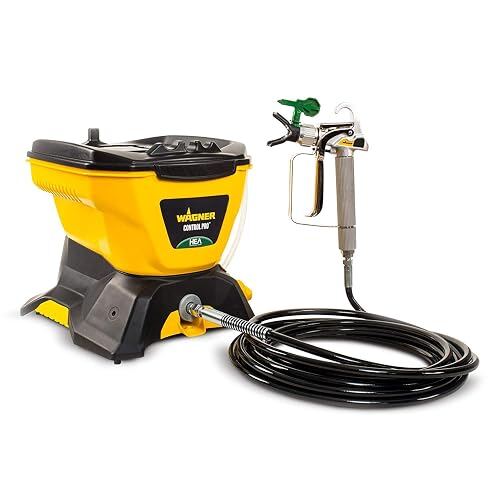
The ProX19 is poorly matched to small exterior jobs. If your realistic annual workload is a fence, a deck and some trim, the flow rate you are paying for goes unused while the noise, the cleanup volume and the single-filter maintenance all remain. The Graco Magnum X5 or the low-overspray Wagner Control Pro 130 Power Tank cover that ground with less machine to clean at the end of the day. Cleanup scales with pump size and hose length, and a 50-foot hose full of exterior latex is a genuine chore.
It is also the wrong choice if you are spraying near cars, neighbouring property or landscaping you care about. At 3000 psi the ProX19 generates real overspray, and the machines in this lineup designed around high-efficiency low-pressure technology exist precisely because that overspray is sometimes the deciding constraint.
Strengths
- +0.38 GPM flow rate is the highest in this group — the practical difference between finishing a two-story exterior in a weekend and stretching it across two
- +Supports up to 150 ft of hose, so the cart can stay parked while you work around a house and up a ladder
- +Sprays unthinned exterior latex straight from the bucket, no viscosity juggling
- +SG3 gun with a swivel hose connector, which stops the hose torquing your wrist during long overhead siding passes
- +Stainless steel piston pump rated for continuous use rather than intermittent DIY duty
Watch-outs
- −Fine Homebuilding's tester found it loud and vibration-prone next to cart sprayers costing $300 more
- −Only one filter in the paint path — Fine Homebuilding flagged this as a real time cost in clogged guns and tips
- −Caps out at a 0.019 tip, so elastomeric and heavy masonry coatings needing 0.025 are out of scope
- −Overkill for anyone whose largest job is a fence or a single shed
How it compares
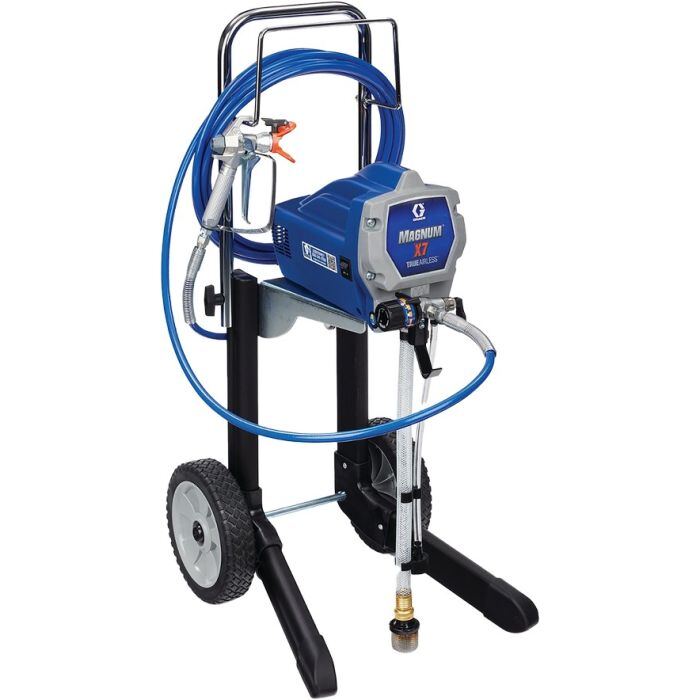
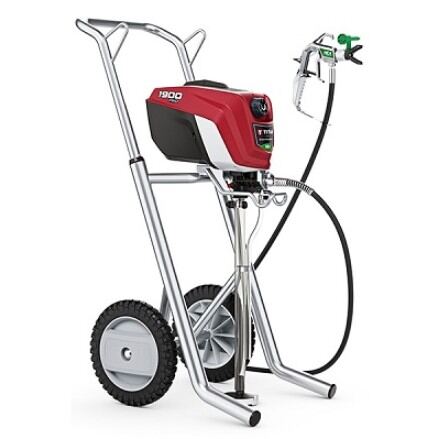
The ProX19 is the only sprayer here built for continuous whole-house work — its 0.38 GPM beats the Graco Magnum X7 at 0.31 and the Graco Magnum X5 at 0.27, and its 150 ft hose ceiling roughly doubles what the X5 supports. Against the low-pressure Titan ControlMax 1900 Pro and Wagner Control Pro 130 Power Tank it trades their reduced overspray for raw throughput. It carries more flow and far more hose than the Graco Magnum X7, but the X7 and Graco Magnum X5 have the broader independent testing record, which is why they rank above it here.
Rating sources
“Everything a professional painter or enthusiastic DIYer needs to paint large projects quickly.”
“I would be concerned about wasted time spent clearing clogged guns and tips.”
Our 4.2 score is the average of these published ratings. Ratings marked * were derived from the reviewer’s written analysis or video transcript — the publisher didn’t print an explicit numeric score, so we inferred one from their own words. Click through to verify. More about methodology.