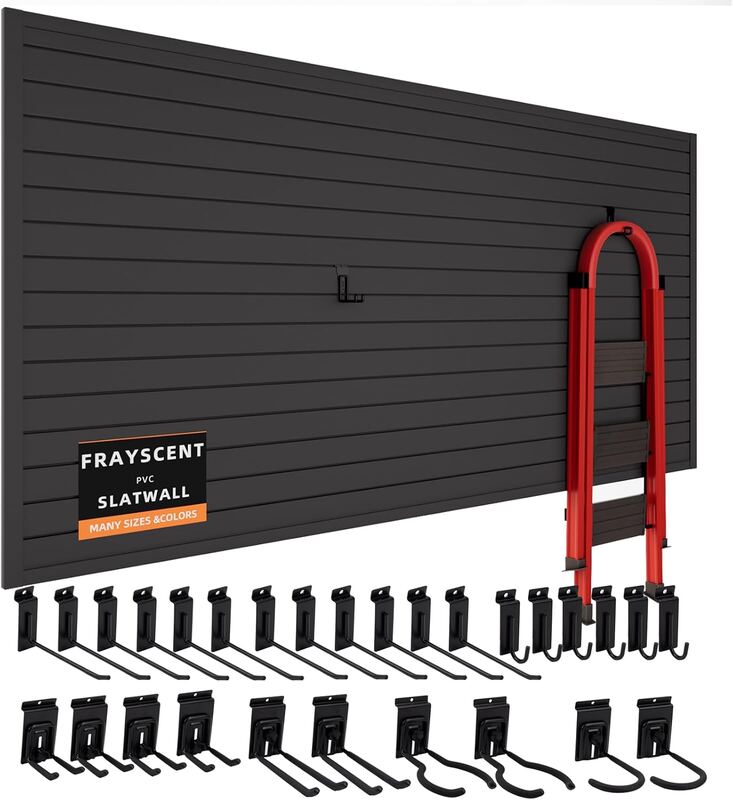
Gladiator's GearWall is the slatwall benchmark for serious garage builds. Its 8-foot PVC panels lock together with tongue-and-groove channels, hold 50 lbs per square foot, and accept a deep ecosystem of Gladiator hooks and accessories, so storage reconfigures as your gear changes. A 10-year warranty and weather resistance make it the long-game choice over cheaper rail systems.
Full review
How it performs day to day
The Gladiator GearWall's 50 lbs per square foot rating is not a hopeful marketing number — multiple long-term users report stacking ladders, leaf blowers, weed trimmers, and full hose reels on a single panel run with zero deflection. Reviewers at Reboot My Garage measured the interlocking 12" x 96" panels carrying "clean, organized" loads after years of use, calling out the panel's resistance to gouging from sharp tool edges. The 3/4-inch PVC body is rigid enough that hooks don't pull through under sustained weight — the failure mode on cheaper rail systems where thin plastic deforms around the hook contact point.
Reviewers at Garage Transformed specifically tested the friction-lock hook design and found it held during "aggressive removal" of tools — no surprise pop-outs when yanking a coiled extension cord or pry bar. That detail matters because the most common slatwall failure is not weight rating but hooks releasing mid-grab and dropping whatever they held. The double-channel slot geometry combined with the spring tab is the load-bearing engineering choice here, and it's why this system gets reused after Gladiator's smaller accessory rails get returned.
Build quality and design
Each panel is 12 inches tall by 96 inches wide and 3/4 of an inch thick. The tongue at the top mates into the groove at the bottom of the next panel, so a wall installation reads as a continuous textured surface rather than visibly stacked planks. Color-matched mounting screws (included in Gladiator's hardware kit but sold separately from the panels themselves) blend into the panel face so the finished wall doesn't look like a hardware store. Jason R. Mitchell's build review called the finished result "clean and professional" — language reviewers don't apply to bare pegboard.
The PVC formulation is the load-bearing material decision. Wood-based slatwall (the cheaper option at big-box stores) warps when garage humidity swings through summer-winter cycles and the slots tear out under repeated hook loading. Gladiator's PVC doesn't warp, doesn't absorb moisture, and the slot geometry stays dimensionally stable. The trade-off is weight — a 2-pack of 8-foot panels ships around 30 pounds, and the boxes are long and awkward to maneuver up a staircase or into a basement workshop.
Modular design and long-term durability drive value
Reboot My Garage gave GearWall a 4.7/5 and called out the modular nature — "build coverage in stages" — as the standout feature. You can start with one 2-pack on a single wall, add a second pack months later, and the panels interlock seamlessly without retrofitting. The accessory catalog (hooks in 6 sizes, baskets, shelves, bike hooks, ball racks, and specialty mounts for fishing rods, golf clubs, and ladders) means almost any tool has a purpose-built mount. The Garage Transformed reviewer noted that hooks can be repositioned "anywhere on panels" so the layout evolves with your tool collection.
The 10-year warranty came up repeatedly as a tie-breaker against $30-cheaper competitors. Garage-storage gear lives in temperature extremes and gets abused — a manufacturer willing to stand behind a decade of that is signaling actual confidence in the product.
What holds it back
Cost of ownership is the recurring knock. The panels are the entry fee, but hooks, baskets, and shelves are all sold separately — and Gladiator-branded accessories are not cheap. Reboot My Garage still rates the GearWall panels highly, 4.7 and its longest-warranty pick, but flags exactly this trade-off: Gladiator "is often pricier and uses a proprietary slat size," and it tells buyers to "double-check accessory compatibility" before ordering third-party hooks. A fully kitted wall can easily run double the panel cost.
Each panel is only 12 inches tall, which means a typical 4-foot wall section needs four stacked panels (two 2-packs) plus optional top and bottom trim. Installers on the Lumberjocks woodworking forum noted that mounting to drywall alone is not sufficient — you need to hit studs or fasten to a plywood backer, and laying out the screw pattern across multiple panels takes careful measurement. First-time installers should plan 2-3 hours for a single 8-foot wall, not the breezy 30-minute estimate the marketing photos suggest.
Who should buy it
Buy GearWall if you have a serious tool collection that's still growing, value visibility over a clean-walled aesthetic, and want a system that will look the same in ten years as it does on day one. It's the right call for weekend mechanics, woodworkers, and anyone whose garage doubles as a workshop. The accessory ecosystem rewards investment over time — you can keep adding specialty mounts as new tools come in.
Skip it if you only need to hang a leaf blower and a couple of rakes (overkill — a $20 utility hook set on drywall is fine), if you rent and can't drill stud patterns into the wall, or if your garage is small enough that the wall-mounted clutter would feel visually overwhelming. The Seville Classics cabinet at #4 is a better fit for those use cases.
Versus the competition
The closest direct competitor is the Proslat Ultimate Bundle (#2 on this list), which holds 75 lbs per square foot — 50% more than Gladiator — and ships as a complete bundle with hooks, shelves, and trim included. Proslat wins on out-of-the-box completeness. Gladiator wins on the accessory ecosystem depth and the larger third-party community building specialty mounts. If you want one shipment that's done, Proslat. If you want a platform you'll grow into, Gladiator.
Against floor-based options like the Gladiator 60-inch heavy-duty rack (#5), GearWall trades raw load capacity for floor-space recovery — wall storage doesn't eat parking square footage. Most serious garage builds pair both: shelving for bins and boxes, GearWall for handheld tools and sporting gear.
Long-Term Durability
Multiple long-term owners on the Garage Journal forum report panels installed 5-8 years ago that still hold full loads without channel wear. The PVC color is UV-stable in indirect light (panels facing east-facing windows haven't yellowed in those reports), and the 10-year limited warranty covers manufacturing defects without the asterisk clauses that competitor warranties bury in fine print. The most common long-term issue noted is hook plating wearing through to base metal on hooks that get tools removed daily — but that's the accessory, not the panel itself, and replacement hooks are readily available.
One additional durability note from Jason R. Mitchell's multi-year review: the panels have survived garage temperature swings from sub-freezing winter mornings to 110-plus-degree summer afternoons without warping, splitting, or releasing hooks. The double-channel slot geometry resists the spreading-out failure mode that plagues single-channel slatwall designs over time. If you're investing in a garage system you plan to keep for the next decade or more, the engineering choices Gladiator made here actually align with that timeline.
Is it worth the price?
At roughly $219 for a 2-pack covering 16 square feet of wall, the Gladiator GearWall panels work out to about $14 per square foot before accessories. That's a premium over big-box wood slatwall (around $6-8 per square foot) and slightly under Proslat's bundled pricing on a panels-only basis. The premium buys you the PVC formulation, the 10-year warranty, the deep accessory ecosystem, and the friction-lock hook engineering. For buyers who plan to keep the system for many years and expand it incrementally, the upfront cost amortizes well. For buyers doing a one-time install of a small wall section, the cheaper Proslat bundle or even basic wood slatwall might be a better dollar match.
One additional value consideration: Gladiator runs frequent promotional pricing through Home Depot, Lowe's, and Amazon — patient buyers who watch for sales can typically pick up the panels at 15-25% off list, and accessory bundle pricing improves further during holiday and spring-cleaning promotional cycles. If you're not in a rush to install, putting the panels and starter accessory kit on a price-watch list usually saves $50-100 on a typical 2-panel-plus-accessories build. Additionally, Gladiator's owner-driven user community on Reddit's r/garage and the Garage Journal forum frequently shares deals and accessory recommendations, which can both stretch your budget and broaden your install ideas beyond what the official Gladiator marketing materials show.
Precision installation is key to a level finish
There's no software dimension to a passive slatwall system, but the setup process is genuinely the make-or-break factor. The right tool kit: a quality stud finder (electronic, not magnetic), a 4-foot level, an impact driver with the matching bit for the included color-matched screws, a step ladder, and a partner. Layout matters more than people expect — measure the wall, mark stud locations, snap a chalk line at your starting panel's bottom edge, and dry-fit the first panel before driving any screws. The tongue-and-groove channels are forgiving if you get the first panel level; if the first panel is crooked, every panel above it amplifies the error and you'll end up with a visibly sloped install. Plan 2-3 hours for a single 8-foot wall first install; experienced installers report 60-90 minutes for subsequent walls.
Strengths
- +Heavy-duty PVC panels hold 50 lbs per square foot, enough for ladders, hand tools, lawn gear, and bulky power equipment
- +Tongue-and-groove channels lock panels together and accept a wide catalog of Gladiator hooks, shelves, baskets, and specialty mounts
- +Friction-lock hook tabs grip the upper channel so hooks stay seated when you yank items off — no surprise drops
- +Built to shrug off garage heat, cold, and humidity without warping; mounts to studs, plywood, or block walls
- +Backed by a 10-year limited manufacturer warranty
Watch-outs
- −Hook and accessory packs are sold separately and the per-piece pricing adds up fast
- −Each 8-foot panel is only 12 inches tall — covering a full wall requires multiple stacked panels plus trim
- −Installation onto studs requires careful layout and pilot holes; a stud finder and impact driver are not optional
How it compares
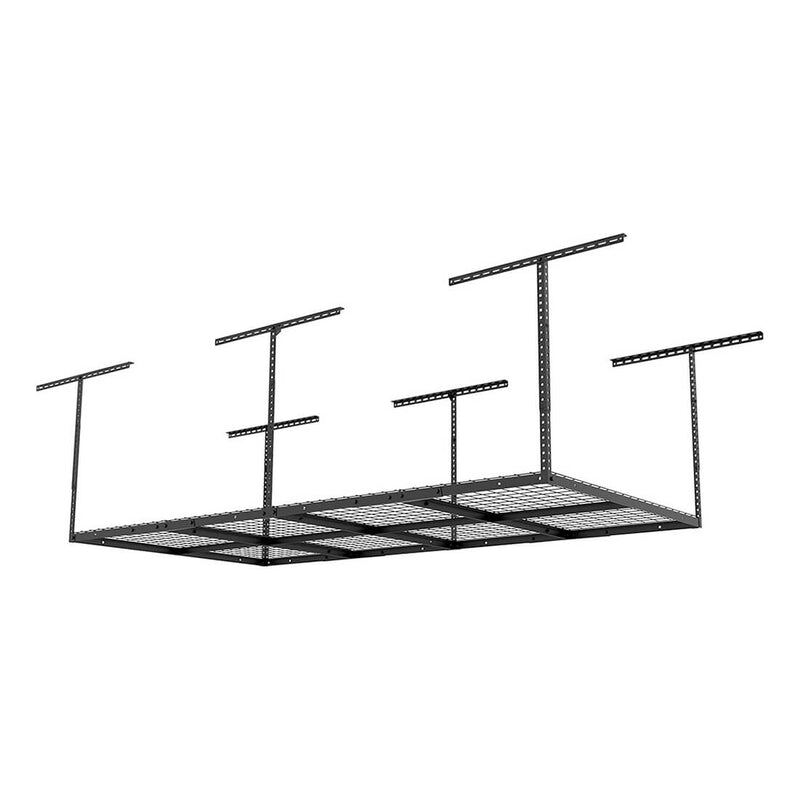
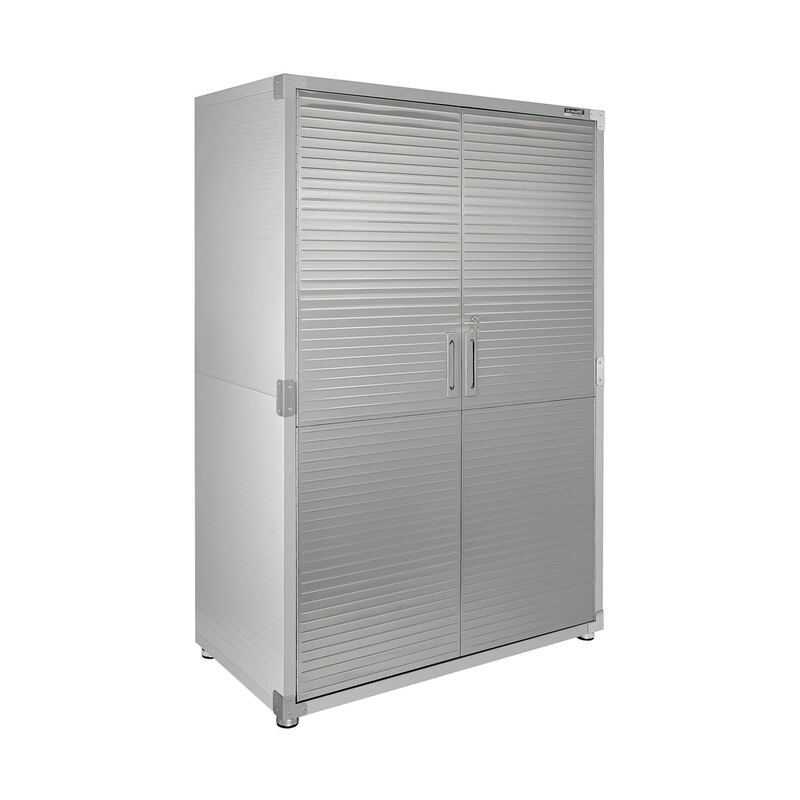
Compared to the Proslat Ultimate Bundle at #2, Gladiator panels hold less per square foot (50 vs 75 lbs) but the accessory ecosystem is far deeper. Unlike the FLEXIMOUNTS overhead rack at #3, this is a vertical wall solution — pair them rather than treat them as alternatives. The Seville Classics UltraHD cabinet at #4 hides clutter behind doors; GearWall keeps everything visible and grab-able.
Rating sources
“Interlocking 12" x 48" sections let you build coverage in stages, and Gladiator's long list of hooks, shelves and specialty attachments means you can change the setup as your needs evolve.”
“Each GearWall panel can hold a maximum of 50 lbs. per square foot.”
Our 4.7 score is the average of these published ratings. Ratings marked * were derived from the reviewer’s written analysis or video transcript — the publisher didn’t print an explicit numeric score, so we inferred one from their own words. Click through to verify. More about methodology.