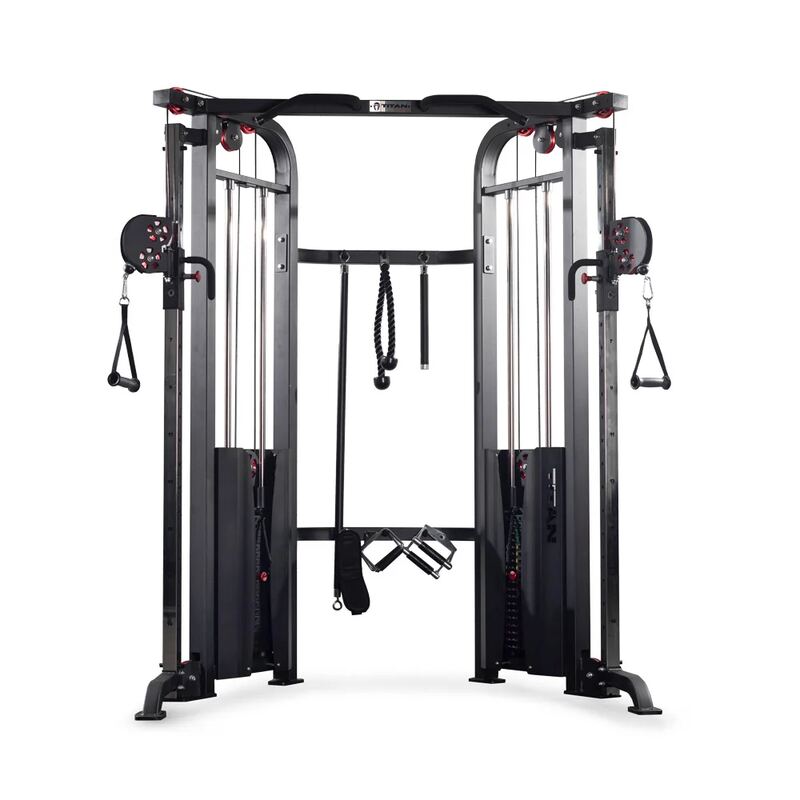
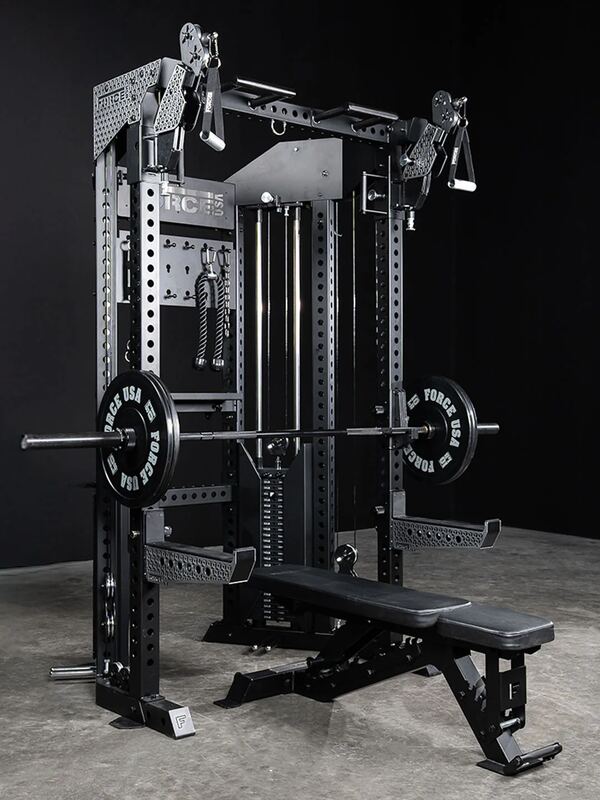
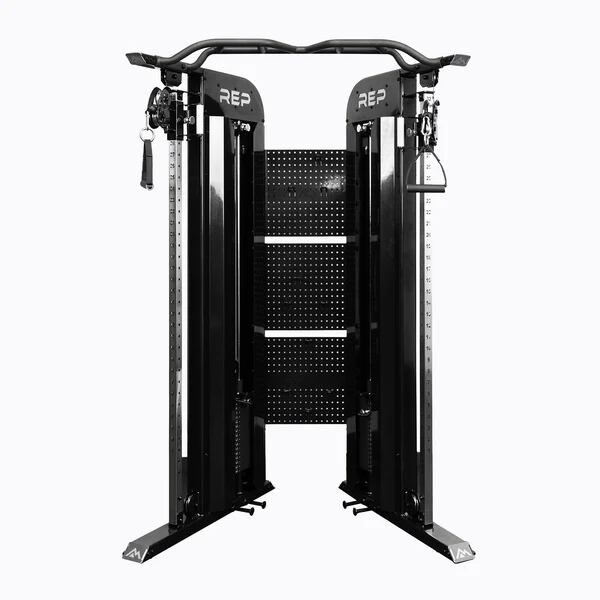
The Jungle Gym Reviews identified the 1:1 cable ratio as the standout feature, delivering exact stack weight for heavy compound movements unlike standard 2:1 competitors. However, this design results in 10 lb increments that may feel too coarse for lighter isolation exercises or rehabilitation work requiring finer progression steps. The trolley rollers are criticized for feeling cheap compared to the robust commercial-grade build quality of the frame. Home Gym HQ warned that the machine’s 92-inch height requires at least an 8-foot ceiling, limiting placement in smaller rooms or basements. This rack fits lifters prioritizing heavy loading capacity and universal metric 3x3 compatibility, but those needing small weight increments or lower clearance should look elsewhere.
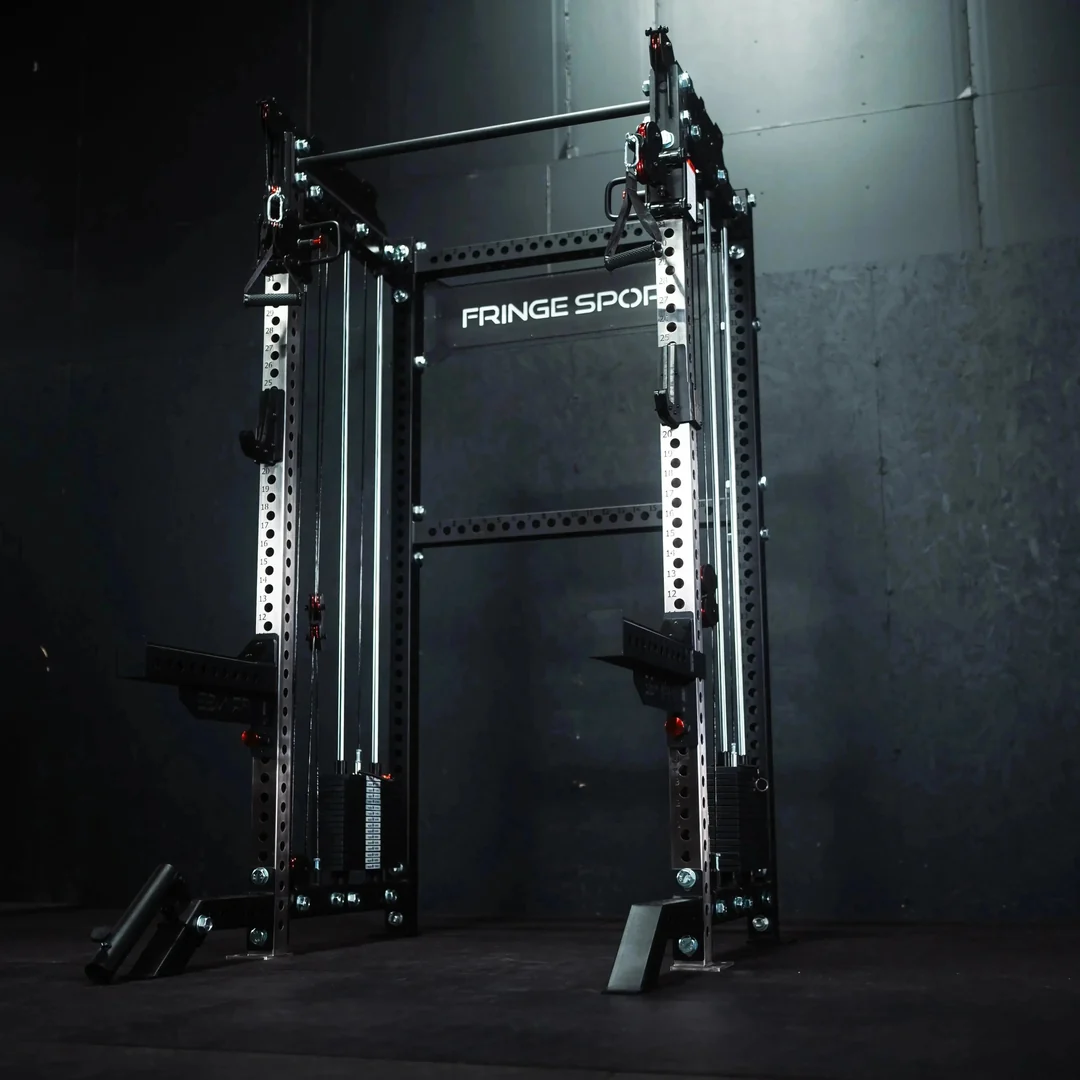
Full review
1:1 cable ratio delivers exact stack weight
The Jungle Gym Reviews identified the 1:1 pulley system as the primary reason to choose this rack over competitors in its price range. In a functional trainer with a standard 2:1 ratio, selecting 160 lbs on the pin actually yields only 80 lbs of resistance because the cable splits across two paths. The Dane 2.0 eliminates that mechanical discount entirely; when the selector pin is set to 160 lbs, the user pulls exactly 160 lbs at the handle. This distinction fundamentally changes how heavy compound movements are loaded on the machine.
Big John from Gym Radar confirmed this performance during real-world coaching scenarios, noting that the true ratio makes lat pulldowns and seated rows significantly more effective for building strength compared to budget alternatives. When performing low rows or belt squats using optional loading horns, the 160 lb stack provides a solid baseline of resistance without relying on mechanical advantage tricks. The Jungle Gym Reviews added that this setup allows lifters to push past 300 lbs when combining the weight stack with loaded horns, creating a heavy-lifting capability rarely found in all-in-one racks under $3,000.
10 lb increments limit light isolation work
The strict 1:1 ratio comes with a specific limitation regarding weight progression. The Jungle Gym Reviews noted that the stack only moves in 10 lb increments, starting at 10 lbs and going up to 160 lbs. This is a stark contrast to many 2:1 machines that offer 5 lb steps. For lifters focused on heavy compound movements like rows or pulldowns, this jump between plates is generally acceptable. However, for lighter users performing delicate isolation exercises, the granularity can feel too coarse.
Big John from Gym Radar highlighted a practical consequence of this design choice during home gym sessions with family members. He observed that while the 10 lb starting weight works well for strong adult lifters, it is often too heavy for women or children attempting single-arm shoulder work or light rehabilitation movements. The Jungle Gym Reviews pointed out that users who need to progress from 15 lbs to 20 lbs cannot do so on this machine without purchasing and attaching a separate magnetic add-on plate, which adds an extra layer of complexity to the setup.
Trolley rollers feel cheap compared to frame
The Jungle Gym Reviews singled out the trolley system as the most significant criticism of the build quality. While the 11-gauge steel frame is robust and heavily praised, the plastic components that guide the cables along the uprights do not match the premium feel of the rest of the machine. The trolleys rotate 180 degrees to allow for inner or outer cable routing, which is a useful feature, but the rollers themselves have been described as feeling inexpensive by reviewers who compare it to higher-end commercial equipment.
Despite this specific component complaint, other aspects of the cable system perform well. Big John from Gym Radar rated the overall cable system an 8 out of 10 in terms of smoothness and consistency. He noted that while the trolleys might feel cheap initially, they move freely without binding during actual use. The Jungle Gym Reviews also mentioned that the cables themselves are on par with competitors like the REP Aries and GetRXd Tornado, suggesting that the roller quality is a minor aesthetic or tactile flaw rather than a functional failure.
92-inch height restricts basement placement
Home Gym HQ warned potential buyers about the vertical clearance required for this machine. The Dane 2.0 stands at exactly 92 inches tall, which translates to just over seven feet and eight inches from the floor to the top of the pulleys. This height is necessary to accommodate the full travel distance of the cables in a 1:1 ratio system, but it creates a strict ceiling requirement for installation. Home Gym HQ emphasized that users must have at least an 8-foot ceiling to set this up safely.
This physical constraint makes the rack unsuitable for many common home gym environments, particularly finished basements or spare bedrooms with standard low ceilings. While garage gyms typically meet this height requirement without issue, anyone planning to install the Dane 2.0 in a tighter residential space needs to measure their vertical clearance carefully before purchasing. The machine does not offer a shorter variant, so compromising on ceiling height is impossible.
Cable travel limits standing distance
The 1:1 pulley ratio dictates that for every foot of resistance pulled by the user, the weight stack moves up exactly one foot. This mechanical reality severely limits how far a lifter can stand away from the rack while performing exercises like lat pulldowns or face pulls without running out of cable travel. Home Gym HQ explained that this is why the machine is designed to be 92 inches tall; a shorter frame would not provide enough rope length for full-range movements.
The Jungle Gym Reviews confirmed that Fringe Sport redesigned the weight plates on the 2.0 version specifically to increase available cable travel, resulting in roughly seven feet of usable rope. While this is sufficient for most standard exercises performed within arm's reach of the uprights, it prevents users from utilizing long resistance bands or performing movements that require significant distance from the machine. Users accustomed to standing several feet away from a cable crossover will find their range of motion restricted by the physical length of the cables.
Metric 3x3 frame allows universal attachments
The Jungle Gym Reviews highlighted that the Dane 2.0 utilizes metric 3x3 steel uprights with a 41-inch interior width, which matches the hole spacing and sizing of REP Fitness racks. This standardization is highly beneficial for home gym owners who want to mix and match components from different manufacturers. Users can attach J-cups, spotter arms, and various storage accessories from other brands without needing proprietary parts exclusive to Fringe Sport.
Big John from Gym Radar praised the pop-pin locking mechanisms on the included spotter arms and J-cups for their security and ease of adjustment. The metric 3x3 compatibility means that as users expand their gym over time, they can add cross-members or other structural attachments without worrying about frame incompatibility. This modular approach extends the lifespan of the investment, allowing the rack to evolve alongside the user's training needs.
User assembly requires cable tension adjustment
Gym Radar owner reviews revealed that initial setup involves more than just bolting the frame together; proper cable installation is critical to prevent operational issues. One user, JD from THE DRAGON’S DEN Gym, noted that cables must be perfectly straightened out before installation and tensioned correctly during assembly. Failure to do so results in significant twisting of the cables during use, which can degrade performance and potentially damage the pulley system over time.
Another Gym Radar owner, Valth606 from T-Bone's Black Cat Gym, reported that the lat pull-down seat moved excessively out of the box due to loose UHMW plastic wear pads. Fringe Sport customer service resolved this issue by sending replacement shims for free, demonstrating strong post-purchase support. The same user also dealt with cable twisting issues and received swivel clips from the manufacturer to mitigate the problem. These experiences suggest that while assembly is straightforward, users must pay close attention to tensioning details to avoid common early-stage faults.
Powder coat durability shows minor scuffing
Big John from Gym Radar rated the powder coat durability around a 7.5 out of 10, noting that while it was nearly flawless when uncrated, it can scuff during metal-on-metal contact with plates or bars. This is a common trait across many racks in this price range and does not typically expose bare steel unless subjected to extreme abuse. The stainless steel upright options available for the Dane 2.0 may offer better long-term resistance to cosmetic wear compared to the standard black powder-coated version.
Home Gym HQ deducted half a point from their durability score specifically because of this coating vulnerability, emphasizing that any painted surface will eventually show signs of wear in a high-traffic home gym environment. Despite these minor aesthetic blemishes, reviewers consistently agreed that the structural integrity of the 11-gauge steel remains completely unaffected by surface scratches or chips.
Strengths
- +1:1 cable ratio delivers the exact weight selected on the stack, unlike most competitors that use a 2:1 ratio.
- +Dual 160 lb weight stacks provide sufficient resistance for heavy compound movements like lat pulldowns and rows.
- +Commercial-grade build quality with 3x3, 11-gauge steel uprights and stainless steel options available.
- +Metric 3x3 compatibility allows the use of J-cups, spotter arms, and attachments from other brands like REP Fitness.
Watch-outs
- −Trolley rollers are criticized for feeling cheap compared to the rest of the build quality.
- −10 lb weight increments can be too large for lighter isolation exercises or users accustomed to 5 lb steps.
- −92-inch height requires at least an 8-foot ceiling, limiting placement in smaller rooms or basements.
How it compares
The Fringe Sport Dane 2.0 features a 1:1 cable ratio that delivers the exact weight selected, avoiding the halved effective resistance found in the Force USA FTR and REP Fitness Arcadia. While it offers heavier actual stack weights than the Arcadia's dual 170 lb setup, its 10 lb increments are coarser than the five-pound micro-adder steps available on the REP model.
Rating sources
“The Fringe Sport Dane 2.0 is what I consider to be my favorite budget pick for an all-in-one functional trainer power rack.”
“Other competitors like Rep, Rogue, Titan, all have similar options, but they're about double the price. And this is really what put Fringe Sport on the map.”
Our 4.5 score is the average of these published ratings. Ratings marked * were derived from the reviewer’s written analysis or video transcript — the publisher didn’t print an explicit numeric score, so we inferred one from their own words. Click through to verify. More about methodology.