The Ecovacs Goat A3000 LiDAR PRO cuts efficiently and has strong app functionality, according to PCWorld's Ed Oswald, but Bluetooth connectivity, narrow passage navigation, and slope detection problems keep it out of the top spot. PCMag's Tyler Hayes points to the dual-LiDAR system and fast cutting performance while acknowledging the same shortcomings. Buyers who want a capable, app-driven mower are the fit; anyone who needs precise navigation or has challenging terrain should consider alternatives.
Full review
Performance and Cutting Quality
The Ecovacs GOAT A3000 LiDAR PRO delivers impressive cutting performance with its dual spinning discs featuring three blades each, achieving a cutting width of 12.99 inches that surpasses many competitors like the Eufy E18's 8-inch width. PCMag's Tyler Hayes noted that while the blades are razor-like and effective, some corrosion appeared after only a couple of weeks of testing, though no performance degradation was observed yet. The mower operates at 1.31 feet per second in delicate mode and 2.3 feet per second in efficient mode, providing a balance between thoroughness and speed. TechAeris reviewer Alex Hernandez highlighted that the mower's performance is solid and predictable, but also pointed out that the blades may not hold up well on rocky terrain and tree debris common in rural settings.
The cutting quality is generally commendable, with the mower handling typical lawn conditions effectively. However, its performance varies significantly based on lawn conditions. TechAeris noted that the mower struggled with challenging terrain including slopes, rocky areas, and tree debris, requiring manual intervention. In contrast, PCWorld's Ed Oswald found the mower efficient even at default speed, though he noted some issues with navigation through narrow passageways and slope detection.
Navigation and Mapping Capabilities
The GOAT A3000's dual-LiDAR navigation system represents a significant advancement, eliminating the need for GPS antennas or base stations. TechAeris emphasized that the lack of base-station requirements makes this mower particularly appealing, especially for suburban lawns with defined borders. The 360-degree rotating LiDAR sensor paired with a 3D Time-of-Flight (ToF) sensor on the front enables accurate mapping and navigation without external signals. PCMag's Tyler Hayes confirmed that the AIVI 3D system uses a fisheye camera to identify over 200 different object types, though he couldn't verify this in his testing environment.
Despite these advanced features, navigation performance varies considerably. TechAeris reported that while smart auto-mapping works well in ideal conditions, his challenging rural terrain required manual mapping. The mower's inability to distinguish tall grass from actual obstacles was a recurring issue, causing it to treat patches of taller grass or weed stems as obstacles, leaving small uncut areas that required manual correction. PCWorld's Ed Oswald also noted problems with narrow passageways and slope detection, suggesting that while the LiDAR system is powerful, it's not foolproof in complex environments.
Handles inclines up to 27 degrees
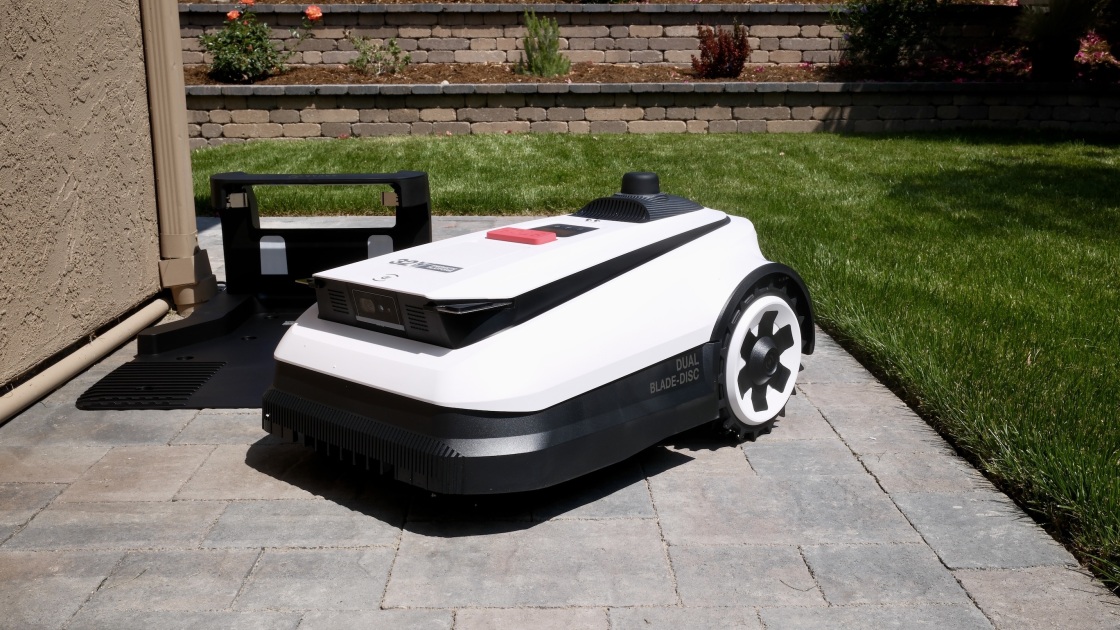
The GOAT A3000 features a robust build quality with a heavy-duty, injection-molded polymer chassis that feels built for outdoor abuse. It measures 27.8 x 23 x 12.2 inches and weighs approximately 40 pounds, making it substantial but manageable with handles provided for lifting. The mower has an IPX6 waterproof rating, allowing it to be hosed down like a car for cleaning. The wheel setup includes smooth front casters for steering and precision, with tread-patterned rear drive wheels for actual work, enabling it to handle inclines up to 27 degrees or 50% grade.
However, design elements show mixed results. TechAeris noted that while the front casters look nice, they're problematic on rocky and uneven terrain, a common issue in rural settings. The back wheels are described as 'fantastic' and 'rugged,' but the front casters don't perform well in challenging conditions. The emergency stop button is prominent and easily accessible, though the overall design is criticized for being awkward to carry due to its size and weight. The charging contacts are located on top of the mower and charging station, which BGR's Christian de Looper found improved docking and charging reliability compared to previous models.
App and Setup Experience
Setup and app functionality represent one of the GOAT A3000's strongest points, with PCMag's Tyler Hayes praising the ease of initial setup through the Ecovacs Home app. The app provides extensive control features including no-go zones, pathway zones, animal detection, avoidance sensing, rain sensing, speed control, pattern choices, and cut height adjustments. TechAeris praised the app and setup, noting that the app has 'a ton of features' and provides 'a massive amount of control and notifications.' The app's interface is described as intuitive, with the ability to map different zones and control various mower functions through smartphone integration.
Despite the app's strengths, there are notable drawbacks. PCWorld's Ed Oswald reported unreliable Bluetooth connectivity during manual mapping, which disrupted the setup process. The mower's charging dock is included and requires only a flat, open area near a power outlet, with no need for separate RTK antenna positioning or wire burial. However, the setup process still requires significant time investment, particularly in complex environments where manual mapping is necessary. TechAeris noted that while setup is simple in theory, the process took considerable patience and tweaking in challenging terrains.
Battery performance drops significantly in heat
The GOAT A3000's 5Ah lithium-ion battery powers a 32-volt motor that can be fully charged in 45 minutes, though this rapid charging capability doesn't necessarily translate to extended runtime. TechAeris reported that battery life is inconsistent and heavily influenced by environmental factors, particularly heat. On hot days, the battery did not last nearly as long as expected, requiring multiple charges to complete mowing tasks in his 19,000-square-foot rural property. The mower's performance depends significantly on the number of slopes in the yard and the power output required.
PCMag's Tyler Hayes noted that while the mower is quieter than many competitors at 62 decibels, the motor, wheels, and plastic cover were louder than the disc blades themselves. The battery performance is described as a 'crapshoot' with elements playing a large factor, indicating that outdoor conditions significantly impact operational time. The mower's ability to return to its charging station automatically is a positive feature, but the battery's inconsistent performance in various conditions limits its overall reliability in demanding environments.
Bluetooth connectivity issues during setup
The GOAT A3000's main shortcomings include inconsistent navigation in complex environments, unreliable Bluetooth connectivity during setup, and poor performance in challenging terrain. TechAeris specifically noted that the mower struggles with rural lawns that have slopes, rocky areas, and tree debris, requiring significant manual intervention and time investment. PCWorld's Ed Oswald highlighted issues with narrow passageways and slope detection, while also noting that the mower's navigation system is too sensitive to 'passable' obstructions such as overgrowth. The Bluetooth connectivity problems during manual mapping were also reported by PCMag's Tyler Hayes, indicating that setup can be disrupted by technical issues.
Additional concerns include the mower's inability to handle certain lawn conditions effectively. TechAeris found that the front caster wheels are problematic on uneven terrain, and the blades may not hold up well on rocky surfaces. The mower's performance in hot weather conditions was also criticized, with battery life significantly reduced during high temperatures. Furthermore, while the mower is designed for lawns up to 0.75 acres, it may not be suitable for larger or more complex properties without significant manual intervention. The price point of $2,499.99 also makes it less accessible for budget-conscious consumers, especially when considering its limitations in challenging environments.
Best in manicured suburban yards, not rural terrain
The Ecovacs GOAT A3000 LiDAR PRO is best suited for suburban homeowners with medium-sized, well-defined lawns that are relatively flat and free from significant obstacles. TechAeris emphasized that the mower performs best in manicured suburban settings with defined borders and areas, while PCMag's Tyler Hayes recommended it for lawns of at least 1,000 square feet. The mower's advanced navigation system and lack of base-station requirements make it particularly appealing to homeowners with simpler lawn layouts where the technology can function optimally.
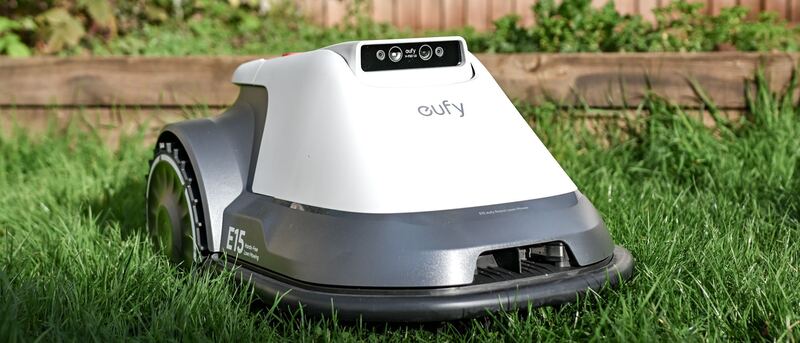
However, the mower is not recommended for rural dwellers or those with challenging terrain including slopes, rocky areas, tree debris, or uneven ground. TechAeris explicitly stated that this mower would score higher in suburban settings but would find rural lawns challenging. The mower's performance in complex environments requires significant manual intervention, making it less ideal for homeowners who want a truly hands-free experience. Additionally, the price point of $2,499.99 makes it a significant investment that may not be justified for those with smaller or simpler lawns where more affordable alternatives like the Eufy E18 ($1,999.99) or Husqvarna Automower 435X AWD ($2,999.99) might be more appropriate.
12.99-inch cutting width beats the Eufy E18
When compared to other robot mowers, the GOAT A3000 stands out with its dual-LiDAR navigation system that eliminates the need for GPS antennas or base stations. PCMag's Tyler Hayes noted that while it's more expensive than the Eufy E18 ($1,999.99), it offers superior cutting width at 12.99 inches versus 8 inches. The mower also provides more advanced features like rain sensing and object/pet avoidance sensors, which are standard in competing models. However, its performance in complex environments is not as robust as the Husqvarna Automower 435X AWD, which can handle slopes up to 70% (35-degree angle) compared to the GOAT A3000's 50% (27-degree) capability.
The GOAT A3000's main competitor in the high-end segment is the Husqvarna Automower 435X AWD, which offers superior ruggedness and slope handling but at a similar price point. While the GOAT A3000 excels in navigation and app features, the Husqvarna model handles rougher terrain better. For those seeking a more affordable option, the Eufy E18 provides similar cutting performance at a lower price but lacks the advanced navigation capabilities of the GOAT A3000. The A2500 model offers a middle ground with similar features but smaller battery capacity and recommended lawn size of 0.5 acres compared to the A3000's 0.75 acres.
Strengths
- +Far more powerful than most robot mowers
- +Outstanding app
- +Fast, efficient cut even at its default speed
- +Dual-LiDAR navigation system with 360-degree sensor and forward-facing LiDAR with AI camera
Watch-outs
- −Unreliable Bluetooth connectivity during manual mapping
- −Poor navigation through narrow passageways
- −Some slope and cliff detection issues
How it compares
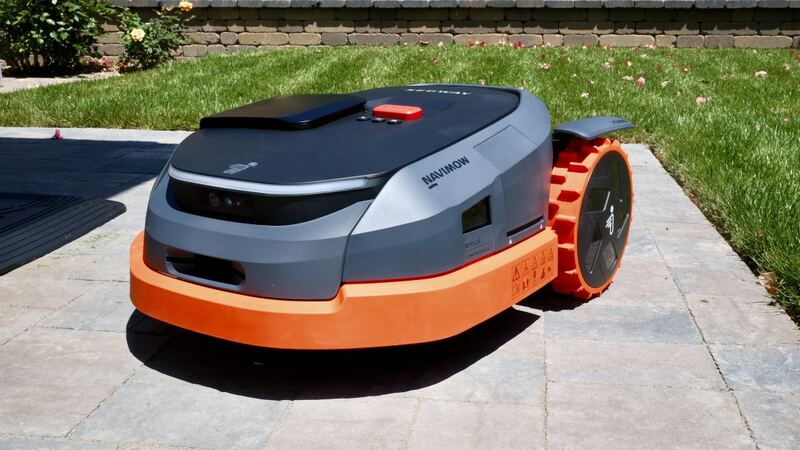
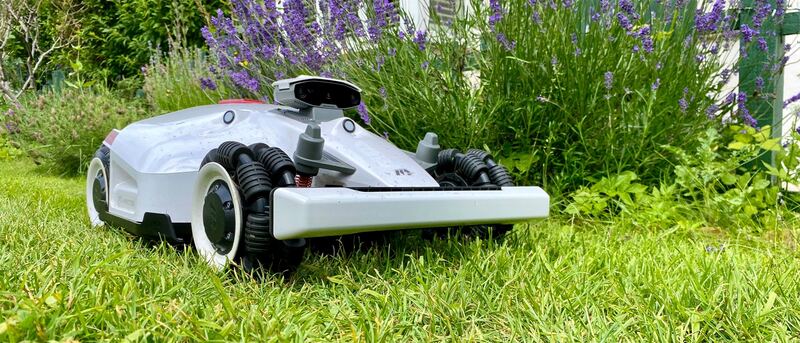
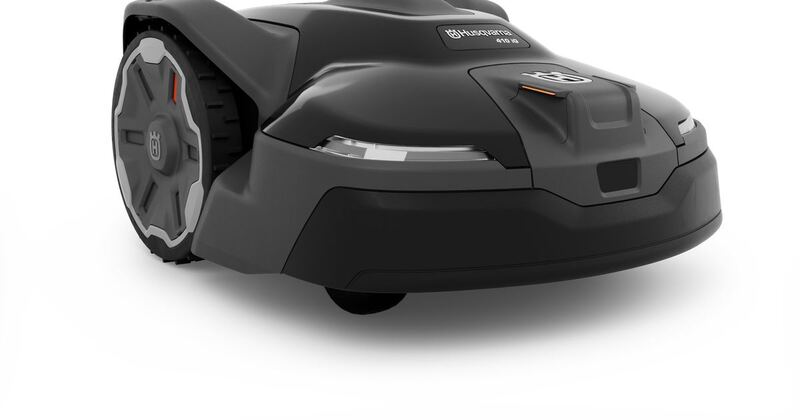
The Ecovacs GOAT A3000 LiDAR PRO stands out with its dual-LiDAR navigation system and fast cutting performance, but it falls short compared to the Segway Navimow X390 in terms of accuracy and the Mammotion Luba 2 in overall reliability. Unlike the Husqvarna Automower 410 iQ, it lacks radar detection and wireless EPOS technology, making it less suitable for challenging conditions.
Rating sources
Our 3.8 score is the average of these published ratings. More about methodology.