Among self-watering containers the EarthBox Original is the gold standard, and it suits balcony, patio and indoor-outdoor gardeners who can't water daily. Sub-irrigation from a 3-gallon reservoir buys 3-7 days of vacation reliability. Capacity is the obvious trade-off, since 2 cubic feet won't replace a real raised bed. For what it does, nothing else on this list comes close.
Full review
How the Self-Watering System Works
The EarthBox is a sub-irrigated planter (SIP). At the base of the container sits a 3-gallon water reservoir; above it is a perforated aeration screen that supports the soil and creates a wicking surface. The soil sits on top of the screen and draws water up through capillary action as the plants need it. The result is consistent root-zone moisture without daily watering — three to seven days between fills depending on plant size, sun exposure, and temperature.
Garden Bed Gear's review explains the mechanic clearly: the sub-irrigated design offers water efficiency, consistent moisture delivery, and reduced soil-borne disease risk. The overflow drain on the side prevents over-watering — once the reservoir is full, excess simply drains out. Alan at Homestead Advisor noted the water reservoir will hold about three gallons of water, which is enough to feed the box for several days even in summer.
Unchanged design since 1994, still 29x13.5x11 inches
The EarthBox is injection-molded BPA-free food-safe plastic, UV-stabilized for outdoor use. The EarthBox brand has been in market since 1994, originally developed by commercial tomato farmers, and the product has not changed materially in 30 years — the same dimensions (29 x 13.5 x 11 inches), the same 3-gallon reservoir, the same aeration screen design. Homestead Advisor's Alan called out the original EarthBox has been around since 1994 and has been implemented all over the world.
The plastic UV-stabilization is the load-bearing durability spec. Alan reported owning 10 EarthBox units and explicitly said he stopped trying to build DIY versions because the EarthBox lasts longer than what he could fabricate, citing a 15+ year service life. The Kitchen Garten described the EarthBox as one item in their garden that gives consistent harvests year after year. The trade-off versus metal or wood is aesthetic — the plastic looks like plastic, and the color palette is utility-grade (Terra Cotta, Green, Black, Sage, Gray, Chocolate). All components are recyclable at end of life, which matters more for buyers who plan to scale to ten or twenty units over multiple seasons.
What's in the Box
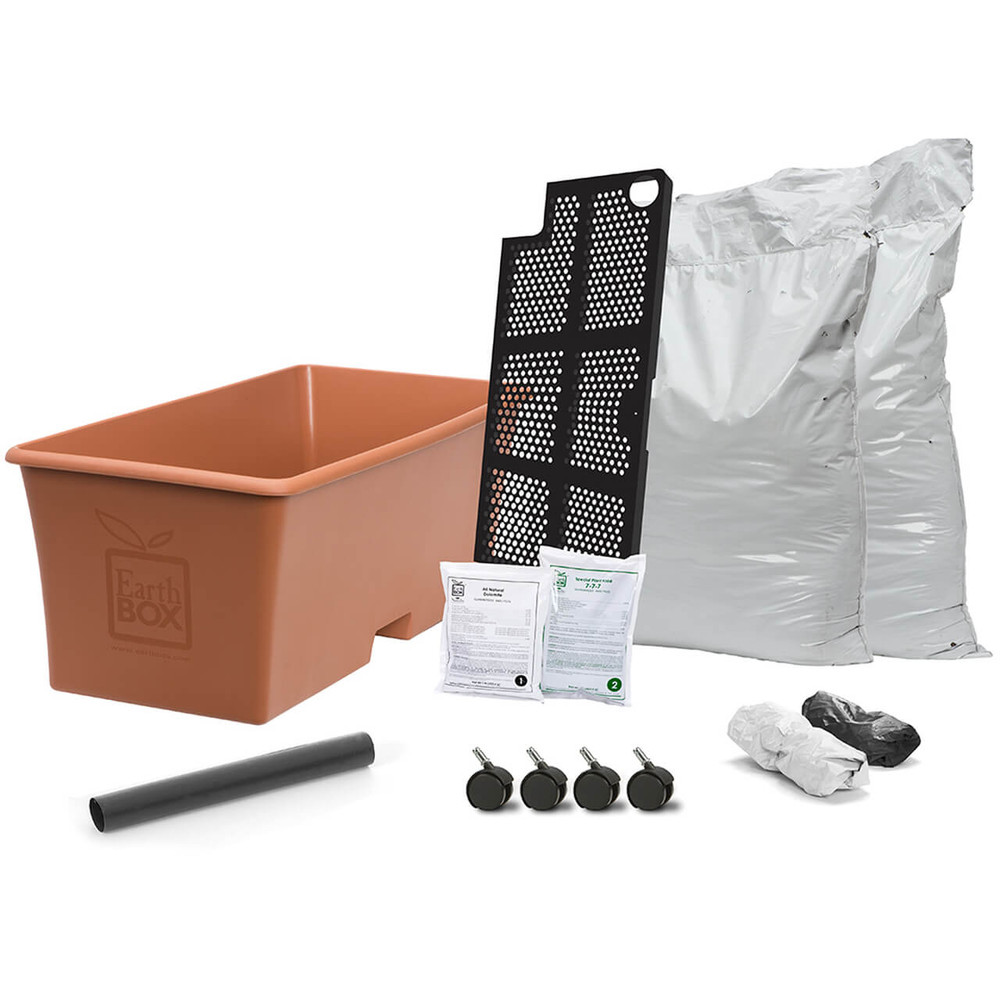
The Original kit ships with everything to plant immediately: the EarthBox container, the aeration screen, the water fill tube, two reversible black-and-white mulch covers, 1 lb of fertilizer (Natural 8-3-5 blend), and 1 lb of dolomite. Add 2 cubic feet of potting mix (not garden soil — the wicking action requires loose, draining mix) and you're ready to transplant.
The mulch cover is non-optional. The covers fit tight against the container rim and serve two roles: they keep the fertilizer strip dry (preventing nutrient leaching from rain) and they suppress weeds while reducing evaporation from the soil surface. EarthBox specifically warns against leaving the cover off — rain on the fertilizer strip will burn plant roots within a few weeks. Reversible black/white lets you choose heat absorption (black for cool spring) or reflection (white for hot summer).
Plant Capacity and Yield
The EarthBox supports two large fruiting plants per box (tomatoes, peppers, eggplant), four to six leafy greens (lettuce, kale, chard), or up to 16 of the small-root crops (onions, carrots, radishes). The 2 cubic feet of soil is the limit; pack it tighter and yields drop because root crowding cuts available water at the root level. The recommended planting density is on the EarthBox-supplied planting guide and is conservative on purpose.
USDA-cited research compared EarthBox sub-irrigation to traditional in-ground gardening and documented yield improvements on indeterminate tomatoes and bell peppers. The Kitchen Garten reported the box is foolproof and makes patio gardening easy from a nearby chair, and Alan at Homestead Advisor scaled to 10 units to handle his family's vegetable production. The implication is real: per square foot, EarthBox out-yields most raised beds because the wicking water delivery never lets the plants dry-stress.
Assembles tool-free in under five minutes
Assembly is genuinely tool-free and completes in under five minutes. Drop the aeration screen into the container, slide the fill tube through its slot, add 2 cubic feet of potting mix, mix in the dolomite for the bottom half, lay the fertilizer strip down the center, place the mulch cover over the top, and cut planting slits where your transplants go. The instruction manual walks through the sequence; Garden Bed Gear noted the EarthBox requires no tools for assembly, making it accessible to all gardeners.
The two friction points are sourcing the right potting mix (not topsoil, not garden soil — must be peat-perlite based for capillary wicking) and getting comfortable with the fertilizer strip. The 1 lb of fertilizer goes in a single line down the center of the box under the mulch cover, where it slowly releases over the season. Many first-time users spread it across the surface and over-fertilize early. The EarthBox-supplied guide is unusually clear on this; follow it.
15 years of service with no replacement parts
Alan at Homestead Advisor reported 15+ years of service from his EarthBox units, with no UV degradation, no cracking, and consistent reservoir performance season after season. The Kitchen Garten's reviewer cited consistent harvests year after year. The plastic does fade slightly in continuous full sun, but reviewers report no functional degradation — the wicking action and the reservoir seal hold.
The one ongoing maintenance task is reservoir cleaning. Algae will grow in the reservoir if you don't drain and refresh it every 2-3 months in active season. The drain plug on the side makes this a 5-minute job, but skipping it for full seasons can clog the wick and reduce capillary draw. EarthBox sells replacement aeration screens and fill tubes for under $10 each, but most users never need them. Winter storage is straightforward — empty the reservoir, knock loose soil out (or leave it in for early spring), and stack the boxes nested under a porch overhang.
Two cubic feet fits just two tomato plants
Capacity is the obvious caveat. Two cubic feet supports two tomato plants — full stop. To match the planting volume of the Vego, Birdies, or Greenes Fence beds you'd need 10-20 EarthBox units, which gets expensive fast (at $43-$99 each, you cross $500 quickly). EarthBox is best understood as a high-yield specialty container, not a raised-bed replacement.
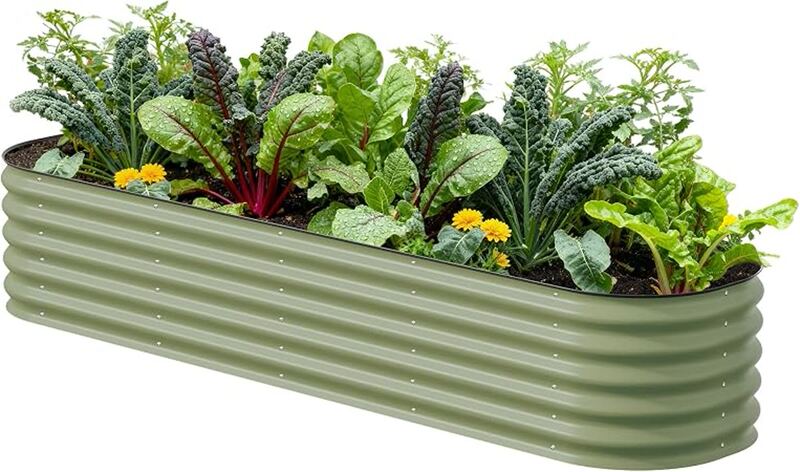
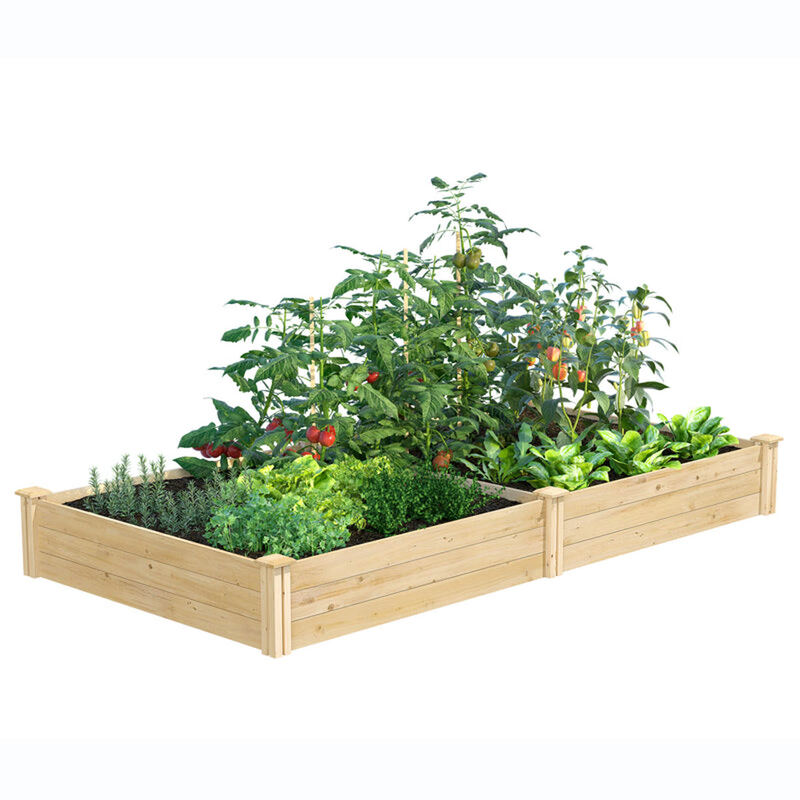
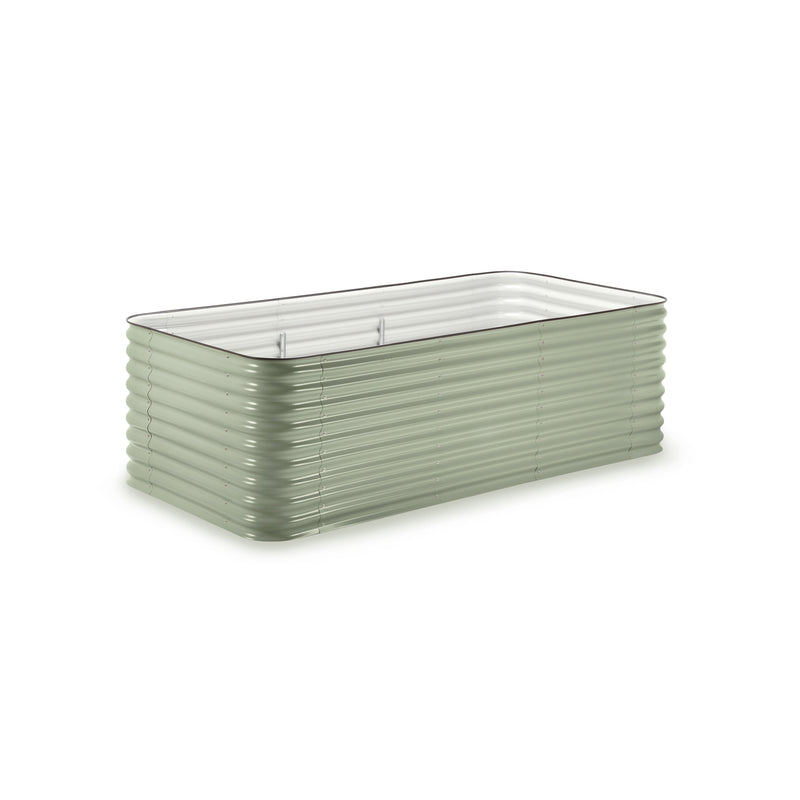
The plastic aesthetic also matters for some users. Compared to the natural cedar of the Greenes Fence or the powder-coated metal of the Vego and Birdies, the injection-molded plastic looks utility-grade. EarthBox offers six colors but none are visually premium. For a front-yard install, this matters; for a deck or rooftop, less so.
Buys 3 to 7 days of vacation-proof watering
Buy the EarthBox Original if you have limited space (balcony, patio, rooftop, indoor-outdoor setup), if you travel and can't water daily, or if you want vegetable-yield reliability without the fussiness of timing irrigation. The 3-gallon reservoir genuinely buys you 3-7 days of vacation-proofness, and the documented yield gains versus in-ground gardening are real.
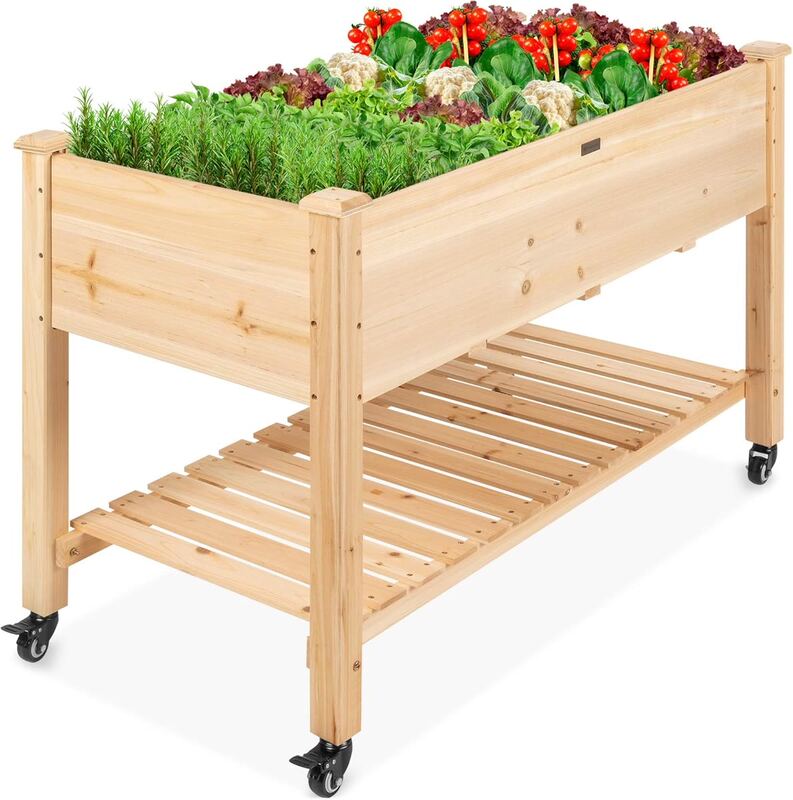
Skip it if you have ground space for a real raised bed (go Greenes Fence Premium Cedar for the value pick or the Vego 32-inch / Birdies 29-inch tall for the premium pick), if you want standing height for back/knee mobility (go Best Choice Products 48x24x32 Mobile Elevated), or if you want capacity for deep-root crops. Many serious gardeners buy a Vego or Birdies bed for the main garden and 2-3 EarthBox units for the patio herbs and tomatoes; the two are complementary, not competing. EarthBox also sells an optional Automatic Watering System that connects multiple units to a single hose-fed supply line — useful if you scale past 4-5 boxes or travel for weeks at a time.
Strengths
- +Includes everything to start: aeration screen, fill tube, fertilizer, dolomite, mulch covers
- +USDA-tested for self-watering yield gains versus traditional in-ground gardening
- +BPA-free, food-safe, UV-stabilized plastic with 15-plus year documented service life
Watch-outs
- −Only 2 cubic feet of soil capacity; not a substitute for a full raised bed
- −Optional caster bases sold separately for mobility
How it compares
The EarthBox Original Gardening System is the only true self-watering bed in this lineup. Its 2 cu ft capacity and 29-inch length make it a different category of product from the Vego Garden 32-Inch Extra Tall 9-In-1 Modular Metal Raised Garden Bed Kit (27+ cu ft in-ground bed), the Birdies Large Modular Raised Garden Bed 29-Inch Tall (38-87 cu ft in-ground bed), and the Greenes Fence Premium Cedar Raised Bed RC6T21B (28 cu ft in-ground bed). The closest functional comparison is the Best Choice Products 48x24x32 Mobile Elevated Raised Garden Bed for small-space gardening, but EarthBox wins on water reliability while Best Choice Products wins on standing height and mobility. Buy multiple EarthBox units for capacity equivalence.
Rating sources
“The EarthBox requires no tools for assembly, making it accessible to all gardeners.”
“one item in their garden gives consistent harvests year after year: the EarthBox”
Our 4.8 score is the average of the 2 scored reviews above; 1 more reviewed it without printing a score and is not in the average. Ratings marked * were derived from the reviewer’s written analysis or video transcript — the publisher didn’t print an explicit numeric score, so we inferred one from their own words. Click through to verify. More about methodology.