The CyberPower CP1500PFCLCD is a line-interactive UPS meant to protect high-end PC systems, rated at 1500VA with an LCD that lays out power statistics in detail. Tom's Hardware found the protection reliable and the interface easy to read, while Custom PC Review flagged that the simulated sine wave output won't suit every piece of sensitive equipment. It weighs 24.7 lb and runs 14.2 inches deep, so it works on a desktop but takes up more room than some alternatives. Mid-to-high-end systems are the target; anyone who specifically needs true sine wave output should look elsewhere.
Full review
A 900W ceiling behind the 1500VA badge
The CP1500PFCLCD is rated 1500 VA and 900 W, and the watt figure is the one that matters when sizing a system: a desktop drawing anywhere near it will not see the quoted runtime. The listing puts that runtime at roughly ten minutes at half load, which is time to save work and shut down in order rather than time to keep working through an outage. Line-interactive topology with automatic voltage regulation handles sags and brownouts without dropping to battery at all, which is the practical advantage over a cheap standby unit.
The LCD is what buyers are paying for
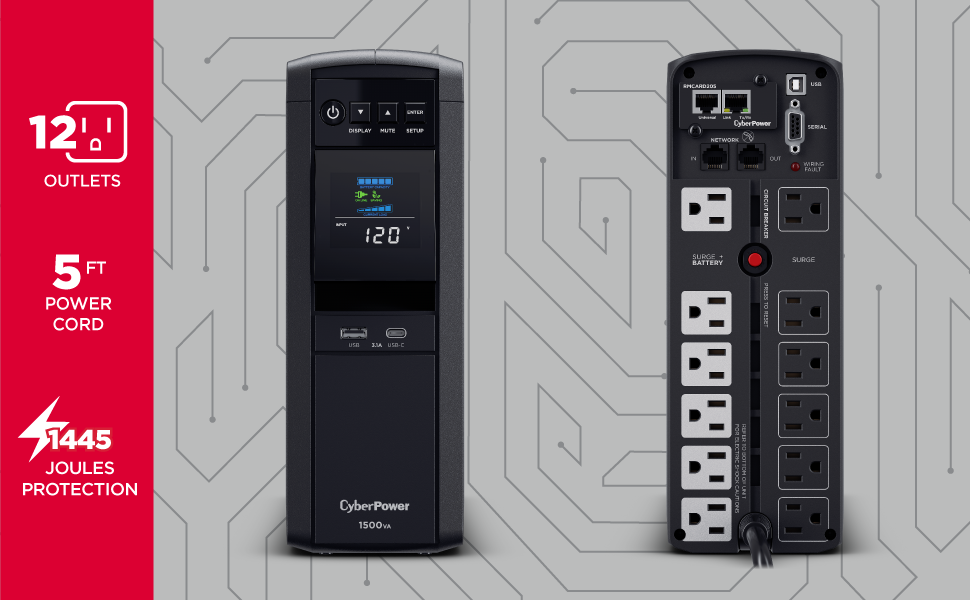
The front panel display is the feature that separates this from cheaper units in the range, cycling through input and output voltage, frequency, load and estimated runtime, alongside buttons for power, display, alarm silence and control. Custom PC Review rates it clear and readable at a distance. It is genuinely useful rather than decorative: a UPS that reports its own load is a UPS whose owner finds out about an overloaded circuit before the battery does.
PowerPanel Personal Edition covers shutdown and logging
The unit talks to a host over USB or serial and runs PowerPanel Personal Edition, which handles monitoring, scheduled self-tests, battery replacement reminders and unattended shutdown, and keeps a log of power events for later reading. Custom PC Review found installation straightforward and the alerting useful. It is basic next to enterprise UPS management, with no real network management story, but it does everything a single protected machine needs.
Firmware updates are the recurring owner complaint
Owner discussion keeps returning to the firmware update process, which has left units needing recovery over a serial connection after an update failed partway through. Most buyers will never attempt one, but it is the failure mode that turns a working UPS into a paperweight, and it deserves weighing against the monitoring features that make the unit attractive in the first place.
Replacement batteries come in below the originals
Both sealed lead-acid cells are user-replaceable, but the replacement kit ships at 8AH against the 9AH cells fitted at the factory, so a rebuilt unit gives up runtime against a new one — a detail that quietly changes the economics of keeping this alive for a second battery cycle. Reaching the cells means removing the front panel rather than sliding out a tray, which is more work than it should be.
A 14-inch footprint and 24.7 pounds
At 3.9 by 11.0 by 14.0 inches and 24.7 pounds this is a large object for a desk, and the depth is the dimension that causes trouble: it is deeper than many shelves and heavy enough that it wants a floor position with the cable run planned around it. Twelve NEMA 5-15R outlets are more than most competitors offer, which partly justifies the volume, and the plastic housing keeps the weight from being worse than it is.
Two published scores, a long way apart
The two reviews on file do not agree. Tom's Hardware, comparing this unit against the APC SMT1500 and the Tripp Lite SMART1500SLT, placed it last of the three; Custom PC Review, by contrast, called it an impressive UPS and recommended it. The site's own 2.3 sits between them. A buyer should read this as a contested product rather than a settled one, and should weigh the monitoring and outlet count against a professional review that placed it last in a three-way comparison.
Strengths
- +Features line-interactive topology for reliable power protection
- +Includes LCD display showing power statistics like voltage and frequency
- +Provides 1500VA capacity suitable for high-end PC setups
- +Equipped with USB and serial interface for computer monitoring
- +Includes user-replaceable maintenance-free sealed lead-acid batteries
Watch-outs
- −Outputs simulated sine wave instead of true sine wave
- −Battery replacement kit is lower capacity (8AH) than original (9AH)
How it compares
The CyberPower CP1500PFCLCD is rated 1500 VA and 900 W, the same as the Tripp Lite SMART1500LCDT, and lists 12 outlets against 10 on the Tripp Lite and on the APC BR1500G. Like the APC it uses a user-replaceable sealed lead-acid battery, and like the Tripp Lite it has an LCD for power status. It costs less than the APC.
Rating sources
“The main difference between the CyberPower CP1500 AVR LCD and the CP1500 PFC LCD is in their electrical output wave form.”
Our 4.4 score is the average of the 1 scored review above; 1 more reviewed it without printing a score and is not in the average. Ratings marked * were derived from the reviewer’s written analysis or video transcript — the publisher didn’t print an explicit numeric score, so we inferred one from their own words. Click through to verify. More about methodology.