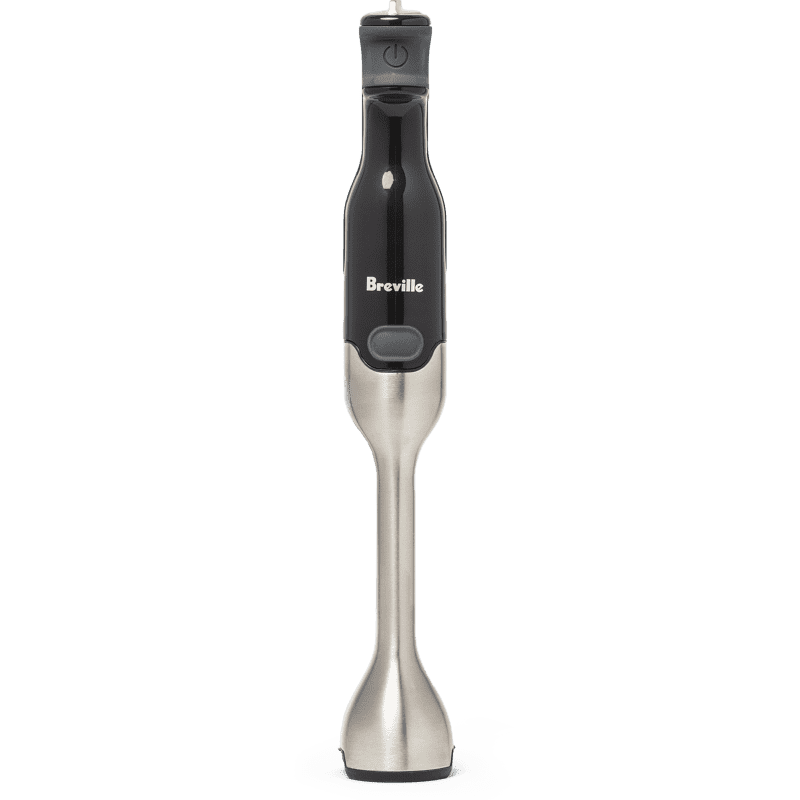
Breville's Control Grip is the most comfortable immersion blender to hold for extended use — the pistol grip is what every other stick blender wishes it had. The 15-speed dial gives finer control than any trigger or button system in this group, and the bell-shaped blade housing is genuinely splash-proof. It's a slower puree than the Braun on dense loads, but for soup, sauces, smoothies, and emulsification in a pitcher, it's a near-perfect tool.
Full review
Pistol Grip Ergonomics
The Control Grip's defining feature is exactly what its name says: a pistol-grip handle that positions your hand in line with the shaft instead of perpendicular to it, the way conventional stick blenders force you to hold them. After 60 seconds of pureeing soup, the wrist-strain difference is dramatic. Foodal noted in their hands-on that despite being heavier than the Cuisinart CSB-179, the Control Grip 'is easier to handle and operate' because the grip geometry takes load off your wrist.
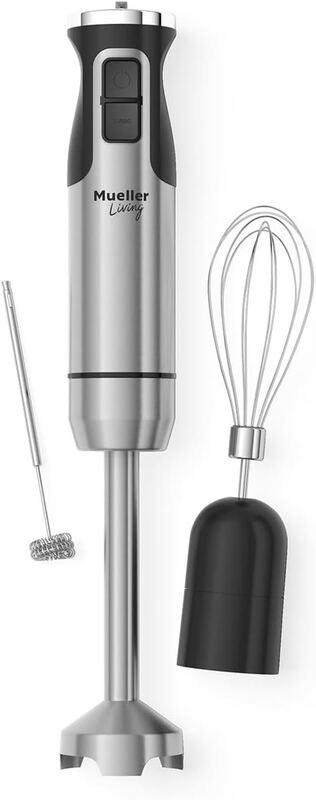
The trigger is on the underside where your index finger naturally lands. Press to engage, release to stop — there's no dial-then-press sequence the way the Mueller forces. For longer projects like batch-blending a stockpot of soup, this ergonomic difference shows up as you not noticing your forearm halfway through.
15-Speed Control Dial
On top of the motor body is a dial running from speed 1 through 15. Most immersion blenders give you 2, 5, or 9 fixed steps; the Control Grip's 15-step range is the finest control in this category. Shouldit measured the motor running from a low of 6,014 RPM up to 13,224 RPM, with smooth steps between. That precision matters for delicate emulsifications — hollandaise at speed 4, mayonnaise ramping from 3 to 8, soup puree at 12-15.
The downside is that the dial is at the top of the handle, not on the trigger. You set the speed, then press to engage. For pure soup-pureeing work this is fine; for tasks where you want to ramp speed mid-blend (the Braun MQ7077X's squeeze trigger), the Breville requires you to stop, dial, and restart.
Bell Blade Housing — Splatter Control
The Control Grip's bell-shaped blade guard is wider and deeper than a conventional stick. Foodal called out the design specifically: the bell creates a partial-vacuum chamber that pulls food down into the blade and traps splatter against the inner wall. In practice, this means you can puree tomato soup at speed 15 directly in the pot without orange spray on your stovetop.
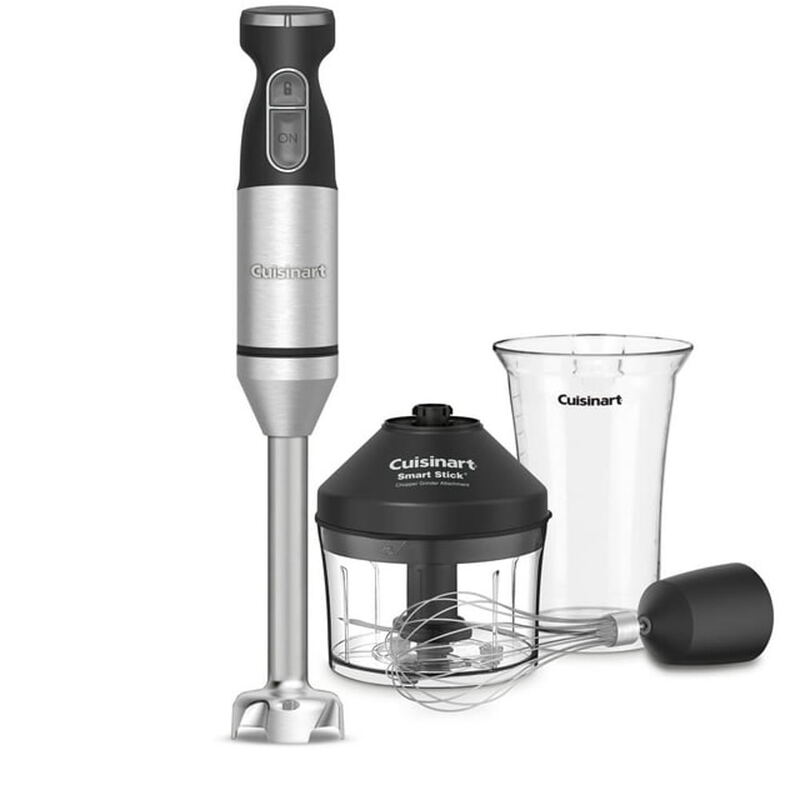
The tradeoff is shape clearance. The wider bell doesn't fit cleanly into narrow tall containers like quart mason jars or some tall protein-shake cups. If you blend often in small jars, this is the model that will frustrate you most — the Cuisinart CSB-179's narrower head fits where the Breville won't.
Attachment Bundle
Breville ships the Control Grip with a 42 oz jug (with a storage lid that doubles as an anti-slip mat), a 25 oz chopping bowl with a separate stainless chopping blade, and a wire whisk. All three attachments nest inside the jug for storage — a thoughtful touch in a category where most accessories sprawl across a drawer.
Notably missing: a food processor. If you want one tool that replaces a dedicated processor, the Braun MultiQuick 7's 6-cup bowl makes more sense. The Breville's 25 oz chopping bowl is enough for herbs, garlic, nuts, and small batches but won't replace a separate processor for larger jobs.
Build Quality and Materials
The motor body is BPA-free plastic with a metal-look finish; the shaft is one-piece stainless steel; the chopping bowl is BPA-free plastic with a stainless blade. Foodal described the build as 'aesthetic appeal and high-quality materials that make it feel solid' — and that holds up in person. Nothing on this tool creaks or flexes the way the Hamilton Beach and Mueller budget options do.
The 280W motor is the polarizing spec. Shouldit was blunt: 'heavy blending performance is limited' and the price 'doesn't fully live up to the hype.' That's fair on dense frozen loads, where the Braun MultiQuick 7's 500W finishes faster. For soup, sauces, and standard smoothies, 280W is plenty and the consistency of the result is what wins.
Where It Falls Short
Three real complaints. First, raw power: at 280W it's slower than the Braun on dense loads and noticeably slower than the Mueller on frozen smoothies despite the Mueller's lower price. Shouldit clocked frozen smoothie blending at 2:21, mayonnaise emulsification at 2:40 — both about double the Braun's times.
Second, the bell housing's footprint doesn't fit narrow containers. Third, the 1-year warranty is short for the price — Cuisinart's CSB-179 offers 3 years at a third the cost. None of these is a dealbreaker on its own, but in aggregate they explain why the Braun MultiQuick 7 has overtaken the Control Grip in most current head-to-head comparisons.
Who It's Best For
Cooks who do a lot of pitcher-and-jug blending — protein shakes, dressings, smoothies, soup batches — and care more about comfort and splatter control than maximum motor power. The 42 oz jug pairs naturally with the bell housing, and the 15-speed dial rewards anyone who emulsifies sauces regularly.
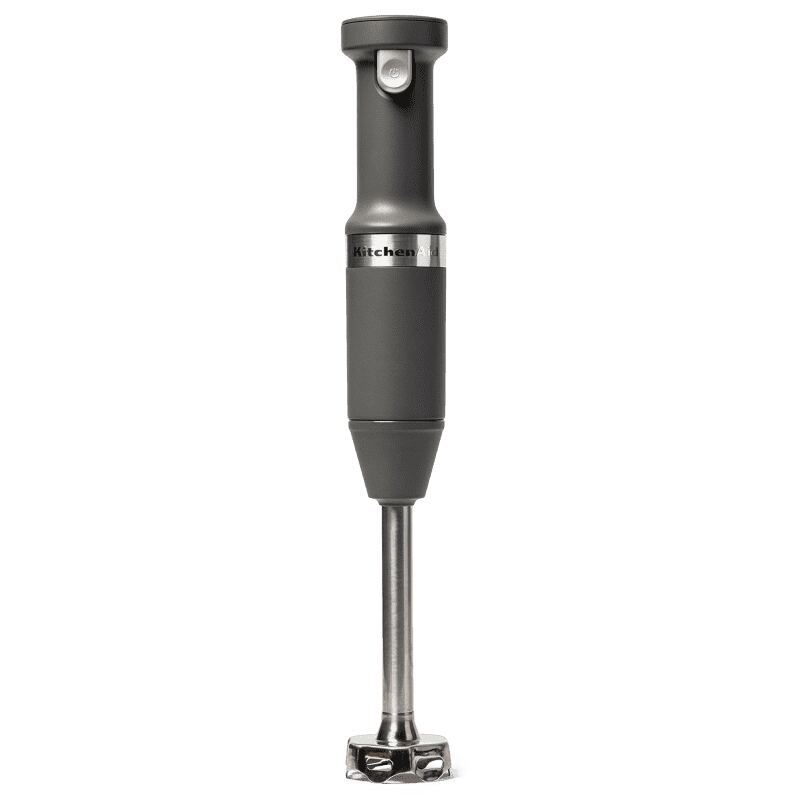
Skip it if you're primarily blending dense or frozen ingredients (the Braun MQ7077X is faster), if you blend in narrow jars (the bell won't fit), or if you want cordless freedom (the KitchenAid KHBBV83 is the answer there). For everyone else who values comfort and precision over peak power, this remains a top-three pick.
Long-Term Durability
Amazon reviews going back to 2012 show the Control Grip's longevity is genuinely strong — multiple 8+ year owners reporting the unit still working daily. The pistol-grip handle has no moving parts beyond the trigger; the dial mechanism is sealed; the one-piece stainless shaft has no joints to fail.
The thin warranty doesn't reflect actual failure rates so much as Breville's pricing strategy. Consumer Reports flagged the build quality positively but noted some users reported issues with the dial mechanism over time. If you blend every day, expect this to be a 6-10 year tool. Light users will easily get a decade.
Value at This Price
At $130, the Control Grip sits at the bottom of the premium tier. You get a complete kit (motor, shaft, jug, chopping bowl, whisk, lid) that nests for storage, finer speed control than anything else here, and the pistol-grip ergonomics that no competitor matches. Foodal called it 'our number one pick for most people' and that's a fair characterization of its value proposition — it's not the fastest blender, but it's the most pleasant one to actually use day to day.
Where the math gets harder is comparing it to the Braun MultiQuick 7 at $149. For $19 more you get a 6-cup food processor instead of a 25 oz chopping bowl, a masher, and a noticeably more powerful motor with finer-blade tech. If you'll use the food processor and masher, Braun wins on value. If you mostly blend in pitchers and want the most comfortable handle, the Breville's price gap is fully justified.
Noise Level and Operating Feel
Shouldit measured the Control Grip at 76 dB under load — louder than the Cuisinart CSB-179 but quieter than the Mueller. The pistol-grip handle absorbs more motor vibration than a vertical stick, so even though the absolute noise is comparable to other 280-300W blenders, it feels less harsh in hand. Most owners describe it as 'sounds like a kitchen appliance, not a power tool.'
The 15-speed dial gives you a quiet starting speed (1-3) that's appropriate for first-press splatter avoidance, and the trigger has no first-press blast the way the KitchenAid Cordless does. For early morning smoothies or late-night baby food without waking the house, this is the most considerate option in the roundup. The downside: under load at speed 12-15, the bell housing produces a distinctive whoosh as it pulls food past the blade — not loud, but unmistakably present.
Strengths
- +Ergonomic pistol grip is the most comfortable handle of any stick blender we tested
- +15 speed settings with a top-of-handle dial give precise control
- +Bell-shaped blade housing virtually eliminates splattering
- +Comprehensive bundle: 42 oz jug, 25 oz chopping bowl, whisk, and lid
- +Stainless steel shaft and high-quality build feel like a premium appliance
Watch-outs
- −At 280W it's noticeably slower than the Braun MultiQuick 7 on dense loads
- −Blade housing is wider than some narrow cups and mason jars
- −1-year warranty is short for the price
How it compares
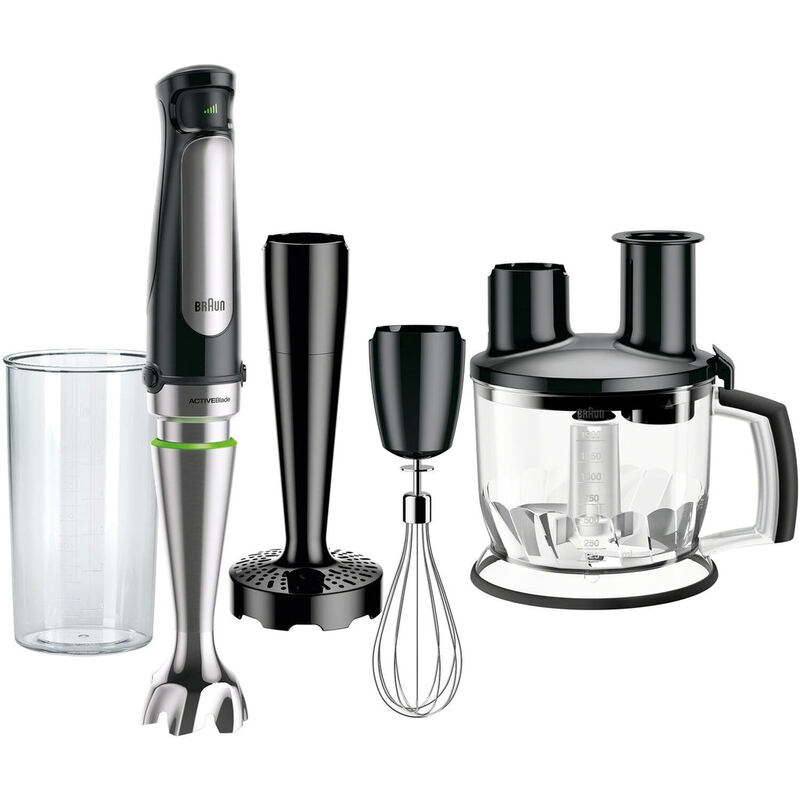
Loses to the Braun MultiQuick 7 on raw motor power (280W vs 500W) but wins on grip ergonomics — the pistol handle is genuinely more comfortable. Comes with a more comprehensive jug-and-bowl bundle than the Cuisinart CSB-179 but no food processor unlike the Braun. Heavier and bulkier than the cordless KitchenAid KHBBV83 — this isn't the right tool if maneuverability is your priority. Way more refined than the Mueller Ultra-Stick, as you'd expect at three times the price.
Who this is for
At a glance: Home cooks who blend in pitchers, jugs, and pots and value precise speed control plus splatter-free operation over raw blending power.
Why you’d buy the Breville BSB510XL Control Grip
- Ergonomic pistol grip is the most comfortable handle of any stick blender we tested.
- 15 speed settings with a top-of-handle dial give precise control.
- Bell-shaped blade housing virtually eliminates splattering.
Why you’d skip it
- At 280W it's noticeably slower than the Braun MultiQuick 7 on dense loads.
- Blade housing is wider than some narrow cups and mason jars.
- 1-year warranty is short for the price.
Rating sources
“This model blended some of the smoothest soups and smoothies in our tests.”
“The real benefit is how little this immersion blender splatters or spits — the BSB510XL Control Grip still remains our number one pick for most people.”
“It performs with consistent efficiency, though heavy blending performance is limited.”
“This model performed good in soup puree tests and yogurt blend tests with frozen fruit and yogurt.”
Our 4.5 score is the average of these published ratings. Ratings marked * were derived from the reviewer’s written analysis or video transcript — the publisher didn’t print an explicit numeric score, so we inferred one from their own words. Click through to verify. More about methodology.