Apple says its MagSafe Battery Pack extends iPhone 12 and 13 battery life by up to 60%, and real-world testing put the figure around 60% additional charge for iPhone 13 Pro users. It's compact, with strong magnets, a soft-touch finish, and iOS integration that needs no setup. Reviewers treated it as a premium option that earns its place on trips while costing too much for the capacity you get. iMore called it a 'premium battery pack for your iPhone 12,' and iPhone J.D. praised how well it held up on extended trips, though both flagged the high price and the modest battery size.
Full review
Larger than Anker, slimmer than mophie's design
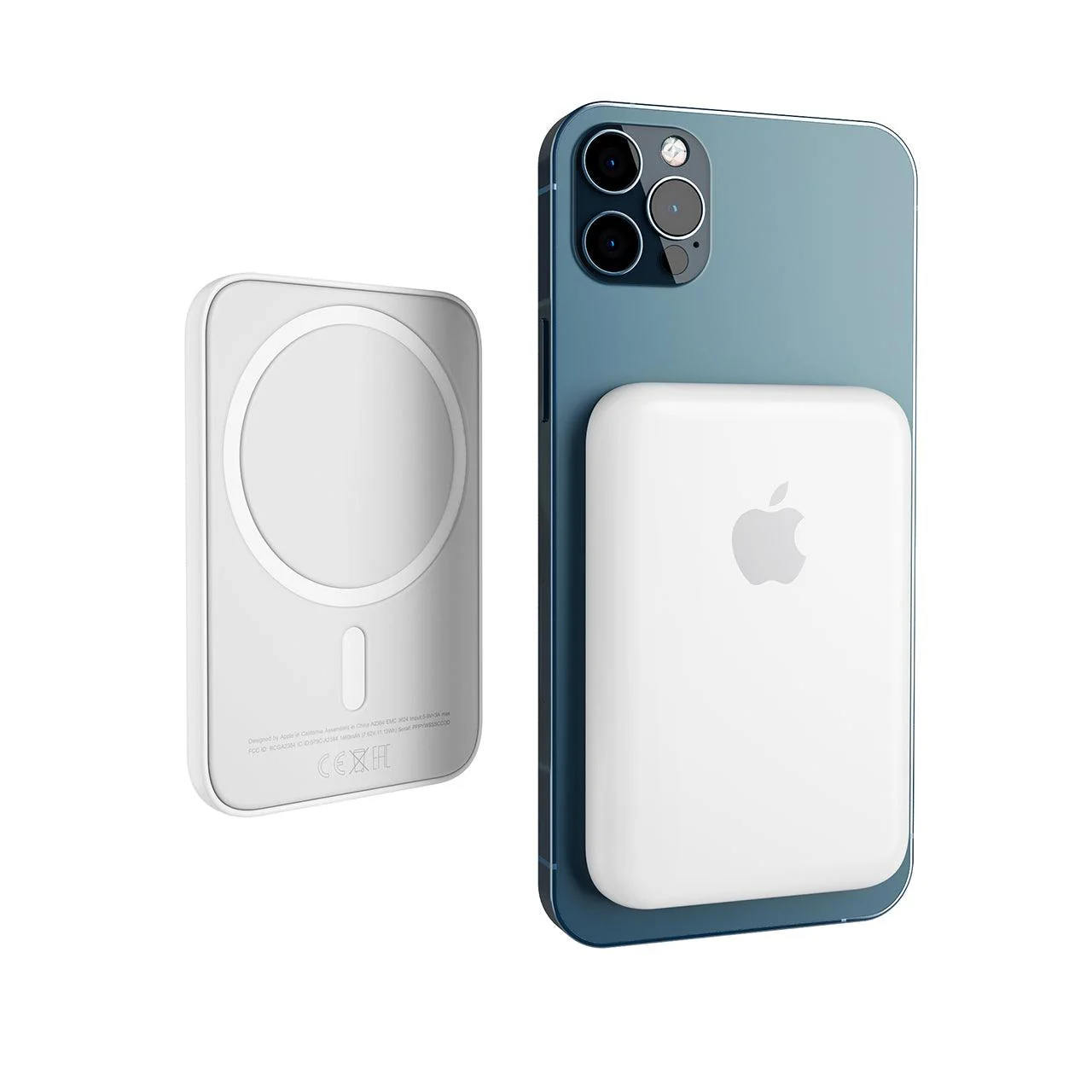
Apple's MagSafe Battery Pack employs a hard plastic construction with a soft-touch finish reminiscent of early 2000s white MacBook designs, according to iMore's review. The material feels premium yet practical, though some reviewers noted it can feel slightly bulky when pocketed. The pack measures 4.46-by-3.24-by 0.93 inches and weighs 6.53 ounces, making it larger than competitors like Anker's 3.66-by-2.46-by 0.63-inch model at 4.6 ounces. However, it's slimmer than mophie's 2.64-by-4.41-by 0.49-inch design at 4.77 ounces. The battery pack features a single Lightning port on the bottom and a status LED indicator, with a magnetic surface that includes silicone padding to prevent scratches on the iPhone. The magnetic attachment is strong enough to hold securely during use, though iPhone J.D. reviewer Jeff Richardson noted it's not as powerful as some third-party alternatives like PopSockets PopGrip for MagSafe, which claims 6x stronger magnets. The pack's design allows for seamless integration with Apple's ecosystem, including a unique launch animation that displays remaining battery life, as reported by AppleInsider.
1,729mAh delivered to the 14 Pro Max
In practical testing, the MagSafe Battery Pack delivers approximately 60% additional charge for iPhone 12 and 13 models, according to Apple's specifications and confirmed by iPhone J.D. reviewer Jeff Richardson during a European vacation where he used his iPhone 13 Pro extensively. Richardson noted that without the battery pack, his phone would typically die in the afternoon, but with it, he made it through full days of heavy usage including GPS navigation, translation apps, video calls, and photography. The pack stops charging at 90% to reduce stress on the internal battery, though users can override this by enabling Lower Power Mode in the Control Center. AppleInsider's year-long review concluded that despite initial controversy over its capacity and charging speed, the pack remains the most efficient MagSafe battery available at its size. The pack's charging efficiency is significantly better than standard Qi wireless charging due to Apple's proprietary voltage compensation technology, which makes it more effective than third-party options with higher mAh ratings but lower charging efficiency.
Charging Capabilities and Efficiency
The MagSafe Battery Pack's charging efficiency is a key differentiator, with AppleInsider's analysis revealing that its 7.62V rating effectively translates to 2,920mAh when accounting for the iPhone's 3.81V system. This calculation results in an effective capacity of 1,729mAh for iPhone 14 Pro Max, significantly better than standard Qi charging where a 5,000mAh battery would only provide about 50% charge. The pack charges wirelessly at up to 15W and can also function as a wired MagSafe charger when connected to a 20W power source. iPhone J.D. reviewer Jeff Richardson emphasized that while the pack is not the most powerful in terms of raw capacity, its efficiency and seamless integration make it superior for on-the-go use. The pack's magnetic attachment system allows for automatic connection without any user interaction, and it can be used to charge other Qi-compatible devices, though AppleInsider noted that third-party accessories lack the same level of integration. The battery pack's ability to charge at 15W wirelessly while also supporting 30W wired charging when connected to a power source demonstrates its versatility, though the 15W wireless charging is the primary benefit for iPhone users.
Performed like a champ through a European trip
Reviewers consistently praised the MagSafe Battery Pack's seamless integration with Apple's ecosystem and its effortless magnetic attachment system. iPhone J.D. reviewer Jeff Richardson called it 'a great way to extend the battery life of any iPhone that supports MagSafe' and noted that it performed 'like a champ' during his European vacation, allowing him to use his phone all day without running out of power. iMore's review highlighted the pack's compact size and soft-touch finish, describing it as 'pleasant to touch' and 'fairly compact' compared to other portable chargers. AppleInsider's year-long review concluded that despite initial controversy, the pack remained the 'favorite way to charge the iPhone when away from a dedicated charger.' The pack's ability to function as both a portable battery and a wired MagSafe charger when connected to an external power source was also appreciated. Reviewers particularly valued the pack's design, which allows it to be easily pocketed without being cumbersome, and its automatic connection feature that eliminates the need for on/off switches or cables. The unique launch animation that displays remaining battery life was also noted as a distinctive feature that enhances user experience.
1,460mAh trails the 10,000mAh Anker PowerCore
Despite its many strengths, the MagSafe Battery Pack has several notable drawbacks that reviewers have identified. The most commonly cited issue is its relatively small capacity of 1,460 mAh, which provides only about 60% additional charge for iPhone 12 and 13 models, according to Apple's specifications. This capacity is significantly smaller than many third-party alternatives like the Anker PowerCore 10000 PD Redux, which offers 10,000 mAh but requires a cable for charging. iMore's review specifically mentioned that the battery can 'wiggle' while attached, and that it can feel bulky to some users, particularly those who prefer ultra-slim designs. The pack's price point of $99, though sometimes discounted to $79.99, is considered expensive by many reviewers, especially when compared to third-party options that offer more capacity for less money. AppleInsider noted that while the pack's efficiency is impressive, its capacity is still limited, making it less suitable for extended travel or heavy usage scenarios. Additionally, the pack's single color option (white) limits aesthetic choices for consumers who prefer more variety.
15W wireless charging trails wired alternatives
The MagSafe Battery Pack is best suited for iPhone 12 and later users who value convenience and seamless integration with Apple's ecosystem. iPhone J.D. reviewer Jeff Richardson recommended it for users who travel frequently and need reliable power extension without the hassle of cables, particularly those who use their phones heavily throughout the day. The pack is ideal for professionals who need to stay connected during long workdays or travel, as well as casual users who want a simple solution to extend their phone's battery life. However, it's not recommended for users who require maximum capacity or are on a tight budget, as third-party alternatives like Anker's PowerCore series offer significantly more power at lower prices. The pack is also not ideal for users who prefer ultra-slim designs, as it's notably thicker than some competitors, though it's still more compact than many portable chargers. Users who prioritize charging speed over capacity should consider the MagSafe Battery Pack's 15W wireless charging, which is slower than some wired alternatives but more convenient for wireless use.
Beats standard Qi charging despite a smaller battery
When compared to third-party alternatives, the MagSafe Battery Pack's efficiency and integration with Apple's ecosystem give it a significant advantage, though it's not necessarily the most cost-effective option. The Anker PowerCore 10000 PD Redux offers 10,000 mAh capacity at $49.95, providing far more power than the 1,460 mAh MagSafe pack, but requires a cable for charging and lacks the magnetic attachment convenience. AppleInsider's analysis showed that despite the MagSafe Battery Pack's smaller capacity, its 7.62V rating and high-efficiency MagSafe charging make it more effective than standard Qi charging, where a 5,000mAh battery would only charge an iPhone 14 Pro Max to about 50%. The pack's magnetic attachment is stronger than many third-party alternatives, though not as strong as some specialized products like PopSockets PopGrip for MagSafe. While the MagSafe Battery Pack is more expensive than many competitors, its seamless integration with iOS 14.7 and later, along with its automatic connection feature, provides a user experience that third-party options cannot match. The pack's ability to function as both a portable battery and a wired MagSafe charger when connected to a power source also gives it an edge over alternatives that only offer one function.
Value rests on convenience, not raw capacity
At its retail price of $99, the MagSafe Battery Pack represents a premium offering that reflects Apple's ecosystem integration and build quality, though reviewers have noted it's expensive relative to its capacity. iMore's review highlighted that while the pack is 'expensive,' its 'smart features' and 'compact size' justify the cost for many users. The pack's value proposition lies in its seamless integration with iOS 14.7 and later, its automatic connection feature, and its ability to function as both a portable battery and a wired MagSafe charger. AppleInsider's year-long review concluded that despite initial controversy, the pack's efficiency and ecosystem integration make it worth the price for iPhone users who value convenience. However, the pack's $99 price point is significantly higher than third-party alternatives like the Anker PowerCore 10000 PD Redux, which costs $49.95 and provides 10 times the capacity. The pack's value is most apparent for users who prioritize the convenience of magnetic attachment and ecosystem integration over raw capacity and cost savings. The pack's ability to be used as a 15W MagSafe charger when connected to a power source adds to its value proposition, though this feature is only available when the pack is plugged in, not when it's being used as a portable battery.
Strengths
- +Fully integrated into iOS 14.7 and later with smart charging features
- +Compact size with strong magnetic attachment for secure iPhone connection
- +Unlocks iPhone 12 reverse wireless charging capability
- +Soft-touch exterior finish reminiscent of classic MacBooks, pleasant to touch
Watch-outs
- −Expensive at $99.99 list price
- −Small battery capacity of 1,460 mAh with limited additional charge
- −Battery can wiggle while attached to iPhone
- −Only available in white color option
How it compares
The Apple MagSafe Battery Pack is integrated into iOS 14.7 and later and unlocks reverse wireless charging on the iPhone 12.
Rating sources
Counts as 3.91/5 in our score — this publisher's 6 scores on the site average 4.33, so its scores are adjusted down to compare fairly with other publishers.
Counts as 3.94/5 in our score — this publisher's 16 scores on the site average 4.25, so its scores are adjusted down to compare fairly with other publishers.
“I really cannot say enough good things about this product. If you are looking for a great way to extend the battery life of any iPhone that supports MagSafe, and if you use an iPhone that supports MagSafe, this is the product to get.”
Not in the average — we derived this score from the review's words, and a publisher printed a score for this product, so the printed number counts instead.
Our 3.9 score is the average of 2 of the scored reviews above, each adjusted for how strictly its publisher scores; 1 more reviewed it without printing a score and is not in the average. 1 derived score above is not in the average because a publisher printed a score for this product. Ratings marked * were derived from the reviewer’s written analysis or video transcript — the publisher didn’t print an explicit numeric score, so we inferred one from their own words. Click through to verify. More about methodology.