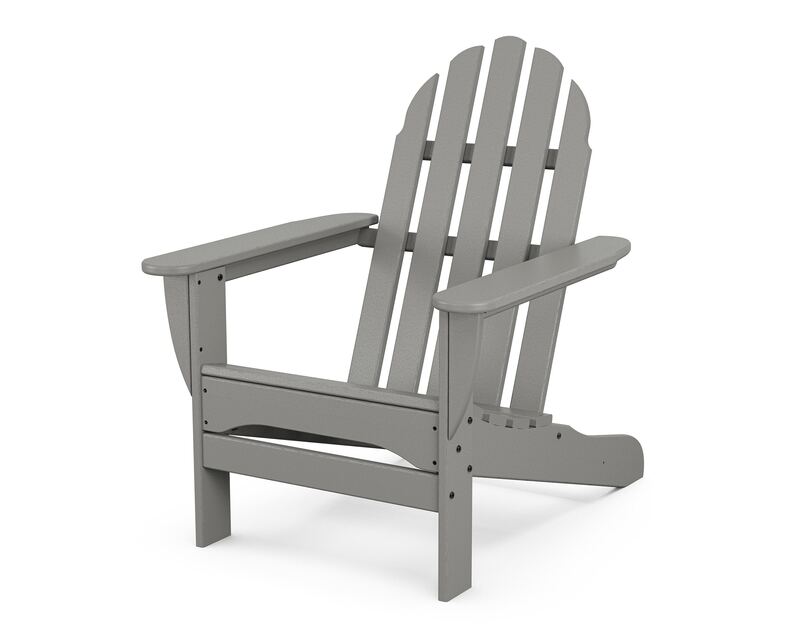
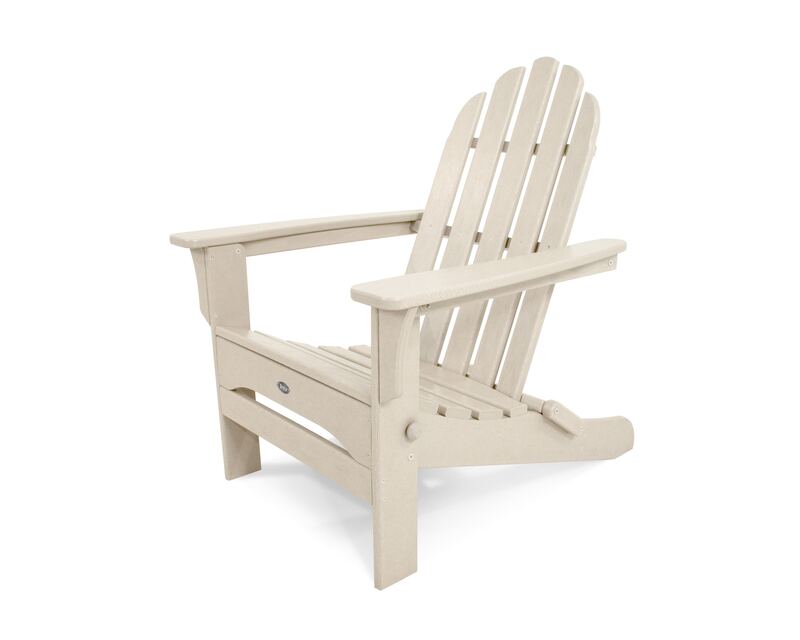
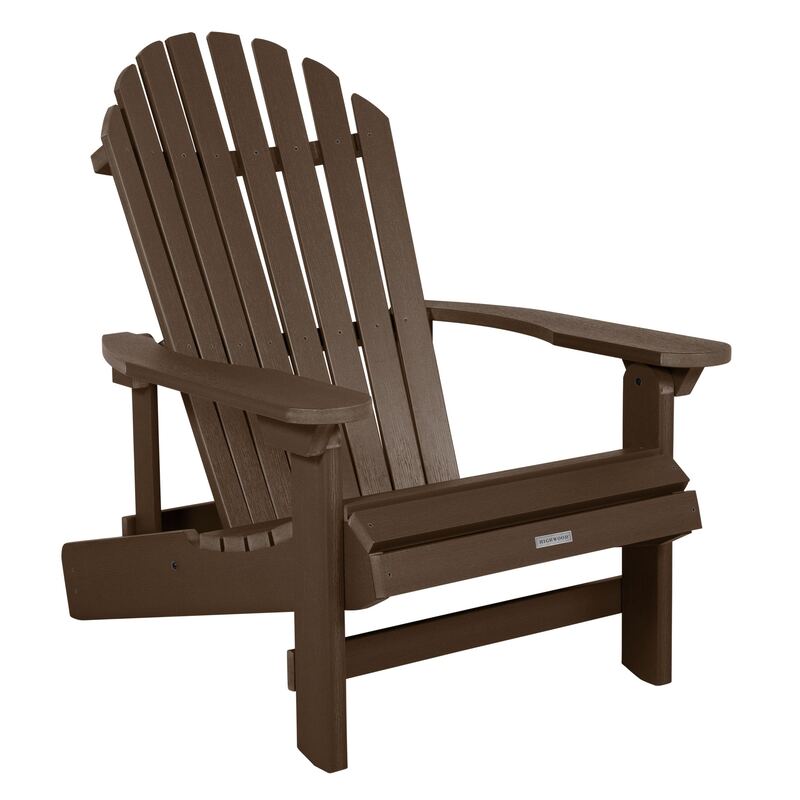
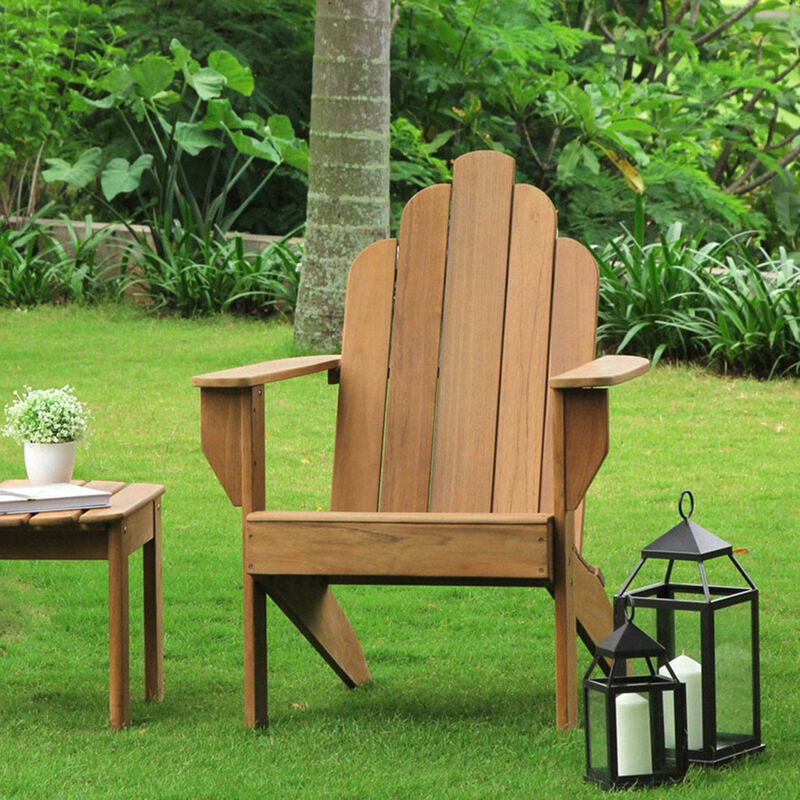
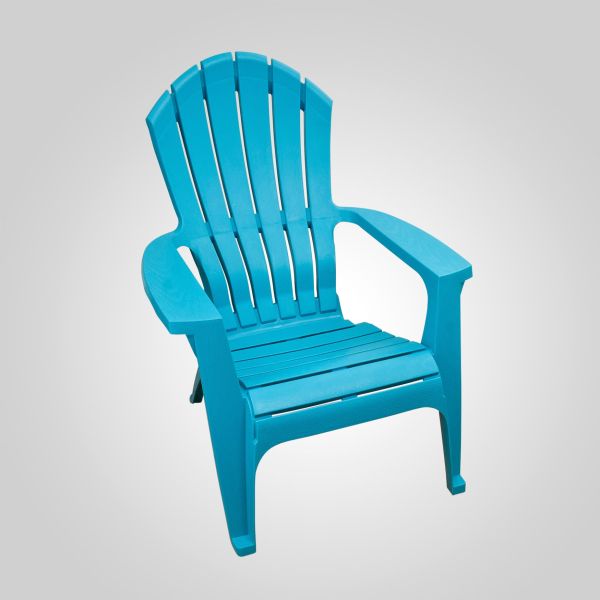
Adams RealComfort is the budget pick: lightweight polypropylene, stackable, made in the USA, typically $35-50 each. Its patented ergonomic curve is a meaningful step up from the flat-back beach-resort Adirondacks at the same price. A January 2026 CPSC recall affected ~6,100 units carrying a specific mold-and-date stamp; the broader RealComfort line is otherwise widely owned and well-rated.
Full review
Ergonomic design compensates for lightweight plastic feel
Adams describes the RealComfort as 'the first significant Adirondack chair redesign since the Civil War,' which is marketing hyperbole, but the patented contoured-seat and lumbar-support shape is a real and noticeable upgrade over the flat-back resin chairs at the same price. The seat has a slight cradle, the back has a lumbar curve, and the wide armrests give you somewhere to put a glass.
Bob Vila's roundup confirmed it as 'Stackable and easy to store in a garage, shed, or other storage space.' At a 14.5-inch seat height, the chair is in the normal Adirondack range. Walmart reviewers consistently call it a 'perfect outdoor, stackable, attractive, comfortable, well priced adirondack.' The plastic does have a slightly hollow feel when you sit down — it does not have the solid thud of HDPE lumber or teak — but the ergonomic shape compensates and the chair is genuinely comfortable for hour-long sit sessions on a porch.
Lightweight resin construction offers portability but flex
100% polypropylene resin, molded as a single major part with separate seat slats. The construction is genuinely lightweight — 7.25 lbs vs. 34.5 lbs for the POLYWOOD AD4030 — which is the chair's biggest selling point AND its biggest structural compromise. Polypropylene is UV-stabilized and doesn't fade quickly, but it is not as dimensionally stable as HDPE lumber and shows more flex under load.
ASTM certification for residential use means the chair meets the standard for normal household use; it is not commercial-grade in the way Highwood's ASTM F1858-98 testing implies. Adams is a third-generation US manufacturer (the company has been making molded resin furniture since the 1940s), and the RealComfort line has been in production for over a decade. The molds are stamped with a date and identifier on the underside of each chair — this is what allowed the January 2026 recall to be narrowly targeted to one specific production run rather than affecting the whole product line.
Durable but prone to UV embrittlement and staining
Polypropylene is naturally weather-resistant — it doesn't absorb water, doesn't rot, and won't rust. The UV stabilizers in the resin keep the color from fading meaningfully over multiple seasons. Cleaning is hose-only; soap is unnecessary for routine maintenance. The chair will not develop the slight 'patina' that POLYWOOD or teak develops, which some buyers prefer and others find sterile.
Resin chairs do become brittle with age (typically 5-8 years of full-sun exposure before noticeable embrittlement), at which point cracking becomes more likely under load. Adams recommends bringing the chair inside or stacking under cover for winter in freeze-prone climates; while polypropylene tolerates freezing temperatures, prolonged freeze-thaw cycles do accelerate the embrittlement process. The chair is also susceptible to staining from extended contact with citronella candles, sunscreen, and sweat — these are removable with mild cleaning but can leave a faint mark on lighter colors over years.
The January 2026 Recall
On January 15, 2026, the Consumer Product Safety Commission announced a recall of approximately 6,100 Adams RealComfort and StyleWell Adirondack chairs after reports of seats cracking and chairs collapsing. The recall is narrow: only chairs with the mold identifier 'ML837-15' molded into the underside AND a manufacture date stamp of August 2025 are affected.
Adams is offering refunds to affected buyers; the recall hotline is 866-546-1806. The broader RealComfort line — millions of chairs in service over decades — is not subject to the recall, and the 8371-series model code we're recommending is unaffected by the specific molding issue. Buyers should still flip any new chair to inspect the underside before assembly, per CPSC guidance. The recall demonstrates the value of Adams's mold-and-date stamping system — it allowed the company and the CPSC to scope the affected population precisely rather than recalling all production of the model.
Lightweight build risks wind movement and flexing
The 250-lb weight capacity is honest for the price and the material, and is the lowest in this lineup. Reviewers on Walmart and Academy note that the chair feels solid at 180-200 lbs but begins to flex noticeably as you approach 240-250 lbs. The chair's 7.25-lb weight is also a wind problem: on exposed patios or pool decks during a windstorm, the RealComfort will blow across the yard in a way the 34-lb POLYWOOD will not.
Owners in windy climates often weight the chair with a small sandbag in the storage compartment or simply bring it inside ahead of storms. The chair does have safety-grip feet that prevent sliding on smooth surfaces (concrete, painted decking), and the wide base makes it stable to sit on even if it is light to pick up. Larger-frame buyers and anyone over 230 lbs should look at the Highwood King Hamilton instead — paying 10x the price for a 400-lb capacity is the right trade in that case.
Stackability and Storage
Stackable design is the killer feature for the right buyer. Event renters, vacation rentals, and party hosts can store 8-12 RealComfort chairs in the floor space of one POLYWOOD, and the 7.25-lb weight means stacking and unstacking doesn't require two people. For weekend rental cleanings, swimming-pool deck rearrangements, or seasonal storage in a garage corner, this is the practical advantage that justifies the resin material vs. heavier HDPE.
Stacked chairs nest cleanly with no instability concerns up to 8 chairs deep; beyond that the stack starts to lean. Adams sells the chair as a stand-alone unit and in 4-packs at lower per-chair pricing for buyers furnishing a full patio in one purchase. Most retailers (Home Depot, Lowes, Walmart, Academy, Tractor Supply) carry the RealComfort line in store, so replacement and matching chairs are easy to source on short notice — a contrast to the brand-direct POLYWOOD and Cambridge Casual lines.
5 to 8 year lifespan versus POLYWOOD's 15-plus
Beyond the recall and the weight-capacity ceiling, the RealComfort's main weakness is longevity. POLYWOOD's 20-year warranty against splintering, cracking, chipping, peeling, and rot doesn't have a meaningful equivalent in the Adams line. Polypropylene resin chairs typically have a 5-8 year useful life under full-sun exposure before embrittlement becomes a real issue, vs. POLYWOOD's documented 15+ year service life.
The math is simple: you can buy 5-6 RealComfort chairs over the lifetime of one POLYWOOD AD4030, and the totals end up similar. Buyers should choose the resin chair for its specific advantages (cost-per-chair, weight, stackability) rather than as a long-term value play. The slat-back design also lets light through, which means the chair does not provide any privacy or shade — the POLYWOOD AD4030 has a slightly tighter back-slat spacing for the same reason.
Buys a whole seating area for one POLYWOOD's price
The RealComfort is the right pick for three buyers. First, anyone on a strict budget who needs multiple Adirondack chairs at once — buying 4-6 of these instead of 1-2 POLYWOODs gets a whole seating area on the same money. Second, vacation rentals and event hosts who need stackability and tolerate replacing the chairs every few years. Third, renters who don't want to invest in heavy permanent outdoor furniture.
It is the wrong pick for owners over 240 lbs (the 250-lb capacity is too close to the line), for windy patios without a way to anchor chairs, and for buyers who value the look and heft of HDPE lumber or real wood. It is also the wrong pick if you are buying a single chair as a permanent fixture for a home you will live in for decades — the math favors POLYWOOD over the long term, and the visual difference between resin and HDPE lumber is meaningful from typical viewing distances on a patio or deck.
Strengths
- +Lightest chair in this lineup at 7.25 lbs; easy to move and stack
- +Stackable design saves storage space
- +100% polypropylene resin with UV protection, hose-rinse cleaning
- +Made in the USA with ASTM-certified residential construction
- +Under $50 in most markets — a fraction of premium poly competitors
Watch-outs
- −January 2026 CPSC recall on ~6,100 units (mold ML837-15, mfg August 2025 only — check underside before use)
- −250-lb weight capacity is the lowest in this lineup
- −Light weight is also a wind-stability problem on exposed patios
- −Plastic construction will not match the heft or longevity of HDPE or teak
How it compares
The RealComfort is the only resin (not HDPE lumber, not wood) pick in this lineup, and it is roughly an order of magnitude cheaper. Compared to the POLYWOOD Classic AD4030 it weighs 7.25 lbs vs. 34.5 lbs (the entire chair is roughly one slat of POLYWOOD), and the 250-lb capacity is significantly lower than POLYWOOD's 300 lbs or Highwood King Hamilton's 400 lbs. The Cambridge Casual Richmond and the Trex Cape Cod Folding both sit at price points 6-10x higher.
Rating sources
Our 4.3 score is the average of these published ratings. Ratings marked * were derived from the reviewer’s written analysis or video transcript — the publisher didn’t print an explicit numeric score, so we inferred one from their own words. Click through to verify. More about methodology.