
Verdict
Head-to-head · Best Laptop Cooling Pads

Klim Everest vs KLIM Wind

Which is the better buy? Side-by-side on rating, price, strengths, and watch-outs — with the published ratings we averaged to get there.

Verdict is reader-supported. As an Amazon Associate we earn from qualifying purchases. Some links on this page are affiliate links — if you click through and buy, we may earn a small commission at no extra cost to you. Our ratings are sourced from independent publications, not sponsors.
The short answer

Klim Everest comes out ahead by a clear margin (4.0 vs 3.4). Klim Everest is best for: power users running high-TDP CPUs. Read the strengths below before deciding.

Klim Everest
Higher ratedRanked #4 in Best Laptop Cooling Pads
Klim Everest
1 sourceall derived$60as of Oct 21

KLIM Everest delivers enhanced cooling performance with its dual 4,400 RPM centrifugal turbines and aluminum-mesh surface, making it ideal for sustained high-load scenarios like gaming or video editing. A buying guide on electronics.alibaba.com points to its targeted airflow design and 5-level speed control that maps to common workload profiles. The unit includes foam padding and intake parts to create a seal around the laptop, and features optional RGB lighting. However, reviewers noted the short USB cable length and potential for increased noise at higher speeds. This cooling pad is best suited for users running high-TDP CPUs under sustained load, while those with lighter thermal needs may find the more basic KLIM Wind sufficient.

Strengths
  • — Dual 4,400 RPM centrifugal turbines provide superior airflow compared to axial fans
  • — Aluminum-mesh top plate offers effective heat dissipation
  • — Includes foam padding and intake parts to create a seal around laptop
Watch-outs
  • — Cord length is short, limiting placement flexibility
  • — Higher RPM may generate more noise than quieter alternatives
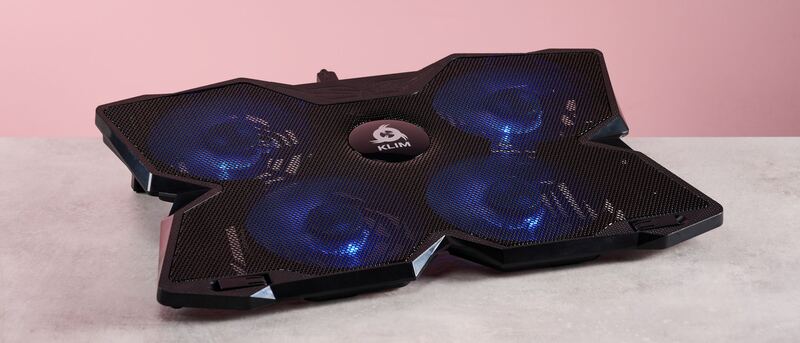
KLIM Wind
Ranked #6 in Best Laptop Cooling Pads
KLIM Wind
1 source$30as of Oct 21

TechRadar called the KLIM Wind as quiet as any laptop cooling pad it has tested, measuring 44dB from head height, but rated its cooling underwhelming: its test laptop warmed by 35F in a 15-minute stress test at the pad's maximum 1,200rpm. T3 notes two integrated USB-A ports that work as a hub. The device is designed for general use and light to moderate cooling needs, making it suitable for office environments but less ideal for power users or gamers seeking maximum performance.

Strengths
  • — Ultra-quiet operation with 1200 RPM fans
  • — Built-in USB hubs for device charging
Watch-outs
  • — May not be sufficient for intensive gaming or heavy workloads

Derived means the reviewer published no score, so one was inferred from their written verdict. Everything else is a number the publisher printed. How we rank.

How they stack up

Klim Everest

The KLIM Everest is aimed at heavier loads than the Kootek, using dual high-RPM centrifugal turbines rather than small axial fans. Unlike the Razer, it lacks smart software integration but provides better performance for sustained high-load tasks, making it superior to the quieter KLIM Wind for power users.

KLIM Wind

The KLIM Wind is one of the quietest pads here (TechRadar measured 44dB at head height), but it lacks the cooling power of its counterparts. While it's ideal for office use, its cooling is modest, making it less suitable for intensive gaming or heavy workloads.

Specs side-by-side

SpecKlim EverestKLIM Wind
Fan Speed4,4001200 RPM
Laptop Compatibility14-17.3 inchesUp to 19 inches (above 17 inches overhangs)
USB PortsUSB-A, USB-C, DC port2
Noise Levelup to 52 dBUltra-quiet
Adjustable Height6 settings—
MaterialFoamPlastic
Weight2.49 lb1.87 lb
Dimensions16.77"L x 12.72"W x 2.13"H16.06"L x 11.42"W x 1.49"H
Air Flow—4 quiet fans spinning up to 1200 RPM
← See the full ranking of best laptop cooling pads