Verdict
Head-to-head · Best Ultrawide Monitors

ASUS ROG Swift PG349Q vs MSI Optix MAG342CQR

Which is the better buy? Side-by-side on rating, price, strengths, and watch-outs — with the published ratings we averaged to get there.

The short answer

ASUS ROG Swift PG349Q and MSI Optix MAG342CQR score essentially the same (4.5 vs 4.5). Pick the one whose trade-offs match your priorities — the strengths and watch-outs below are where they actually differ.

ASUS ROG Swift PG349Q
Ranked #2 in Best Ultrawide Monitors
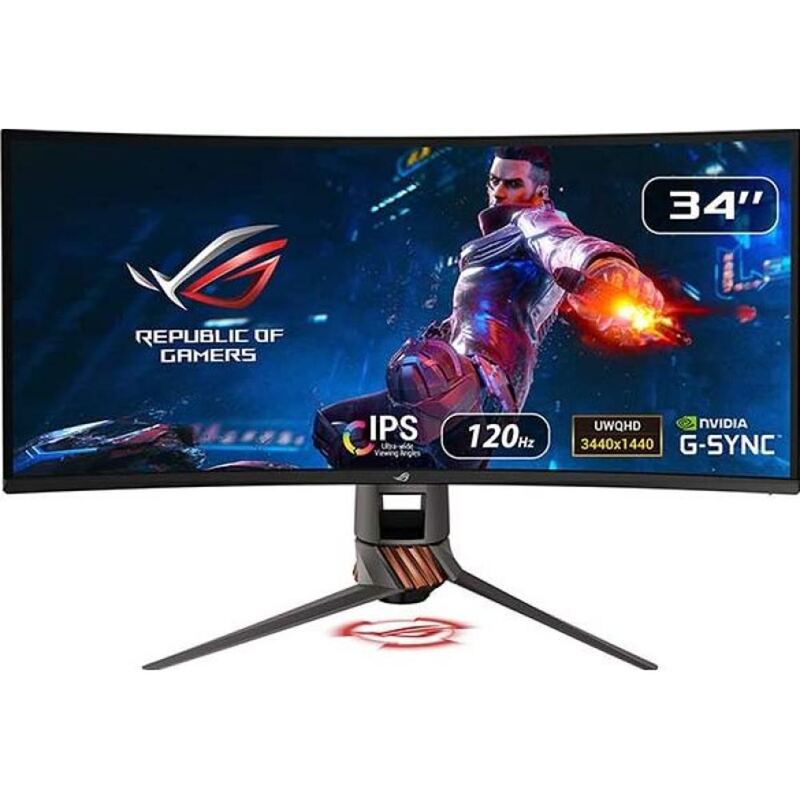
ASUS ROG Swift PG349Q
4.5
$800

The ASUS ROG Swift PG349Q is a solid mid-range ultrawide gaming monitor that excels in color accuracy and offers native G-Sync support for smooth gameplay. While its 1900R curvature and ergonomic stand enhance the immersive experience, the display is held back by poor black uniformity and a lack of HDR capabilities. It serves well for both gaming and professional editing tasks, though its older connectivity options and modest brightness limit its premium appeal.

Strengths
  • Image color accuracy remains consistent even when viewed at extreme angles
  • Includes native Nvidia G-Sync support for smooth, tear-free gaming
  • Ergonomic stand offers height, tilt, and swivel adjustments with a unique helix design
Watch-outs
  • Suffers from poor black uniformity typical of IPS panels
  • Lacks HDR support due to limited 300 nits brightness and 1000:1 contrast ratio
  • Video connectivity is restricted to older DisplayPort 1.2 and HDMI 1.4 standards
MSI Optix MAG342CQR
Ranked #1 in Best Ultrawide Monitors
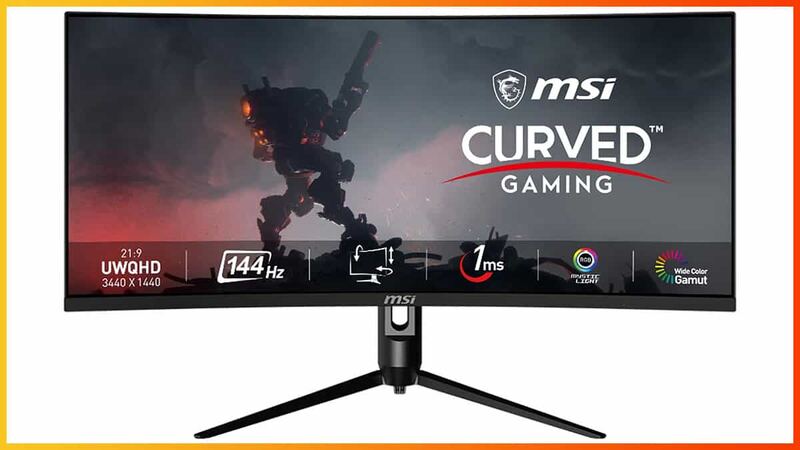
MSI Optix MAG342CQR
4.5
$299

The MSI Optix MAG342CQR is a budget-friendly 34-inch curved ultrawide monitor that excels in gaming with its 144Hz refresh rate, 1ms response time, and deep blacks from its VA panel. While it offers vibrant colors and a sharp 3440x1440 resolution, its HDR capabilities are limited due to the lack of local dimming, and viewing angles show slight color shifts compared to IPS alternatives.

Strengths
  • Delivers deep, inky blacks with a 4,000:1 static contrast ratio typical of VA panels
  • Offers a 144Hz refresh rate and 1ms response time for smooth, fluid gaming motion
  • Provides a 3440x1440 resolution with 21:9 ultrawide format for immersive gaming and productivity
Watch-outs
  • Lacks full-array local dimming (FALD), resulting in improper HDR performance
  • Exhibits minor gamma and saturation shifts at certain viewing angles compared to IPS panels

How they stack up

ASUS ROG Swift PG349Q

The ASUS ROG Swift PG349Q distinguishes itself with native G-Sync support and a unique ergonomic stand, offering a reliable experience that avoids the burn-in concerns of the Dell Alienware AW3423DW. However, it lags behind the LG 34GN850-B in modern connectivity and brightness, and it cannot compete with the deep contrast ratios found in the MSI Optix MAG342CQR or the Samsung Odyssey G9.

MSI Optix MAG342CQR

The MSI Optix MAG342CQR stands out by delivering deep, inky blacks via its VA panel, a significant advantage over the washed-out contrast of the IPS-based LG 34GN850-B and ASUS ROG Swift PG349Q. While it lacks the infinite contrast of the Dell Alienware AW3423DW and the extreme size of the Samsung Odyssey G9, it provides a cost-effective alternative that balances deep blacks with a 144Hz refresh rate for budget-conscious gamers.

Specs side-by-side

SpecASUS ROG Swift PG349QMSI Optix MAG342CQR
Screen Size34 Inches34 inches
Resolution3440 x 1440 UW-QHD3440 x 1440
Panel TechnologyIn-Plane Switching (IPS)
Refresh Rate120Hz144 Hz
Response Time5ms1 ms
Brightness300 cd/m²
Contrast Ratio1000:14,000:1
Curvature1900R
Panel TypeVA
Color Gamut90% DCI-P3
Aspect Ratio21:9
← See the full ranking of best ultrawide monitors