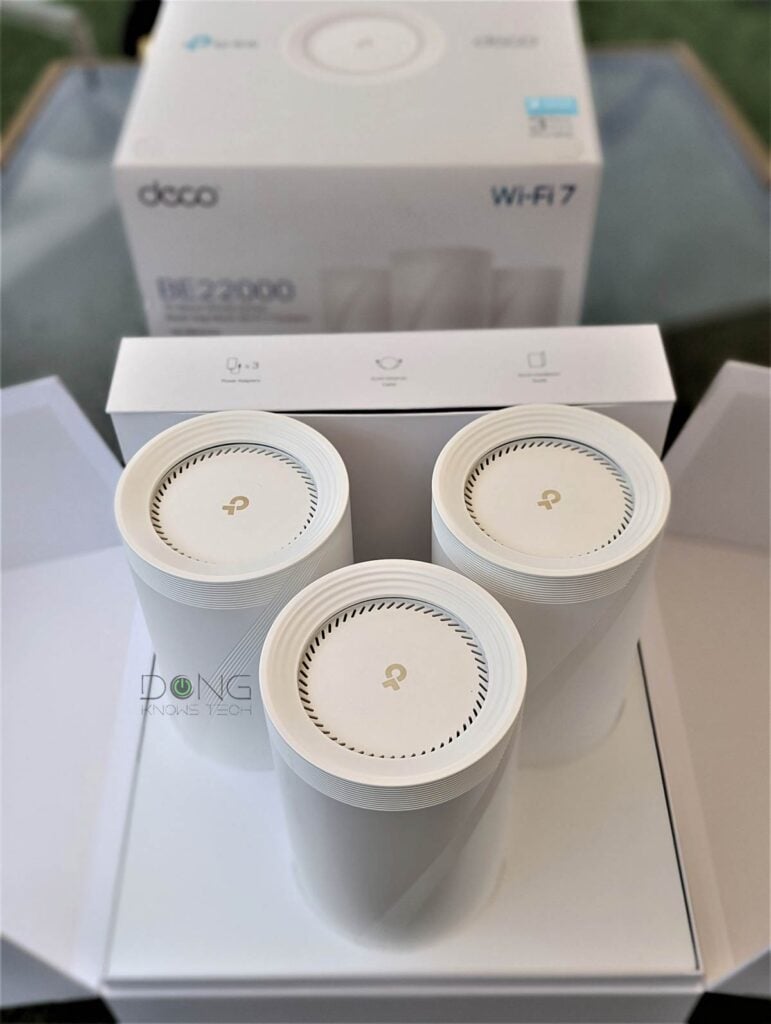
TP-Link's flagship tri-band Wi-Fi 7 mesh delivers the rare combination of true multi-gig wired backhaul, 10Gbps ports on every node, and BE22000 wireless throughput. Reviewers consistently call it the best whole-home Wi-Fi 7 buy short of quad-band Orbi territory.
Full review
Real-World Performance
Dong Knows Tech, whose multi-day stress tests are the most cited Wi-Fi 7 benchmarks online, sustained roughly 5Gbps over the 6GHz wireless backhaul between Deco BE85 nodes and pushed nearly the full 10Gbps line rate over wired backhaul. That's a category-leading number for a tri-band system, and it puts the BE85 within striking distance of quad-band rigs like the Netgear Orbi RBE973 at a fraction of the price. Tom's Guide called it 'blistering' and noted that even at the far end of a 3,000 sq ft test home, the 6GHz client speeds stayed above 2Gbps, far ahead of any Wi-Fi 6E mesh.
Where the BE85 really differentiates is on the 5GHz band, which Dong Knows clocked at over 1.5Gbps to a Wi-Fi 6E client at close range. That matters because most laptops, phones, and consoles still spend most of their time on 5GHz, not 6GHz. XDA's reviewer ran a multi-week streaming + Steam-download torture test and saw zero dropouts across three nodes, a result consistent with Tom's Guide's findings on the BE85's wired backhaul reliability.
Build Quality and Design
Each BE85 unit is a tall cylinder roughly the size of a 1-liter water bottle and runs noticeably warmer than older Deco hardware. Multiple reviewers including Dong Knows and XDA called out the internal fan: it spins up under load and is audible if a node is sitting on a desk next to you. The fan exists because the Qualcomm BE platform inside the BE85 pulls real wattage; a fanless design at this performance class would thermal-throttle within minutes.
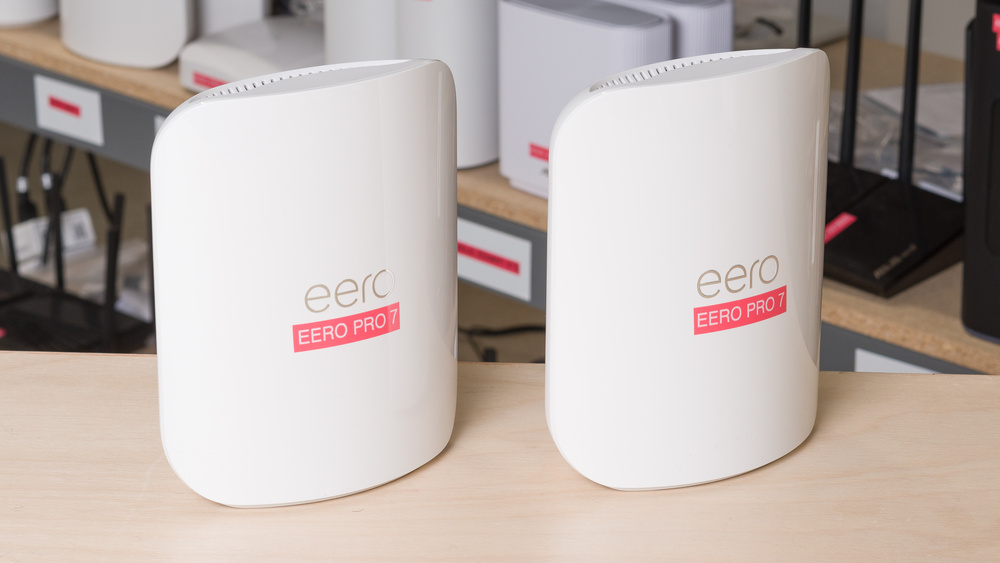
Ports are the standout. Every node ships with two 10Gbps and two 2.5Gbps Ethernet jacks plus a USB 3.0 port, which is unique at this price tier. TP-Link's choice to put 10Gbps on every node (not just the gateway) means you can build a true multi-gig backbone without needing a separate switch in every room. The build is plasticky but solid, with no creaks; nothing about it feels premium the way the Eero Pro 7 hardware does, but the port count more than makes up for it.
Setup and Software
Setup is app-only through the Deco app and takes about ten minutes for a 3-pack, including firmware updates. Tom's Guide and XDA both praised the onboarding flow as one of the cleanest in the category. The friction starts once you go past basic setup. There is a web interface, but it's almost empty - no per-band channel control, no power level adjustment, no advanced QoS. Dong Knows specifically called this out as the biggest software downgrade vs Asus or even Netgear.
HomeShield Pro, the $55/year subscription, gates the more advanced security and parental control features. Basic IoT scanning, ad blocking, and time limits are free; granular per-device profiles, advanced threat intelligence, and a VPN client require the paid tier. For users coming from Eero Plus or Asus AiProtection Pro (which are included free), the paywall is a noticeable downgrade.
Where It Falls Short
The fan noise is the most-cited complaint across reviews and you should plan node placement accordingly - a closet or shelf is fine, a nightstand or desk is not. The HomeShield Pro paywall is the second sting; you're already paying flagship money and the most-wanted features still cost extra. Reviewers also flagged the absence of granular wireless controls. If you tune your network manually, the Asus ZenWiFi BT8 is a better fit; the BE85 expects you to trust the auto-settings.
Dong Knows noted that the 2.4GHz band performance lags slightly behind the BE85's 5GHz and 6GHz bands, which matters for older smart-home devices that only speak 2.4GHz. The 10Gbps port performance is also slightly under what a wired 10Gbps client can pull from a dedicated switch - close to 9Gbps in testing rather than full line rate. Both are minor at this performance class but worth knowing.
Who It's Best For
Buy the Deco BE85 if you have a large home, a multi-gig internet plan (1Gbps+), and you want to wire 10Gbps backbone between rooms without buying a separate switch. The combination of dual 10Gbps + dual 2.5Gbps ports per node is unmatched at this price; it's the cheapest path to a true 10Gbps wired backbone for a mesh.
Skip it if your internet is 500Mbps or slower and you don't have any multi-gig wired clients - you'll never see the wireless or wired ceiling and the Eero Pro 7 or Asus ZenWiFi BT8 will give you similar real-world speed for half the money. Skip it also if you want hands-on network controls or refuse to pay subscription fees for security features; the BE85 is designed for set-and-forget, app-only operation.
How It Compares to Alternatives
Versus the Netgear Orbi RBE973: the Orbi has an extra band (quad-band with dedicated backhaul) and a slightly higher ceiling, but costs roughly $1,000 more and Dong Knows scored it lower overall (6.9/10 vs 8/10) due to firmware quirks and the price-to-value ratio. The BE85 is the smarter purchase for nearly every buyer.
Versus the Eero Pro 7: the Eero has dual 5Gbps ports instead of dual 10Gbps + dual 2.5Gbps, far simpler software, and built-in smart-home hub features (Thread, Matter, Zigbee). The BE85 wins on raw throughput and port count; the Eero wins on ease of use and smart-home integration. Pick by which you value more.
Value at This Price
At $1,299 for a 3-pack, the BE85 isn't cheap, but it's the value play in its tier. The closest comparable - Asus ZenWiFi BT10 - costs about the same with more ports but worse reviewer scores; the Orbi RBE973 above it costs $500-1000 more with no meaningful performance gain at common home distances. As of 2026, the BE85 sits at the sweet spot of the high-end Wi-Fi 7 mesh market.
Strengths
- +Tri-band Wi-Fi 7 with BE22000 speeds and 12 spatial streams
- +Four multi-gig ports per node (2x 10Gbps + 2x 2.5Gbps)
- +Multi-gig wired backhaul up to 5Gbps sustained
- +Each node covers roughly 2,000-2,500 sq ft for ~7,000 sq ft total in a 3-pack
- +Backward compatible with older Deco nodes for cheap satellite expansion
Watch-outs
- −App-only management with no real web interface
- −HomeShield Pro features hidden behind a $55/year subscription
- −Internal fan runs hot and audibly under load
- −Premium price keeps it out of value territory
How it compares
Sits in the same Wi-Fi 7 tier as the Amazon eero Pro 7 and Asus ZenWiFi BT8, but offers more multi-gig ports (dual 10Gbps + dual 2.5Gbps) than either, at a higher price point.
Who this is for
At a glance: Power users wiring a large multi-gig home who want the most ports per node without paying Orbi 970 prices.
Why you’d buy the TP-Link Deco BE85
- Tri-band Wi-Fi 7 with BE22000 speeds and 12 spatial streams.
- Four multi-gig ports per node (2x 10Gbps + 2x 2.5Gbps).
- Multi-gig wired backhaul up to 5Gbps sustained.
Why you’d skip it
- App-only management with no real web interface.
- HomeShield Pro features hidden behind a $55/year subscription.
- Internal fan runs hot and audibly under load.
Rating sources
“An excellent buy for a large home with Wi-Fi 7 and full multi-gig wired backhauling.”
“Excellent mesh kit for multi-gig whole-home wireless speeds.”
“TP-Link's first Wi-Fi 7 mesh delivers blistering speeds and a packed port menu.”
Our 4.6 score is the average of these published ratings. Ratings marked * were derived from the reviewer’s written analysis or video transcript — the publisher didn’t print an explicit numeric score, so we inferred one from their own words. Click through to verify. More about methodology.