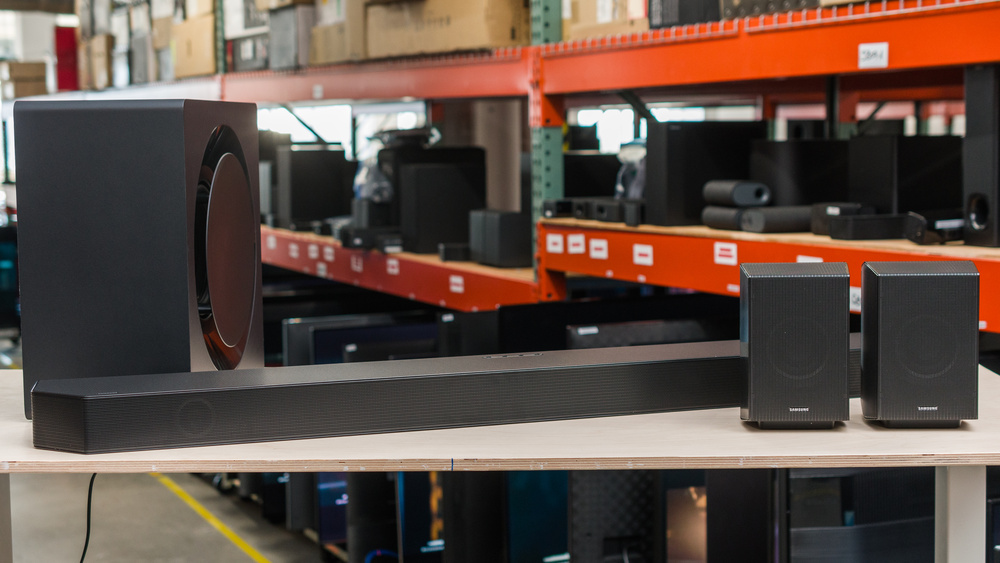
The Samsung HW-Q990D is the choice when you want a complete 11.1.4 home theater system out of the box without piecing together a separate AVR and speakers. The four-piece set delivers more raw channels and more physical surround envelopment than any one-piece soundbar can match, and HDMI 2.1 passthrough makes it a real fit for PS5 and Xbox Series X owners. Trade-offs are the more involved installation and a software experience that lags Sonos.
Full review
Real-World Performance
The HW-Q990D delivers the kind of envelopment that one-piece soundbars cannot physically reproduce, because it actually has rear speakers in the back of the room driving discrete surround content. RTINGS measured strong bass extension down to roughly 27.5 Hz with the included wireless subwoofer, which is deeper than most competing systems and well into territory normally reserved for separate subwoofers in AVR setups. Atmos demo material that depends on overhead localization - rain, helicopters, aircraft flyovers - resolves with genuine spatial precision because the rear satellites include their own up-firing drivers.
What Hi-Fi awarded it five stars and called the Atmos performance impressive, with particular praise for how the system locks in clean front-to-rear panning during action scenes. The 11.1.4 layout produces a noticeably larger sound bubble than a 9.1.4 one-piece bar even in smaller rooms, and dialogue stays anchored to the center channel without bleeding into the surrounds. Music playback is competent but not the system's strength - this is fundamentally a home theater product.
Build Quality and Design
The main bar is 48.5 inches wide and just under three inches tall, which means it will fit under most 55-inch and larger TVs but may crowd 50-inch models if not wall-mounted. Build quality is consistent across the four pieces, with a clean perforated metal grille on the front face and a matte black finish throughout. The wireless subwoofer is a substantial cube that needs its own AC outlet, and the rear satellites are about the size of a small bookshelf speaker with their own power cables.
The installation overhead is the real cost of the discrete-channel approach. You need three additional power outlets distributed around the room - one for the sub and one for each rear - and ideally the rears placed at or slightly above ear height behind the listening position. This is more involved than any one-piece bar and approaches the complexity of an AVR-and-speakers setup. The wireless links between the components are reliable but they are not zero-friction the way a single Sonos bar is.
What Reviewers Loved
The headline strengths in reviews are the discrete surround envelopment and the HDMI 2.1 feature set. RTINGS, What Hi-Fi, and Newsweek all praised the system's ability to fill medium-to-large rooms with cohesive Atmos sound, and the inclusion of two HDMI 2.1 passthrough inputs with 4K/120Hz, VRR, and ALLM makes it one of the few flagship soundbars that genuinely fits a PS5 or Xbox Series X workflow without forcing you to route the console through the TV first.
Q-Symphony, which uses a compatible Samsung TV's built-in speakers as additional output channels, is a Samsung-only feature that genuinely improves the soundstage if you own the matching ecosystem. The Private Rear Sound feature - which can route audio only to the rear speakers for late-night TV without disturbing others in the room - is the kind of practical detail that does not show up in spec sheets but shows up in long-term use. Format support is broad: Atmos, DTS:X, and Samsung's Eclipsa Audio all work.
Where It Falls Short
Pure audio quality is the system's weak spot relative to its price. FlatpanelsHD noted that you get a lot of surround sound for your money but with clear limitations in fidelity - the bass can sound boomy in untreated rooms, the highs occasionally feel etched, and the system favors quantity over the natural tonal balance you would get from a Sennheiser Ambeo Plus or a properly set up AVR with dedicated bookshelf speakers. Music listening is competent but not enjoyable in the way the Sonos Arc Ultra's stereo mode is.
The 2024 firmware-bricking incident is the other major caveat. Multiple owners reported that an over-the-air firmware update rendered units inoperable, with WiFi, Bluetooth, and Q-Symphony functionality all failing. Samsung responded with a free repair program regardless of warranty status, but the underlying experience exposed the brittleness of Samsung's connected-device software stack. The SmartThings app required for setup and control is also notably less polished than the Sonos app for daily use.
Who It's Best For
If you want a complete 11.1.4 Atmos system in one purchase, you have somewhere to put four pieces and three extra power outlets, and you want HDMI 2.1 passthrough for current-generation game consoles, this is the system to buy. It is particularly well-suited to medium and large living rooms - roughly 250 to 500 square feet - where the discrete rear speakers can do their job without overpowering the seating position.
It is the wrong choice if your priority is one-piece simplicity, if you live in an apartment where placing rear speakers behind the couch is impractical, or if your primary use case is music listening rather than movies. In those scenarios the Sonos Arc Ultra or Sennheiser Ambeo Soundbar Plus deliver more refined sound in a single bar.
How It Compares to Alternatives
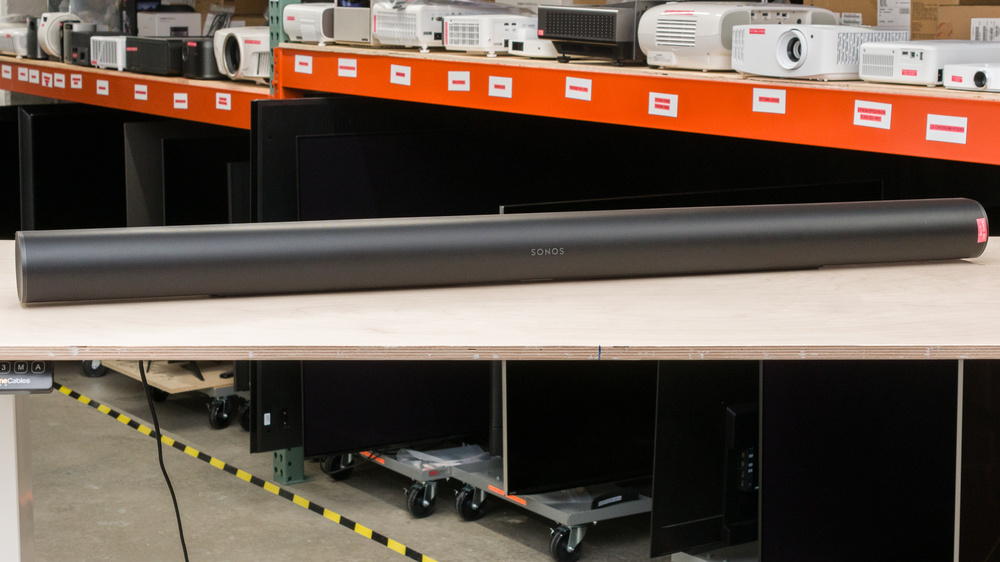
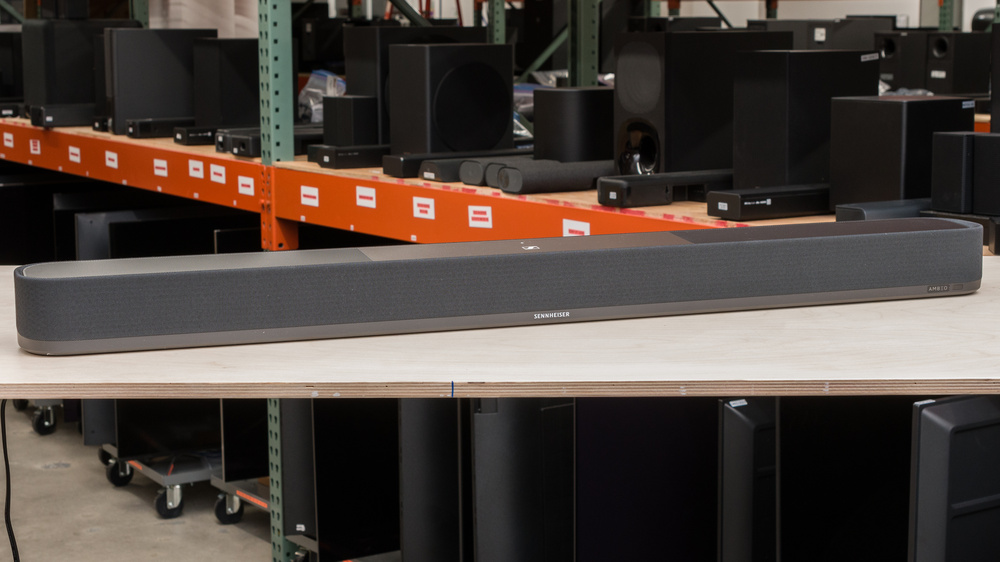
Against the Sonos Arc Ultra, the HW-Q990D wins on raw channel count, physical surround envelopment, and HDMI 2.1 passthrough, but loses on software polish, music playback, and ease of installation. Against the Sennheiser Ambeo Soundbar Plus, it offers true discrete rears instead of virtualized height channels and costs about the same all-in, but the Sennheiser sounds more natural and refined for music and TV dialogue.
Compared with stepping up to a discrete AVR with bookshelf speakers and a separate subwoofer at the same price, the HW-Q990D loses on upgrade flexibility and pure sound quality but wins decisively on installation simplicity and on having physical rear speakers without needing in-wall speaker wire. It is a real shortcut to a 5.1.4 or 7.1.4 system for people who do not want to manage an AVR.
Value at This Price
At $1,499 list - frequently discounted to around $999 during sales events - the HW-Q990D delivers a quantity of channels and physical speakers that nothing else in the soundbar category matches. The Wirecutter listed it at $868 during one sale event, which represents extraordinary value for what is effectively a complete home theater system. Compare that against buying a Sonos Arc Ultra plus Sub 4 plus a pair of Era 300 surrounds, and you are looking at $2,000-plus for a comparable channel layout.
The trade-off is that the audio quality of a $1,500 AVR plus a set of decent bookshelf speakers and a subwoofer will exceed the Samsung in pure fidelity, but the installation work is also dramatically higher. For buyers who want the discrete-surround experience without the AVR-installation hassle, the HW-Q990D is the most efficient path to get there.
Long-Term Durability
The 2024 firmware-bricking incident is the dominant concern for long-term ownership and worth understanding in detail. Samsung pushed an OTA firmware update that rendered an unspecified but significant number of HW-Q990D units inoperable, with units losing WiFi, Bluetooth, and Q-Symphony functionality. The company responded with a free repair program that covered the affected hardware regardless of warranty status, but the underlying lesson is that Samsung's connected-device software stack is brittle in ways that Sonos' or Sennheiser's are not. Out-of-warranty WLAN board replacement costs can reach $700 in some regions if the free program does not apply.
Hardware durability is otherwise strong - the four-piece system uses sealed enclosures, reliable wireless links, and well-built drivers. Samsung typically supports its flagship soundbars with feature updates for three to four years after launch, which would put the HW-Q990D out of meaningful update support around 2027-2028. The 1-year warranty is short for a $1,500-plus system; extended warranty plans from Amazon or Best Buy are worth considering specifically because of the firmware-incident history.
Strengths
- +True 11.1.4-channel layout with main bar, wireless subwoofer, and two wireless rear satellites in the box
- +22 individual speakers including up-firing drivers on the rears for genuine overhead localization
- +HDMI 2.1 passthrough with 4K/120Hz, VRR, and ALLM for next-gen game consoles
- +Q-Symphony pairs the bar with compatible Samsung TVs to use the TV speakers as additional channels
- +Supports Dolby Atmos, DTS:X, and Samsung's Eclipsa Audio for broad format compatibility
Watch-outs
- −Significantly more cluttered installation than a one-piece bar - rear speakers need power outlets
- −Samsung's SmartThings app is less polished than Sonos for day-to-day use and music streaming
- −Some 2024 buyers reported firmware-update bricking incidents requiring service center repair
- −Subwoofer and rear speakers can dominate the front bar if you do not calibrate carefully
How it compares
Compared with the Sonos Arc Ultra it offers more raw channels and a complete surround system out of the box, but with a more cluttered installation and weaker software. Against the Sennheiser Ambeo Soundbar Plus it provides true discrete rears and a sub instead of virtualized height channels.
Who this is for
At a glance: Home theater buyers who want a complete 11.1.4 Dolby Atmos system in one purchase and need HDMI 2.1 passthrough for current-generation game consoles.
Why you’d buy the Samsung HW-Q990D
- True 11.1.4-channel layout with main bar, wireless subwoofer, and two wireless rear satellites in the box.
- 22 individual speakers including up-firing drivers on the rears for genuine overhead localization.
- HDMI 2.1 passthrough with 4K/120Hz, VRR, and ALLM for next-gen game consoles.
Why you’d skip it
- Significantly more cluttered installation than a one-piece bar - rear speakers need power outlets.
- Samsung's SmartThings app is less polished than Sonos for day-to-day use and music streaming.
- Some 2024 buyers reported firmware-update bricking incidents requiring service center repair.
Rating sources
“An impressive premium soundbar with a discrete 11.1.4 setup that excels at immersive surround playback.”
“Delivers Dolby Atmos in very impressive fashion.”
“A lot of surround sound for your money, but there are clear limitations in pure sound quality.”
“The best Dolby Atmos soundbar you can buy in 2024.”
Our 4.6 score is the average of these published ratings. Ratings marked * were derived from the reviewer’s written analysis or video transcript — the publisher didn’t print an explicit numeric score, so we inferred one from their own words. Click through to verify. More about methodology.