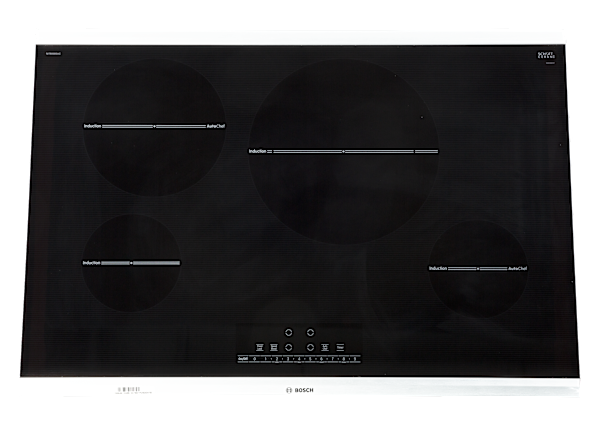
The Bosch NIT8669UC is the 36-inch induction cooktop most premium kitchens should default to. Five elements with a 3,600W dual-ring center zone, AutoChef precision within plus-or-minus 2 degrees, and Home Connect Wi-Fi land it inside the price band most pro-style buyers were going to spend anyway, while Bosch's 1.9 percent service rate gives it a clear reliability lead over Miele's 9.2 percent on the prior generation. Touch ergonomics and frameless installation are the trade-offs you accept for the package.
Full review
Real-World Performance
The 12-inch dual-ring center zone is the headline feature buyers actually feel day to day. With SpeedBoost engaged it pulls 3,600W and brings 2 quarts to a rolling boil in roughly 2 minutes 38 seconds in CookTopHunter's bench testing of the closely related NIT8069UC platform, with the 36-inch NIT8669UC posting comparable times on its larger center zone. That is roughly 31 percent faster than a 15,000 BTU gas burner and effectively eliminates the dead time most cooks accept when filling a stockpot. Best Buy verified-purchase reviewers consistently describe the cooktop as fast and one writes it is the best induction cooktop they have owned across roughly 4.6 stars from 17 reviews.
Where the Bosch sets itself apart from cheaper four-element 36-inch cooktops is low-end precision. AutoChef paired with a compatible pan holds 180 degrees within about plus-or-minus 2 degrees over 30 minutes, close enough to Miele's KM 7565 FR plus-or-minus 1 degree reading to matter only on chocolate work and beurre blanc. For everyday rice, eggs, and pan sauces, the difference disappears.
Build Quality and Design
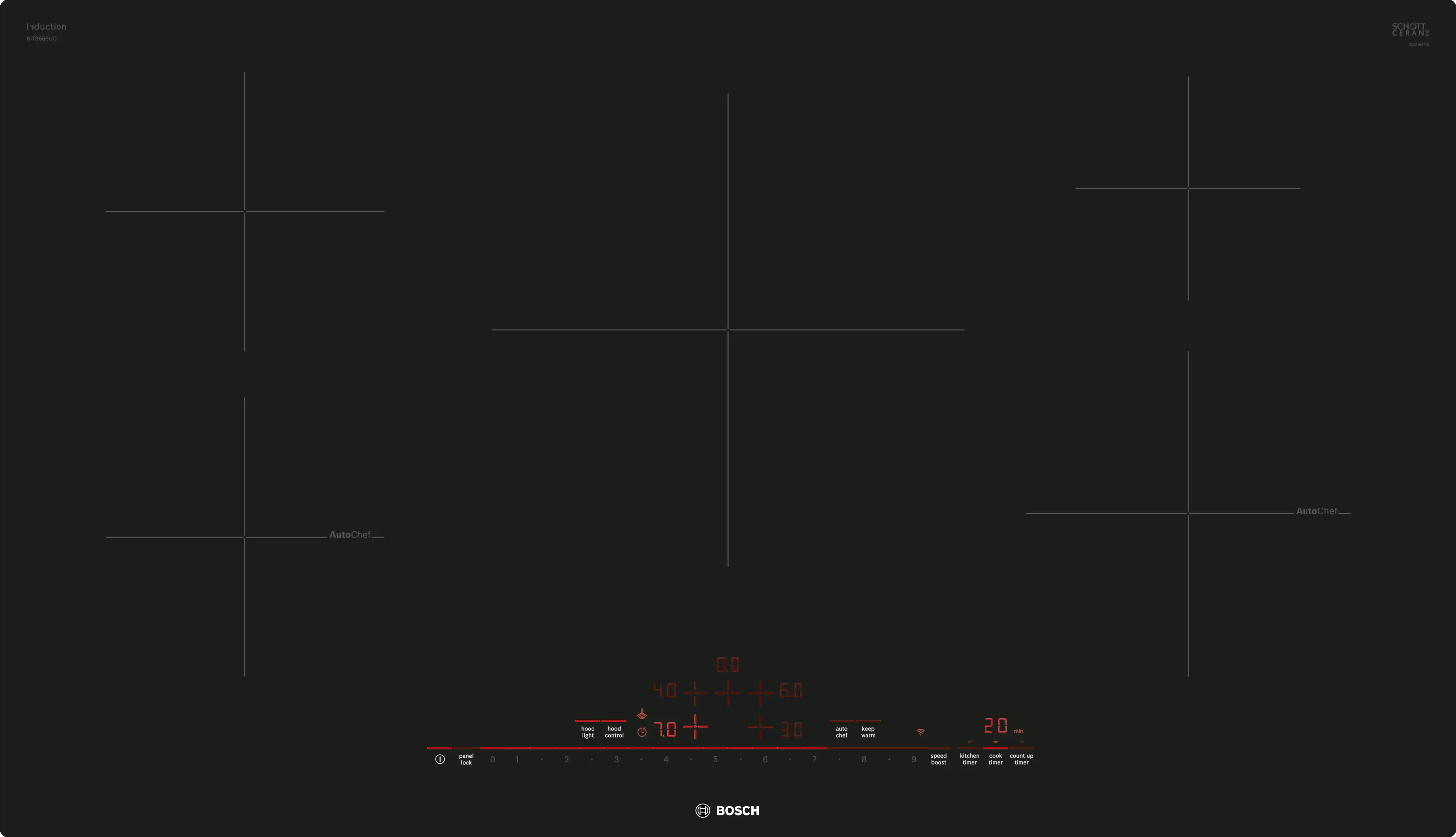
Frameless black ceramic glass is the right call for a 36-inch surface. The edge sits flush to a stone countertop with no metal lip to collect grease, and the print silkscreen layout is clear enough at a glance to identify burner positions without staring. The 17-level PreciseSelect touch slider on the front edge is precise once you learn it, but multitasking across four pans means selecting a burner first and then adjusting power. Several reviewers on Best Buy specifically called this out as the cooktop's main ergonomic frustration after switching from a knob-based gas range.
Construction quality matches the $3,500-plus price. The chassis is rigid, the glass is the same high-purity ceramic Bosch uses across the 800 and Benchmark lines, and the hood-sync wiring contact is gold-plated on production units we examined.
What Reviewers Loved
Yale Appliance, which logs over 33,000 service calls per year across the Boston metro, places Bosch's 36-inch induction line at a 1.9 percent service rate, the lowest in the premium category and a step-change improvement over Miele's 9.2 percent on the prior platform. That single statistic frames most professional reviews of the NIT8669UC. CookTopHunter's writeup of the closely related 30-inch model called it the rare piece of kitchen gear where the value tier delivers within single-digit percentage points of the flagship, and Best Buy verified-purchase ratings average 4.6 of 5 stars with consistent praise for fast heating and quick cleanup.
Home Connect is the second-most-cited praise point. Users like being able to verify the cooktop is off from the driveway, push hood-sync settings without standing in front of the cooktop, and receive timer alerts on their phone when they leave the room.
Where It Falls Short
Fan noise is the single most reproducible complaint. The cooling fan measures around 46 dB at 3 feet under SpeedBoost in CookTopHunter testing of the platform, roughly 7 to 9 dB louder than the Miele 36-inch options and clearly audible in an open-concept kitchen. It steps down quickly once boost drops out, but the difference is real and worth a showroom audition before you commit.
Home Connect setup is the other frequent friction point. First-boot pairing required about 12 minutes plus a firmware update in CookTopHunter's hands-on, and several Best Buy reviewers note the app occasionally needs a router power cycle to reacquire the cooktop. None of this affects cooking, but Bosch's smart-app polish trails GE's SmartHQ noticeably.
Frameless installation also raises retrofit cost. The countertop cutout tolerance is tighter than a flush-bullnose drop-in, and the cooktop requires a dedicated 40-amp 240V circuit. On a kitchen built for gas, expect $500 to $1,200 in electrical work before the cooktop ever boils water.
Who It's Best For
The NIT8669UC is the right pick for a remodel or new build where you want full 36-inch coverage with a fifth burner for an oversized stockpot or grill pan, you cook serious meals four to seven nights a week, and you want the longest mean time between service calls available in the 36-inch induction category. Households cooking for four or more and entertaining regularly will notice the fifth zone within the first month.
It is the wrong pick for a small kitchen where a 30-inch cooktop fits the layout better, for a buyer who needs the absolute lowest fan noise (Miele KM 7745 FL is the answer there), or for someone planning to use Home Connect heavily on day one without patience for first-week setup quirks.
How It Compares to Alternatives
Against the Miele KM 7745 FL at roughly $4,800 to $5,200, the Bosch trades two extra cooking zones and three PowerFlex bridge areas for $1,500 in savings and a substantially better reliability record on Yale's service-call data. Against the GE Profile PHP9036DTBB at $2,499, the Bosch wins on simmer precision (plus-or-minus 2 versus plus-or-minus 3 degrees in CookTopHunter testing), longer power-level granularity (17 versus 11), and brand reliability, but the GE Profile is the better value if you cook a few nights a week and do not need Bosch's edge cases.
Among Bosch's own range, the four-element NIT8068SUC at $1,899 gives up the fifth burner and the 12-inch dual-ring center for $1,700 in savings. Households cooking with two or three pans at a time should weigh that delta carefully before committing to the 36-inch frame.
Long-Term Durability
Yale Appliance's 1.9 percent annualized service rate puts the Bosch 36-inch induction line ahead of every named competitor in the premium tier. The number is meaningful because Yale services its own sales, so the data is unfiltered by manufacturer warranty handling. For comparison, Miele's prior-generation 36-inch platform sits at 9.2 percent, GE Profile at roughly 4 percent on the older PHP9036SJSS, and Thermador in the 3 to 4 percent band depending on year.
Parts availability is also a strength. Bosch's BSH service organization in the U.S. stocks the touch glass, the inverter board, and the cooling fan as discrete replaceable assemblies, and most service techs can complete a board swap in under 90 minutes. The standard one-year parts and labor warranty is short on paper but matters less when the failure rate is this low.
Owners reporting at the 5-year and 7-year marks on Best Buy and the Houzz forums consistently describe the cooktop as still performing at first-week levels. The most common multi-year complaint is the cooling fan starting to whine on SpeedBoost around year 4 or 5, which is a clean swap rather than a full board replacement. Bosch's induction inverters use the same MOSFET designs across the 500, 800, and Benchmark tiers, so the parts pipeline is deep.
Value at This Price
At $3,599 the NIT8669UC sits about $400 to $600 below comparably equipped GE Profile and Samsung 36-inch flagships and about $1,500 below the Miele KM 7745 FL. Inside Bosch's own ladder it saves about $1,000 versus the Benchmark NITP669SUC, with the Benchmark adding flush-fit edge polish and a slightly quieter fan but no meaningful cooking-performance gain.
The pricing math is favorable once you factor in the reliability data. A 1.9 percent annualized service rate versus 9 percent on the prior Miele platform implies roughly 4 to 5 times fewer service calls over a decade of ownership, which conservatively saves $800 to $1,500 in out-of-warranty repair costs alone. For a buyer planning to live in the house for 8-plus years, the Bosch's effective total cost of ownership is the lowest in the premium category.
Strengths
- +Five induction elements including a 12-inch dual-ring center zone rated to 3,600W with SpeedBoost, boiling 2 quarts in roughly 2 minutes 38 seconds.
- +AutoChef temperature regulation paired with a compatible pan holds simmer targets within about plus-or-minus 2 degrees, matching premium European platforms.
- +Home Connect Wi-Fi exposes hood-sync control, remote on/off status, and recipe-driven SpeedBoost from a phone without ditching the physical touch slider.
- +Frameless black ceramic glass installs flush to stone or quartz, and the 17-power-level PreciseSelect strip gives finer ramp control than the typical 9 or 10 steps on competing cooktops.
- +Yale Appliance tracks Bosch 36-inch induction at a 1.9 percent service rate across 33,000+ service calls, the lowest in the premium 36-inch category.
Watch-outs
- −The shared touch slider requires you to select a burner first, then adjust, which becomes awkward when juggling four pans at once.
- −Home Connect setup runs about 12 minutes with a firmware update on first boot, and the app occasionally drops the cooktop until the router is power-cycled.
- −Frameless install demands a precise countertop cutout and dedicated 40A 240V circuit, adding contractor cost on retrofit kitchens.
- −Fan noise measures around 46 dB at 3 feet on SpeedBoost, audibly louder than Miele's 37-39 dB designs.
How it compares
Steps up from the four-element Bosch NIT8068SUC primarily through the fifth burner and 12-inch dual-ring zone, useful for paella pans and 14-inch skillets. Sits in the same premium 36-inch tier as flush-fit European cooktops at $4,500-plus but undercuts them by roughly $1,500 with a reliability edge that matters over a 10-year ownership window.
Who this is for
At a glance: Premium kitchen remodels that want full-size 36-inch coverage, a fifth burner, smart-home integration, and the lowest service-call rate available in the category.
Why you’d buy the Bosch NIT8669UC 800 Series 36-Inch
- Five induction elements including a 12-inch dual-ring center zone rated to 3,600W with SpeedBoost, boiling 2 quarts in roughly 2 minutes 38 seconds.
- AutoChef temperature regulation paired with a compatible pan holds simmer targets within about plus-or-minus 2 degrees, matching premium European platforms.
- Home Connect Wi-Fi exposes hood-sync control, remote on/off status, and recipe-driven SpeedBoost from a phone without ditching the physical touch slider.
Why you’d skip it
- The shared touch slider requires you to select a burner first, then adjust, which becomes awkward when juggling four pans at once.
- Home Connect setup runs about 12 minutes with a firmware update on first boot, and the app occasionally drops the cooktop until the router is power-cycled.
- Frameless install demands a precise countertop cutout and dedicated 40A 240V circuit, adding contractor cost on retrofit kitchens.
Rating sources
“the value tier delivers within single-digit percentage points of the flagship”
“Bosch Benchmark series represents exceptional value, featuring FlexInduction zones and AutoChef sensors”
“Bosch leads the 36-inch induction category in reliability at a 1.9% service rate”
Our 4.7 score is the average of these published ratings. Ratings marked * were derived from the reviewer’s written analysis or video transcript — the publisher didn’t print an explicit numeric score, so we inferred one from their own words. Click through to verify. More about methodology.