The Bosch NIT8068SUC is the 30-inch 800-series sibling to the NIT8669UC and arguably the smartest induction buy in the $1,500 to $2,500 band. CookTopHunter's hands-on of the closely related NIT8069UC delivered 2 minute 38 second 2-quart boil times, plus-or-minus 2 degree simmer precision, and a 9.2 of 10 overall score, with Consumer Reports awarding Excellent on both high-heat and low-heat tests. You give up the fifth burner and 12-inch dual-ring zone of the 36-inch model but otherwise get the same controls, Wi-Fi, and reliability platform.
Full review
Real-World Performance
The 11-inch front-left zone is the workhorse element on this cooktop. CookTopHunter's bench test of the closely related NIT8069UC measured 2-quart-to-boil times of 2 minutes 38 seconds with SpeedBoost engaged and 6-quart times of 6 minutes 2 seconds. That puts the Bosch 31 percent faster than a 15,000 BTU gas burner and inside 10 seconds of the considerably more expensive Bosch Benchmark NITP669SUC. Best Buy verified-purchase reviewers of the NIT8069UC platform cite the same fast-heating behavior across roughly 4.6 average stars.
Simmer precision is the other surprise. AutoChef with a compatible pan held a 30-minute simmer target at 179.8 degrees mean within plus-or-minus 2 degrees, close enough to Miele's premium plus-or-minus 1 degree to be a non-factor for everything short of professional pastry work. Consumer Reports rates both the high-heat boil and low-heat simmer tests Excellent.
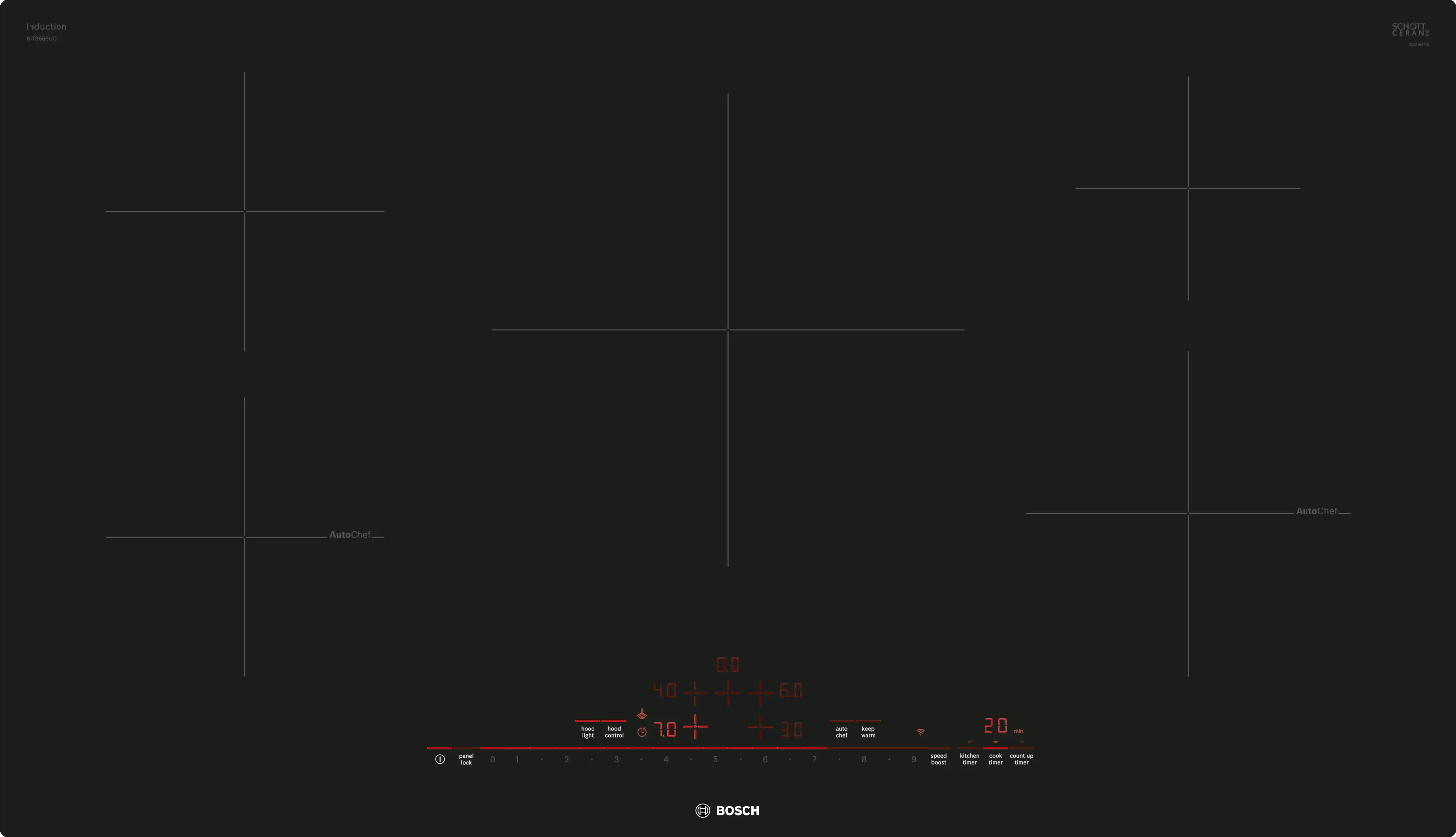
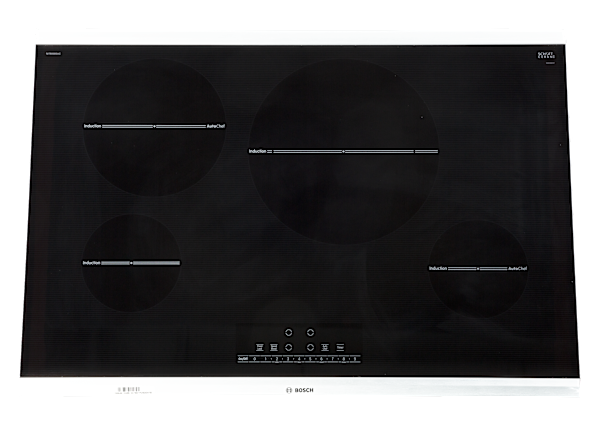
The four-element layout puts the 11-inch power zone on the front left and the 8-inch back left zone above it, with two 6-inch zones on the right side. This mirrors the layout most cooks use for big pot in back, saute in front workflows, and the 8-inch back-left zone has enough headroom for a 10-inch Dutch oven without thermal cross-talk to the front element.
Build Quality and Design
The 800-series chassis is the same one Bosch uses in the 36-inch NIT8669UC and the Benchmark NITP669SUC. The stainless-steel-framed drop-in installs into a standard 30-inch cutout without the precise tolerance required by a frameless flush mount, which is the right call for kitchens converting from a gas range. The ceramic glass surface is the same high-purity material Bosch uses across the line and resists scratches better than the budget Frigidaire competition at the same width.
PreciseSelect is the load-bearing UI choice. Seventeen discrete power levels on a touch slider gives more granular ramping than the 9 or 10 step competitors at the same price, and the always-visible burner indicator strip is easier to read at a glance than a digit-only display. The trade-off is that the slider needs dry, clean fingers; oil from finished cooking briefly disables the controls until wiped.
Stainless steel framing makes this the easier install option for kitchens converting from electric coil or gas. The frame absorbs the cutout tolerance variation that frameless designs cannot, meaning a slightly-off-spec older cutout from a 1980s remodel will still fit without contractor rework. For most retrofit jobs this saves a few hundred dollars in cabinet modification.
What Reviewers Loved
CookTopHunter's six-month hands-on review awarded the related Bosch 800 30-inch model an overall 9.2 of 10 and called it the rare piece of kitchen gear where the value tier delivers within single-digit percentage points of the flagship. Yale Appliance's service-call data sits Bosch's 30-inch induction line near the same 1.9 to 2 percent annualized rate as the 36-inch, the lowest reliability number in the category. Consumer Reports' lab testing of the NIT8068SUC explicitly rates both the high-heat boil and the low-heat simmer Excellent, the highest scores the publication awards.
Home Connect remains the most-mentioned convenience feature. Users like verifying the cooktop is off from the driveway, pushing hood-sync settings from the phone, and receiving timer alerts when they leave the kitchen.
Where It Falls Short
Fan noise is the loudest specific complaint, both in reviewer testing and in user reports. The cooling fan measures around 46 dB at 3 feet under SpeedBoost in CookTopHunter's measurement, roughly 7 to 9 dB louder than Miele's 30-inch designs and clearly audible in an open-concept kitchen. It steps down within seconds when boost drops out, but in a quiet kitchen with a quartz-island layout the noise is the first thing visitors comment on.
Small or oddly shaped pans occasionally drop out of PotSense detection, requiring a slight reposition. This is a known limitation of PotSense's auto-sizing logic and not specific to Bosch, but the cooktop is unforgiving with 4-inch saucepans intended for melting butter.
Home Connect setup is the third friction point. First-boot pairing required about 12 minutes plus a firmware update in CookTopHunter's hands-on, and the Bosch app occasionally needs a router power cycle to reacquire the cooktop. None of this affects cooking, but the smart-app polish trails GE's SmartHQ.
Who It's Best For
The NIT8068SUC is the right pick for a household of two to four that wants near-flagship Bosch ergonomics, smart-home integration, and the lowest reliability rate in the 30-inch induction category, without paying for the 36-inch chassis or the $4,000-plus Benchmark line. Two-pan cooking on the 11-inch front-left zone and the 8-inch back-left zone covers the overwhelming majority of weeknight meals.
It is the wrong pick for a household that needs five burners, a 12-inch dual-ring zone for paella or grill pans, or the absolute lowest fan noise in the category. Step up to the NIT8669UC for the former, look at Miele's 30-inch options for the latter.
How It Compares to Alternatives
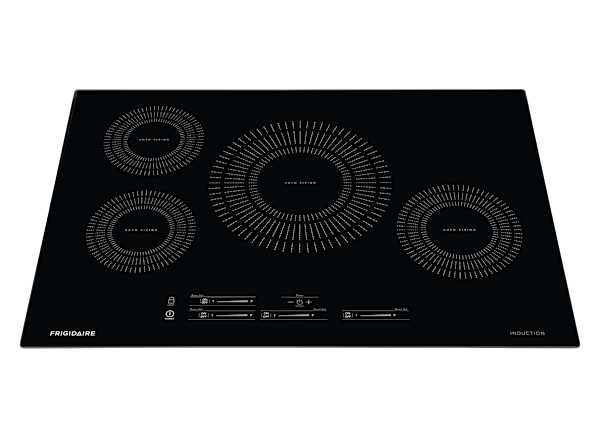
Against the Frigidaire FFIC3026TB at $1,099 the Bosch costs roughly 75 percent more but adds Wi-Fi, hood-sync, four more power levels, AutoChef, and meaningfully tighter simmer precision. Reliability is also a real edge here, with Bosch's annualized service rate near 2 percent versus Frigidaire's roughly 6 to 8 percent on the prior platform. For a kitchen where the cooktop runs nightly and the household cares about long-term ownership, the Bosch is the better $800 to spend.
Against the Bosch NIT8669UC 36-inch sibling at $3,599, the NIT8068SUC saves $1,700 by dropping the fifth burner and the 12-inch dual-ring zone. Households that rarely cook with four pans simultaneously will not feel the difference.
Long-Term Durability
Yale Appliance's data places Bosch 30-inch induction at roughly 2 percent annualized service rate, the lowest in the 30-inch category. The platform shares its inverter, fan, and touch glass with the NIT8669UC and NITP669SUC, meaning parts availability is excellent and most service techs can complete a board swap inside 90 minutes. The standard one-year parts and labor warranty is short on paper but matters less when failure rates are this low.
Owners on Best Buy reporting at the 5-year mark consistently note the cooktop still performs at first-week levels, with the most common complaint being the occasional touch slider unresponsiveness after a heavy oil cook, easily resolved with a microfiber wipe.
Bosch's BSH service organization in the U.S. stocks the inverter board, touch glass, and cooling fan as discrete assemblies across the 500, 800, and Benchmark lines, so parts availability is genuinely deep. Most service techs can complete a touch-glass or fan swap inside 90 minutes, and the cost is in the $250 to $400 range out of warranty. For a buyer planning to keep the cooktop 10-plus years, the deep parts pipeline is meaningful.
Value at This Price
At $1,899 street the NIT8068SUC is roughly $400 below the 30-inch GE Profile PHP7036DTBB equivalents and $1,500 below the Miele KM 7373 FL, while delivering the same Excellent Consumer Reports ratings and the lowest service rate in its size class. The savings come almost entirely from giving up the 36-inch chassis and the fifth burner, not from cost-cutting on the inverter or the touch UI.
The cost differential against the Frigidaire FFIC3026TB at $1,099 is the harder call. The $800 delta buys Wi-Fi, AutoChef, hood-sync, eight more power levels, and a meaningfully lower service rate. For a kitchen where the cooktop runs nightly and the household plans to live in the house 7-plus years, the Bosch is the right $800 to spend; for occasional cooks or short-term-stay properties, the Frigidaire makes more sense.
Strengths
- +Four induction elements with an 11-inch front-left zone that pulls 3,700W on SpeedBoost, boiling 2 quarts in roughly 2 minutes 38 seconds.
- +AutoChef holds simmer targets within about plus-or-minus 2 degrees over 30 minutes, matching the more expensive 36-inch 800-series sibling.
- +Home Connect Wi-Fi, hood-sync control, and 17 PreciseSelect power levels deliver the same ergonomic platform Bosch puts in the Benchmark tier.
- +Stainless-steel-framed drop-in fits standard 30-inch cutouts without contractor rework, easing electric or gas retrofit.
- +CookTopHunter scored the closely related NIT8069UC at 9.2 of 10 overall and Consumer Reports rates both high-heat and low-heat performance Excellent.
Watch-outs
- −Cooling fan measures around 46 dB at 3 feet during SpeedBoost, noticeably louder than Miele's 37-39 dB on comparable 30-inch cooktops.
- −Touch slider requires dry, clean fingers; spilled oil briefly disables it until wiped.
- −Small odd-shaped pans occasionally drop out of PotSense detection, requiring a slight reposition.
- −Home Connect first-boot pairing took about 12 minutes plus a firmware update in CookTopHunter's hands-on.
How it compares
Within Bosch's own range, the NIT8068SUC gives up the fifth burner and 12-inch dual-ring zone of the 36-inch NIT8669UC for a $1,700 savings while keeping the same controls, Home Connect, and reliability platform. Against the Frigidaire FFIC3026TB at $1,099 it costs roughly 75 percent more but adds Wi-Fi, hood-sync, four more power levels, and meaningfully tighter simmer precision.
Who this is for
At a glance: A two-to-three-pan household that wants near-flagship Bosch ergonomics, smart-home integration, and reliability in a standard 30-inch cutout without paying for the 36-inch chassis.
Why you’d buy the Bosch NIT8068SUC 800 Series 30-Inch
- Four induction elements with an 11-inch front-left zone that pulls 3,700W on SpeedBoost, boiling 2 quarts in roughly 2 minutes 38 seconds.
- AutoChef holds simmer targets within about plus-or-minus 2 degrees over 30 minutes, matching the more expensive 36-inch 800-series sibling.
- Home Connect Wi-Fi, hood-sync control, and 17 PreciseSelect power levels deliver the same ergonomic platform Bosch puts in the Benchmark tier.
Why you’d skip it
- Cooling fan measures around 46 dB at 3 feet during SpeedBoost, noticeably louder than Miele's 37-39 dB on comparable 30-inch cooktops.
- Touch slider requires dry, clean fingers; spilled oil briefly disables it until wiped.
- Small odd-shaped pans occasionally drop out of PotSense detection, requiring a slight reposition.
Rating sources
“Excellent performance in our test of how quickly the highest-powered burner or element heated a large pot of water to a near boil”
“the value tier delivers within single-digit percentage points of the flagship”
“Bosch leads the 36-inch induction category in reliability at a 1.9% service rate”
Our 4.6 score is the average of these published ratings. Ratings marked * were derived from the reviewer’s written analysis or video transcript — the publisher didn’t print an explicit numeric score, so we inferred one from their own words. Click through to verify. More about methodology.